Rotational Kinetic Energy (DP IB Physics: HL): Revision Note

Rotational Kinetic Energy
A body moving with linear velocity has an associated linear kinetic energy given by
Similarly, a rotating body with angular velocity has an associated rotational kinetic energy given by
Where:
= rotational kinetic energy (J)
= moment of inertia (kg m2)
= angular velocity (rad s−1)
= angular momentum (kg m2 s−1)
Rolling without slipping
Circular objects, such as wheels, are made to move with both linear and rotational motion
For example, the wheels of a car, or bicycle rotate causing it to move forward
Rolling motion without slipping is a combination of rotating and sliding (translational) motion
When a disc rotates:
Each point on the disc has a different linear velocity depending on its distance from the centre
The linear velocity is the same at all points on the circumference
When a disc slips, or slides:
There is not enough friction present to allow the object to roll
Each point on the object has the same linear velocity
The angular velocity is zero
So, when a disc rolls without slipping:
There is enough friction present to initiate rotational motion allowing the object to roll
The point in contact with the surface has a velocity of zero
The centre of mass has a velocity of
The top point has a velocity of or
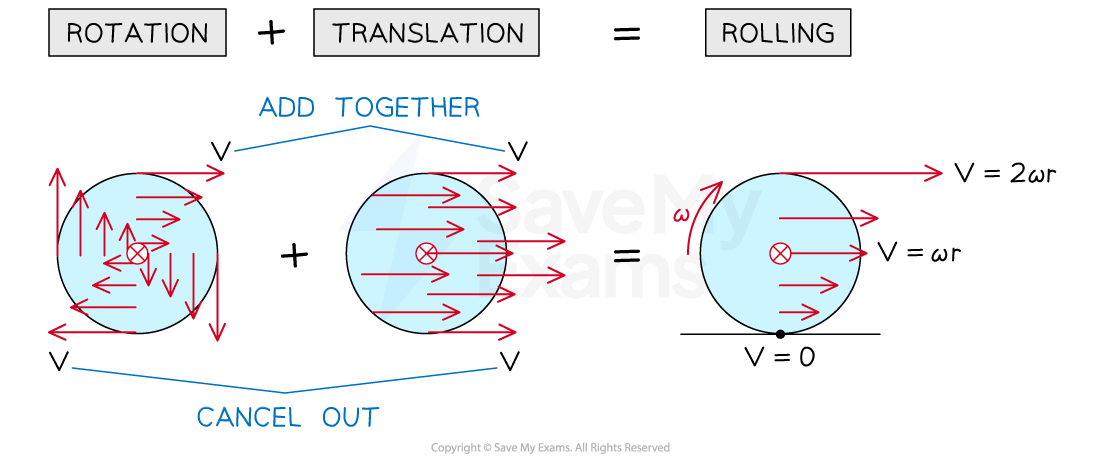
Rolling motion is a combination of rotational and translational motion. The resultant velocity at the bottom is zero and the resultant velocity at the top is 2v
Rolling down a slope
Another common scenario involving rotational and translational motion is an object (usually a ball or a disc) rolling down a slope
At the top of the slope, a stationary object will have gravitational potential energy equal to
As the object rolls down the slope, the gravitational potential energy will be transferred to both translational (linear) and rotational kinetic energy
At the bottom of the slope, the total kinetic energy of the object will be equal to
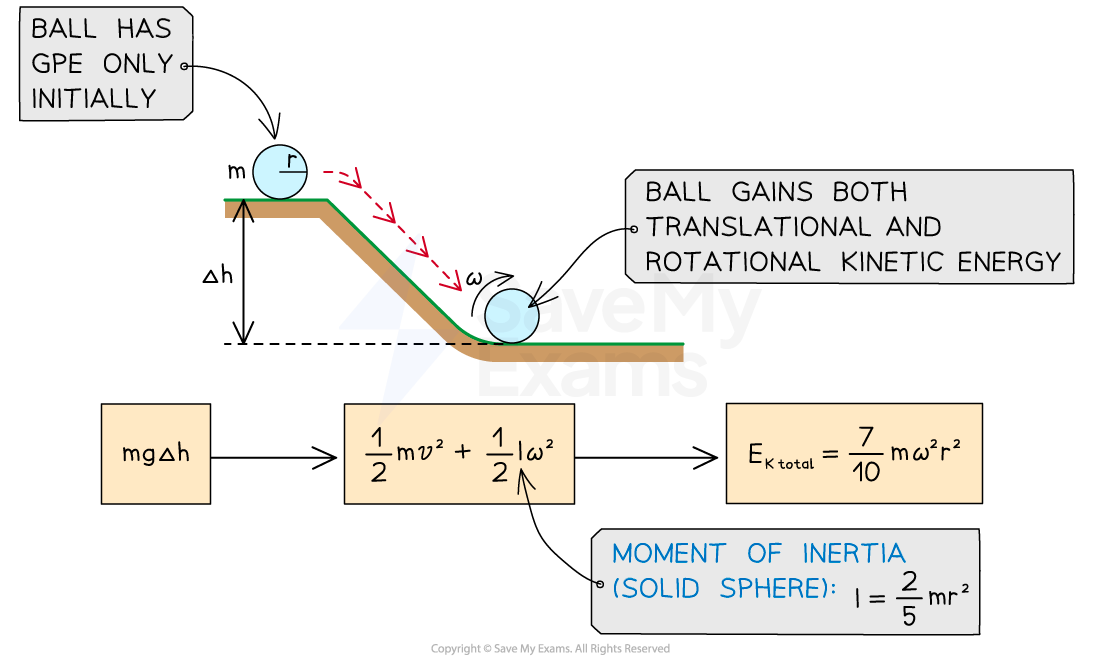
The linear or angular velocity can then be determined by
Equating and
Using the equation for the moment of inertia of the object
Using the relationship between linear and angular velocity
For example, for a ball (a solid sphere) of mass m and radius r, its moment of inertia is
Equating the equations for and and simplifying gives
Worked Example
A flywheel of mass M and radius R rotates at a constant angular velocity ω about an axis through its centre. The rotational kinetic energy of the flywheel is .
The moment of inertia of the flywheel is .
A second flywheel of mass and radius is placed on top of the first flywheel. The new angular velocity of the combined flywheels is .

What is the new rotational kinetic energy of the combined flywheels?
A.
B.
C.
D.
Answer: A
The kinetic energy of the first flywheel is
The combined flywheels have a total moment of inertia of
The kinetic energy of the combined flywheels is

Unlock more, it's free!
Join the 100,000+ Students that ❤️ Save My Exams
the (exam) results speak for themselves:

Was this revision note helpful?
Build on this topic