The Doppler Effect (DP IB Physics: HL): Revision Note

The Doppler Effect
When a source of sound, such as the whistle of a train or the siren of an ambulance, moves away from an observer:
It appears to decrease in frequency, i.e. it sounds lower in pitch
The source of the sound however, remains at a constant frequency
This frequency change due to the relative motion between a source of sound or light and an observer is known as the Doppler effect (or Doppler shift)
When the observer and the source of sound (e.g. ambulance siren) are both stationary:
The waves appear to remain at the same frequency for both the observer and the source
When the observer and the source of sound (e.g. ambulance siren) are moving relative to each other
The waves appear to have a different frequency for both the observer and the source

Stationary source and observer. The wavelength of the waves are the same for both observers
When the source starts to move towards the observer, the wavelength of the waves is shortened
The sound, therefore, appears at a higher frequency to the observer

Moving source at speed vs and stationary observer. The waves are closer together closer near the stationary observer
Notice how the waves are closer together between the source and the observer compared to point P and the source
This also works if the source is moving away from the observer
If the observer was at point P instead, they would hear the sound at a lower frequency due to the wavelength of the waves broadening
The frequency is increased when the source is moving towards the observer
The frequency is decreased when the source is moving away from the observer
The same phenomena occurs for electromagnetic waves, such as light
Waves moving away from the observer are red-shifted
Their wavelengths shift to the red end of the electromagnetic spectrum
This is equivalent to sound waves appearing at a lower frequency to the observer
Waves moving towards the observer are blue-shifted
Their wavelengths shift to the blue end of the electromagnetic spectrum
This is equivalent to sound waves appearing at a higher frequency to the observer
This is because red light has a longer wavelength than blue light
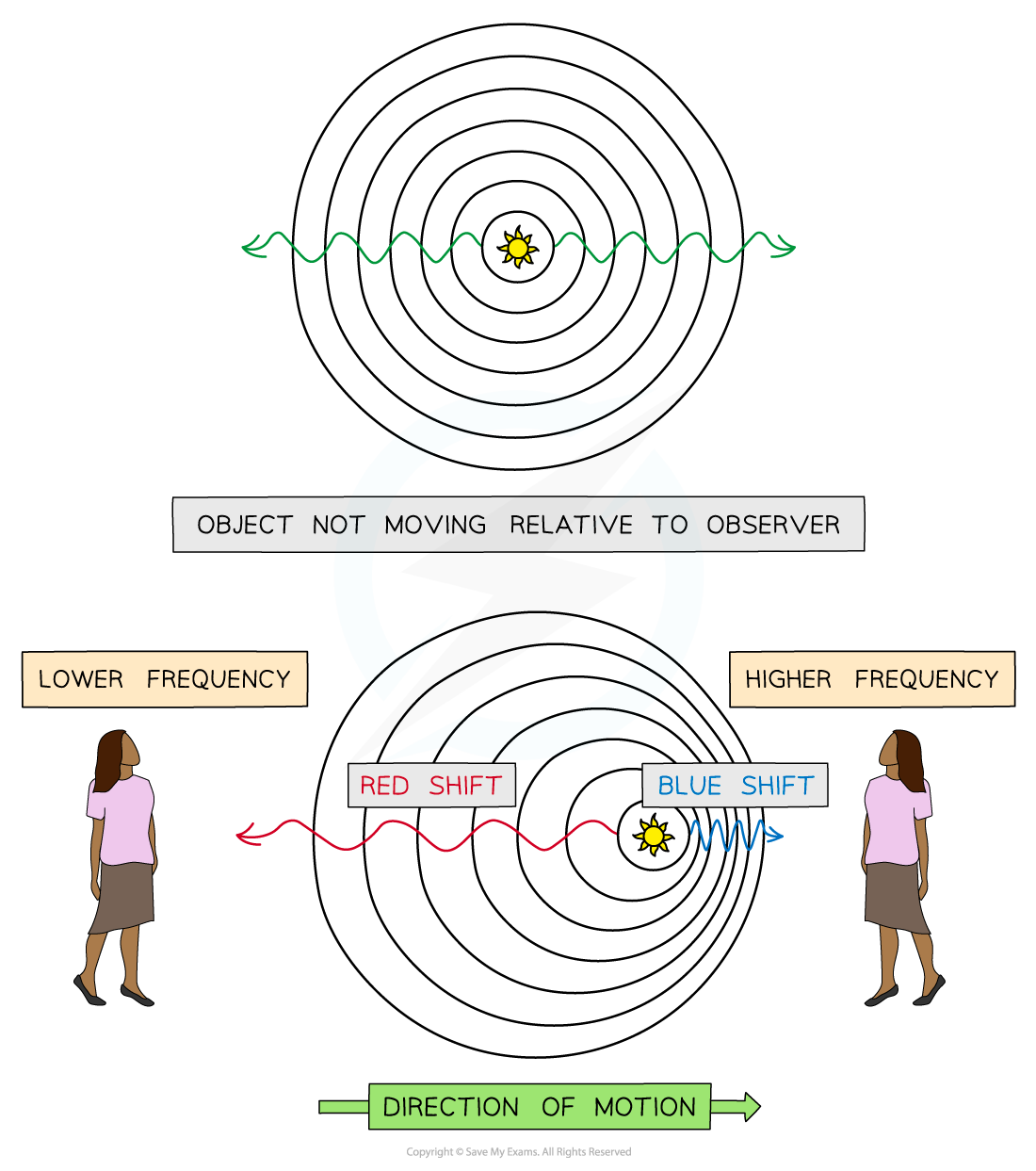
Red shift and blue shift for electromagnetic waves
Worked Example
A cyclist rides a bike ringing their bell past a stationary observer.
Which row correctly describes the Doppler shift caused by the sound of the bell?

Answer: D
If the cyclist is riding past the observer, the wavelength of sound waves are going to become longer
This rules out options A and C
A longer wavelength means a lower frequency (from )
Lower frequency creates a lower sound pitch
Therefore, the answer is row D
Examiner Tips and Tricks
The relationship between frequency and wavelength is determined by the wave equation, which is given in your data booklet. The speed v of the wave does not change.
Representing the Doppler Effect
Wavefront diagrams help visualise the Doppler effect for moving wave sources and stationary observers

Wavefronts are even in a stationary object but are squashed in the direction of the moving wave source
Δλ is the change in wavelength
The bigger the change, the bigger the doppler shift
A moving object will cause the wavelength, λ, (and frequency) of the waves to change:
The wavelength of the waves in front of the source decreases (λ – Δλ) and the frequency increases
The wavelength behind the source increases (λ + Δλ) and the frequency decreases
The Doppler shift is observed by all waves including sound and light

Unlock more, it's free!
Join the 100,000+ Students that ❤️ Save My Exams
the (exam) results speak for themselves:

Was this revision note helpful?
Build on this topic
