Projectile Motion (DP IB Physics: HL): Revision Note

Projectile Motion
What is a projectile?
A projectile is a particle moving freely (non-powered), under gravity, in a two-dimensional plane
Examples of projectile motion include throwing a ball, jumping off a diving board and hitting a baseball with a baseball bat
In these examples, it is assumed that:
Resistance from the air or liquid (known as fluid resistance) the object is travelling through is negligible
Acceleration due to free-fall, g is constant as the object is moving close to the surface of the Earth

Examples of objects in a projectile motion trajectory
An object is sent into a projectile motion trajectory with a resultant velocity, u at an angle, θ to the horizontal
Examples of this include a ball thrown from a height and a cannonball launched from a cannon

An object in a projectile motion trajectory has a resultant velocity at a given angle to the horizontal ground
Some key terms to know, and how to calculate them, are:
Time of flight (total time): how long the projectile is in the air
For typical projectile motion, the time to the maximum height is half of the total time
Maximum height attained: the height at which the projectile is momentarily at rest
This is when the vertical velocity component = 0
When the projectile is released and lands on the ground the projectile is at its maximum height when half of its total time has elapsed
Range: the horizontal distance travelled by the projectile

An object in projectile motion will have a vertical velocity of zero at maximum height when half the time has elapsed
Horizontal and vertical components
The trajectory of an object undergoing projectile motion consists of a vertical component and a horizontal component
These quantities are independent of each other
Displacement, velocity and acceleration are all vector quantities that are different in both components
They need to be evaluated separately using the kinematic equations
| Horizontal Component | Vertical Component |
|---|---|---|
Displacement |
| Maximum height is at the top of the motion when half the time has elapsed |
Velocity | Constant | Zero at maximum height |
Acceleration | Zero (because velocity remains constant) | Acceleration of free fall, g = 9.8 m s−2, acting vertically downwards throughout the flight
|

Acceleration and horizontal velocity are always constant whilst vertical velocity changes
The resultant velocity of an object in projectile motion can be split into its horizontal and vertical vector components using trigonometry where:
Vertical component = opposite side of the projectile triangle
opposite = sinθ × hyp = u sinθ
Horizontal component = adjacent side of the projectile triangle
adjacent = cosθ × hyp = u cosθ

The resultant velocity at an angle to the horizontal can be resolved using trigonometry into the horizontal and vertical components
It can be helpful to see how different equations calculate different quantities using SUVAT equations
Examples of obtaining the equations for total time, maximum height and range are shown below
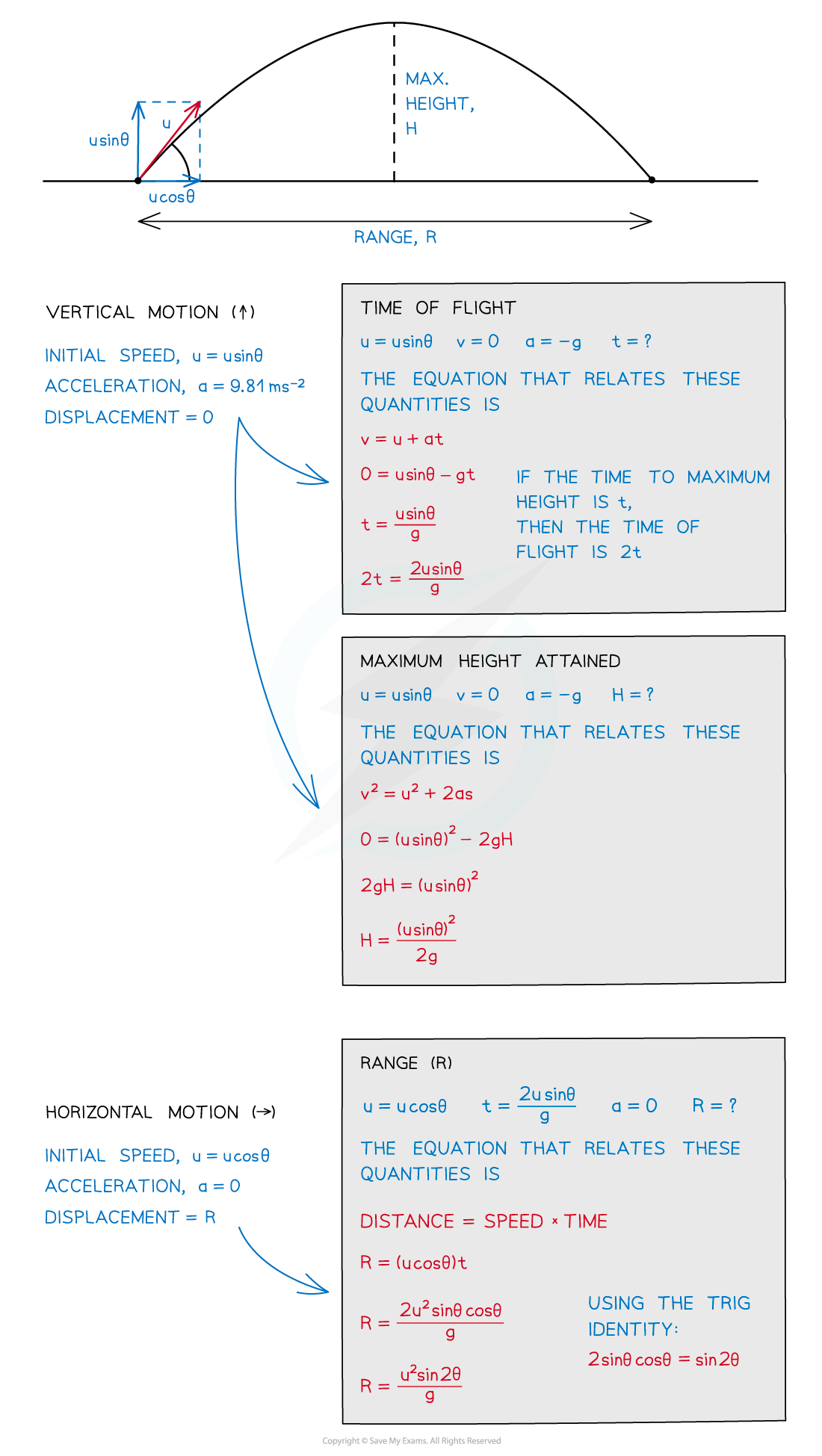
Examples of using SUVAT equations to determine the time of flight, maximum height and range of a projectile
Solving problems with projectiles
You may be required to calculate the missing quantities from the following projectile motion scenarios:
Vertical projection above the horizontal
Vertical projection below the horizontal
Horizontal projection
Projection at an angle, the most common scenario
Worked Example
A stone is projected from the top of a cliff 50.0 m high at an angle of 25.0° below the horizontal. The stone has an initial speed of 30.0 m s−1 and follows a curved trajectory. The stone hits the ground at a horizontal distance D from the base of the cliff with a vertical velocity of 33.8 m s−1.

Calculate the horizontal distance D.
Answer:
Step 1: Understand the information given in the question
The final vertical velocity of the stone, v = 33.8 m s−1
The horizontal velocity will remain constant throughout the motion
The question wants us to calculate the range of the stone
The vertical acceleration is +g m s−2
Step 2: Resolve velocity into the vertical and horizontal components
Draw a triangle on the diagram to show the vertical and horizontal velocity components

Calculate the initial vertical component of velocity, uv using trigonometry:
uv = opposite side
uv = sinθ × hypotenuse side
uv = sin(25) × 30 = 12.68 m s−1
Calculate the initial horizontal component of velocity, uH using trigonometry:
uH = adjacent side
uH = cosθ × hypotenuse side
uH = cos(25) × 30 = 27.19 m s−1
Step 3: Consider the equations of motion in the vertical and horizontal directions
| Vertical Motion | Horizontal Motion |
u | 12.68 m s−1 | 27.19 m s−1 |
v | 33.8 m s−1 | 27.19 m s−1 |
a | +9.81 m s−2 | 0 m s−2 |
t |
|
|
s | 50 m | D m ? |
Step 4: Calculate the time of flight from the vertical motion
v = u + at
33.8 = 12.68 + 9.81t
33.8 - 12.68 = 9.81t
t = 2.15 s
Step 5: Calculate the range of the stone, D using the elapsed time and horizontal motion
s = ut
D = 27.19 × 2.15
D = 58.46 m = 58 m (2 s.f.)
Worked Example
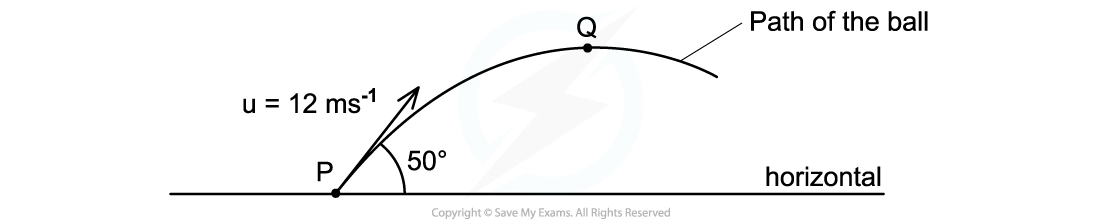
A ball is thrown from a point P with an initial velocity u of 12 m s-1 at 50° to the horizontal.
What is the value of the maximum height at Q? (ignoring air resistance)
Answer:
Answer:
Step 1: Consider the vertical motion and list the known quantities:
Maximum height,
Final velocity,
Acceleration,
Step 2: Calculate the vertical component of velocity
Step 2: Calculate the maximum height using the quantities listed in Step 1
The equation that links , , and is
Worked Example
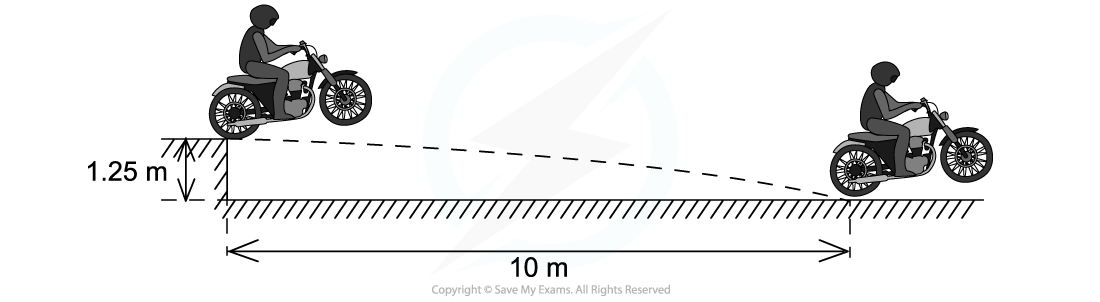
A motorcycle stunt-rider moving horizontally takes off from a point 1.25 m above the ground, landing 10 m away as shown.
What was the speed at take-off? (ignoring air resistance)
Answer:
Step 1: Consider the vertical motion first and list the known quantities:
Height,
Initial velocity,
Acceleration,
Time of flight,
Step 2: Calculate the time of flight using the quantities listed in Step 1
The equation that links , , and is
Step 3: Consider the horizontal motion and list the known quantities:
Distance travelled,
Initial velocity,
Acceleration,
Time of flight,
Step 4: Calculate the speed at take-off
Since the acceleration is zero, use the following equation
Examiner Tips and Tricks
Make sure you don’t make these common mistakes:
Mixing up positive and negative values for vectors
Mixing up velocities and distances between horizontal and vertical motion
Confusing the direction of sin θ and cos θ
Not converting units (mm, cm, km etc.) to metres
Furthermore, it is worth noting that projectile motion is typically symmetrical when air resistance is ignored, allowing for the use of the peak to find the total time of flight or total horizontal distance by doubling the amount to get from the start point to the peak.
In these exam questions, unless specified, fluid resistance can be ignored.

Unlock more, it's free!
Join the 100,000+ Students that ❤️ Save My Exams
the (exam) results speak for themselves:

Was this revision note helpful?
Build on this topic