Collisions & Explosions in One-Dimension (DP IB Physics: HL): Revision Note

Collisions & Explosions in One-Dimension
Collisions are when two or more moving objects come together and exert a force on one another for a relatively short time
Explosions are when two or more objects that are initially at rest are propelled apart from one another
In both collisions and explosions, momentum is conserved, provided no external resultant force acts
However, kinetic energy might not always be
Collisions in one dimension
Collisions in one dimension (1D) usually involve two objects interacting on a single straight line
This means the velocity vectors before and after the collision are directed along the same axis and can be either positive or negative

During a collision in one dimension between two objects, A and B, they move along the same line before and after the collision
Explosions in one dimension
Explosions in one dimension (1D) usually involve one stationary object becoming two objects that move away from each other along the same line
Before the explosion, the velocity and, therefore, momentum, are zero
After the collision, the velocity vectors are directed along the same axis and can be either positive or negative

During an explosion in one dimension, a single object AB explodes and becomes two objects, A and B, which move along the same line in opposite directions
Elastic and inelastic collisions
Collisions can be either:
elastic – if the kinetic energy is conserved
inelastic – if the kinetic energy is not conserved
A perfectly elastic collision is an idealised situation that does not actually occur in everyday life
Perfectly elastic collisions do occur commonly between particles
All collisions occurring on a macroscopic level are inelastic collisions
However, exam questions can use the theoretical idea of an elastic collision on a macroscopic level
A totally inelastic collision is a special case of an inelastic collision where the colliding bodies stick together and move as one body
In a totally inelastic collision, the maximum amount of kinetic energy is transferred away from the moving bodies and is dissipated to the surroundings
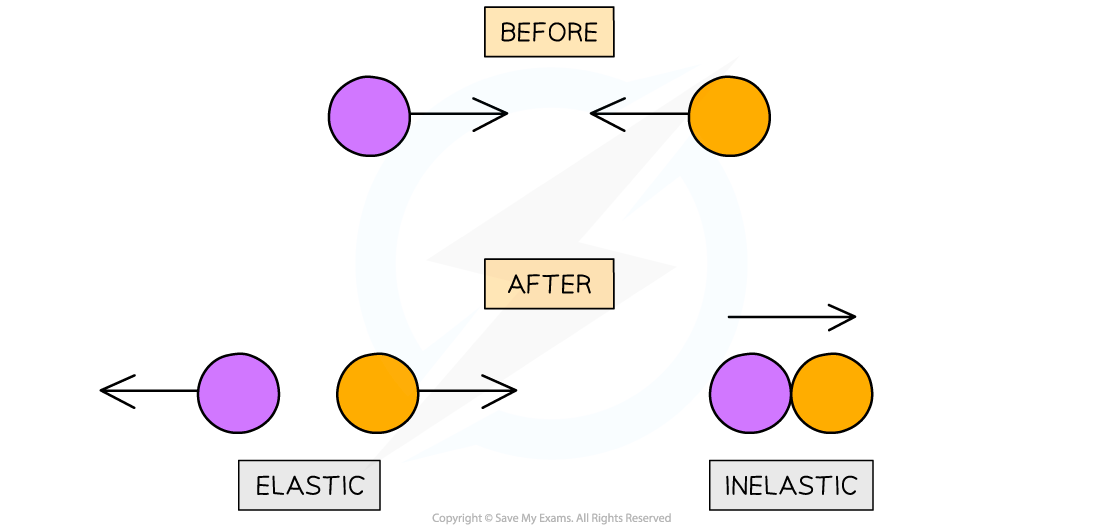
In an elastic collision, kinetic energy is conserved. In a totally inelastic collision, the two objects stick together and move as one
An explosion is commonly associated with recoil
For example, a gun recoiling after shooting a bullet or an unstable nucleus emitting an alpha particle and a daughter nucleus
Kinetic energy is never conserved in an explosion, as the objects are always at rest initially
To find out whether a collision is elastic or inelastic, compare the kinetic energy before and after the collision
The equation for kinetic energy is:
Where:
Ek = kinetic energy (J)
m = mass (kg)
v = velocity (m s–1)
Examiner Tips and Tricks
It can be helpful to think about collisions and explosions as if there are four types rather than two:
elastic - kinetic energy conserved
perfectly elastic - kinetic energy conserved and no energy transferred between objects
inelastic - kinetic energy not conserved
totally inelastic - kinetic energy not conserved and maximum energy transferred to surroundings
Worked Example
Two similar spheres, each of mass m and velocity v are travelling towards each other. The spheres have a head-on elastic collision.
What is the total kinetic energy after the impact?

Answer: C
In an elastic collision, kinetic energy is conserved, so:
kinetic energy before = kinetic energy after
kinetic energy before = ½mv2 + ½mv2 = mv2
Therefore, kinetic energy after = mv2
Worked Example
Trolley A of mass 0.80 kg collides head-on with stationary trolley B at speed 3.0 m s–1. Trolley B has twice the mass of trolley A. The trolleys stick together and travel at a velocity of 1.0 m s–1.
Determine whether this is an elastic or inelastic collision.
Answer:
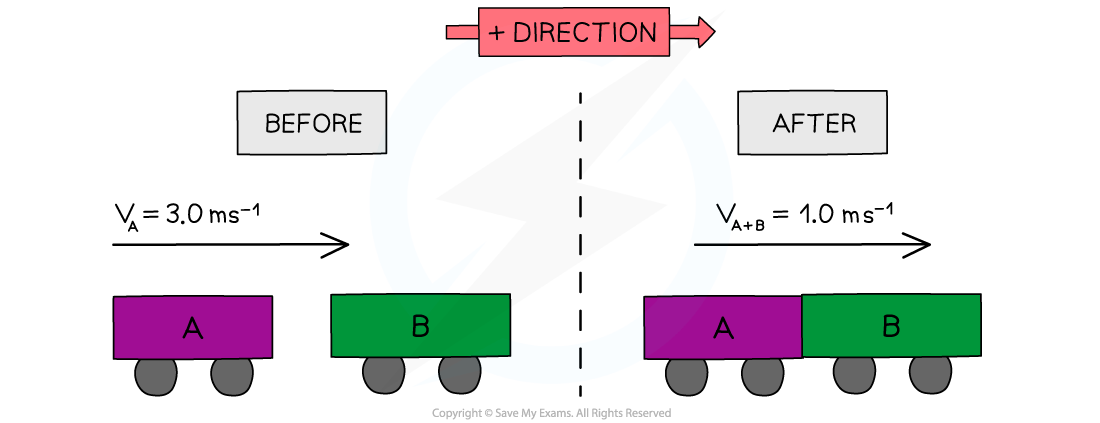
Step 1: List the known quantities
Mass of trolley A,
Initial velocity of trolley A,
Mass of trolley B,
Initial velocity of trolley B,
Combined velocity of trolleys A and B,
Step 2: Calculate the kinetic energy before the collision
Step 3: Calculate the kinetic energy after the collision
Step 4: Determine the type of collision
Kinetic energy is not conserved in this collision
Therefore, this is an inelastic collision
Examiner Tips and Tricks
If an object is stationary or at rest, its initial velocity is 0, therefore, the momentum and kinetic energy are also equal to 0.
When a collision occurs in which two objects are stuck together, treat the final object as a single object with a mass equal to the sum of the masses of the two individual objects.
Kinetic energy depends on v2, so it is never negative, whether the velocity is positive or negative.

Unlock more, it's free!
Join the 100,000+ Students that ❤️ Save My Exams
the (exam) results speak for themselves:

Was this revision note helpful?
Build on this topic