Coulomb's Law (DP IB Physics: HL): Revision Note

Coulomb's Law
All charged particles generate an electric field
This field exerts a force on charged particles which are nearby
The electric force between two charges is defined by Coulomb’s law, which states that:
The electric force between two point charges is directly proportional to the product of the charges and inversely proportional to the square of their separation
This electric force can be calculated using the expression:
Where:
F = electric force (N)
q1, q2 = magnitudes of the charges (C)
r = distance between the centres of the two charges (m)
k = Coulomb constant (8.99 × 10⁹ N m2 C–2)
Coulomb's law for two charges is analogous to Newton's law of gravitation for two masses
This means that electric and gravitational forces are very similar
For example, both forces follow an inverse square law with the separation between charge or mass
Electrostatic attraction between two charges
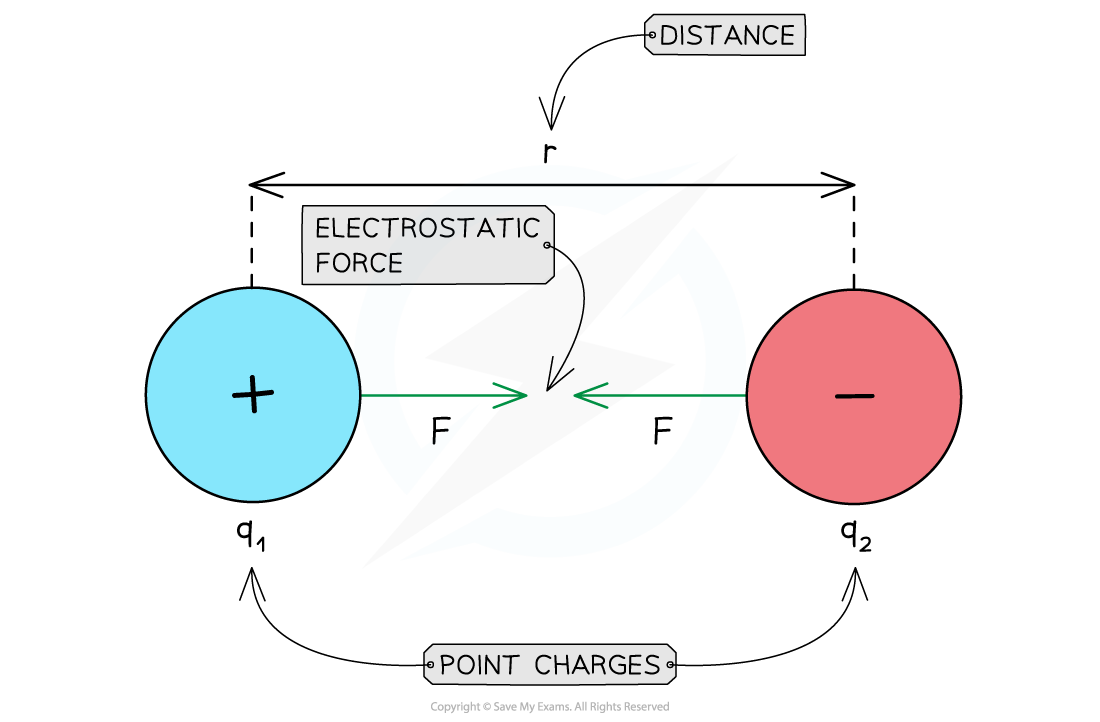
The attractive electric force F between two point charges +q1 and −q2 with a separation of r is defined by Coulomb’s law
Coulomb's constant is given by:
Where ε0 is the permittivity of free space
ε0 = 8.85 × 10⁻¹² C2 N–1 m–2 and refers to charges in a vacuum
The value of the permittivity of air is taken to be the same as ε0
All other materials have a higher permittivity ε > ε0
ε is a measure of the resistance offered by a material in creating an electric field within it
The value of k depends on the material between the charges
In a vacuum, k = 8.99 × 10⁹ N m2 C–2
Repulsive & Attractive Forces
Unlike the gravitational force between two masses which is only attractive, electric forces can be attractive or repulsive
Between two charges of the same type:
The product q1q2 is positive, so the forces have positive signs
Positive forces mean the charges experience repulsion
For two opposite charges:
The product q1q2 is negative, so the forces have negative signs
Negative forces mean the charges experience attraction
Worked Example
An alpha particle is placed 2.0 mm from a gold nucleus in a vacuum.
Taking them as point charges, calculate the magnitude of the electric force acting between the nuclei.
Proton number of helium = 2
Proton number of gold = 79
Answer:
Step 1: Write down the known quantities
Separation between charges, r = 2.0 mm = 2.0 × 10⁻³ m
Elementary charge, e = 1.60 × 10⁻¹⁹ C (from the data booklet)
Coulomb constant, k = 8.99 × 10⁹ N m2 C–2 (from the data booklet)
Step 2: Calculate the charges of the alpha particle and gold nucleus
An alpha particle (helium nucleus) has 2 protons, hence, it has a charge of:
q1 = 2e = 2 × (1.60 × 10–19)
A gold nucleus has 79 protons, hence, it has a charge of:
q2 = 79e = 79 × (1.60 × 10–19)
Step 3: Write down Coulomb's law
Step 4: Substitute the values and calculate the magnitude of the electric force
N (2 s.f.)
Examiner Tips and Tricks
You do not need to memorise the numerical value of the Coulomb's constant k or that of the permittivity of free space ε0. They will both be given in the data booklet.
Unless specified in the question, you should assume that charges are located in a vacuum.
You should note that Coulomb's law can only be applied to charged spheres whose size is much smaller than their separation. Only in this case, the point charge approximation is valid. You must remember that the separation r must be taken from the centres of the spheres.
You cannot use Coulomb's law to calculate the electrostatic force between charges distributed on irregularly-shaped objects.
Different Values of Permittivity
Permittivity is the measure of how easily an electric field can be generated in a certain material
The relative permittivity εr is sometimes known as the dielectric constant
For a given material, it is defined as:
The ratio of the permittivity of a material to the permittivity of free space
Relative permittivity can be expressed as:
Where:
εr = relative permittivity
ε = permittivity of a material (F m−1)
ε0 = permittivity of free space (F m−1)
Relative permittivity has no units because it is a ratio of two values with the same unit
When there is a material between two charges, the Coulomb constant becomes
In air, the relative permittivity is 1, so
In other materials, the Coulomb constant reduces as
Examples of relative permittivity
Some values of relative permittivity for different insulators are shown in the table below:
Material | Relative Permittivity, εr |
|---|---|
free space (vacuum) | 1 |
air | 1.0005 |
paper | 4 |
polystyrene | 3 |
ceramic | 100 - 15 000 |
paraffin | 2.3 |
pure water | 80 |
Worked Example
Calculate the permittivity of a material that has a relative permittivity of 4.5 × 10¹¹. State an appropriate unit for your answer.
Answer:
Step 1: Write down the relative permittivity equation
Step 2: Rearrange for the permittivity of the material ε
Step 3: Substitute the values and calculate
F m−1 (2 s.f.)

Unlock more, it's free!
Join the 100,000+ Students that ❤️ Save My Exams
the (exam) results speak for themselves:

Was this revision note helpful?
Build on this topic
