Gravitational Potential Energy Equation (DP IB Physics: HL): Revision Note

Work Done on a Mass
When a mass is moved against the force of gravity, work is required
This is because gravity is attractive, therefore, energy is needed to work against this attractive force
The work done in moving a mass m is given by:
Where:
ΔW = change in work done (J)
m = mass (kg)
ΔVg = change in gravitational potential (J kg−1)
Worked Example
A particle of mass 50 g is moved vertically from point A to point B, as shown in the diagram.
Take the gravitational field strength to be 10 N kg−1.
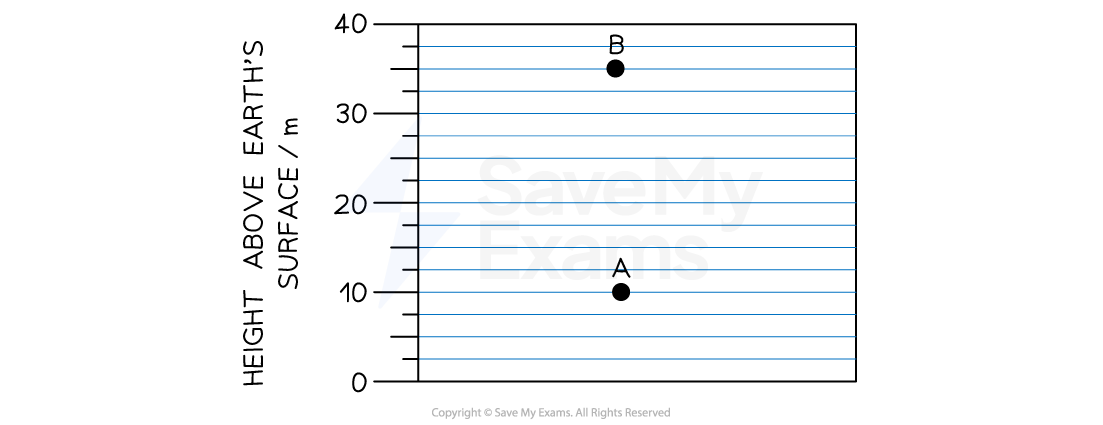
Determine
(a) the potential difference between A and B
(b) the work done in moving the mass from A to B
Answer:
(a)
The work done in moving a mass in a gravitational field is:
and (close to the Earth's surface)
Where the change in height is = 35 − 10 = 25 m
Therefore, the potential difference between A and B is:
(b)
The work done in moving the mass from A to B is:
Gravitational Potential Energy Equation
In a radial field, gravitational potential energy (GPE) describes the energy an object possesses due to its position in a gravitational field
The gravitational potential energy of a system is defined as:
The work done to assemble the system from infinite separation of the components of the system
Similarly, the gravitational potential energy of a point mass is defined as:
The work done in bringing a mass from infinity to a point
The equation for GPE of two point masses m and M at a distance r is:
Where:
G = universal gravitational constant (N m2 kg–2)
m1 = larger mass producing the field (kg)
m2 = mass moving within the field of M (kg)
r = distance between the centre of m and M (m)
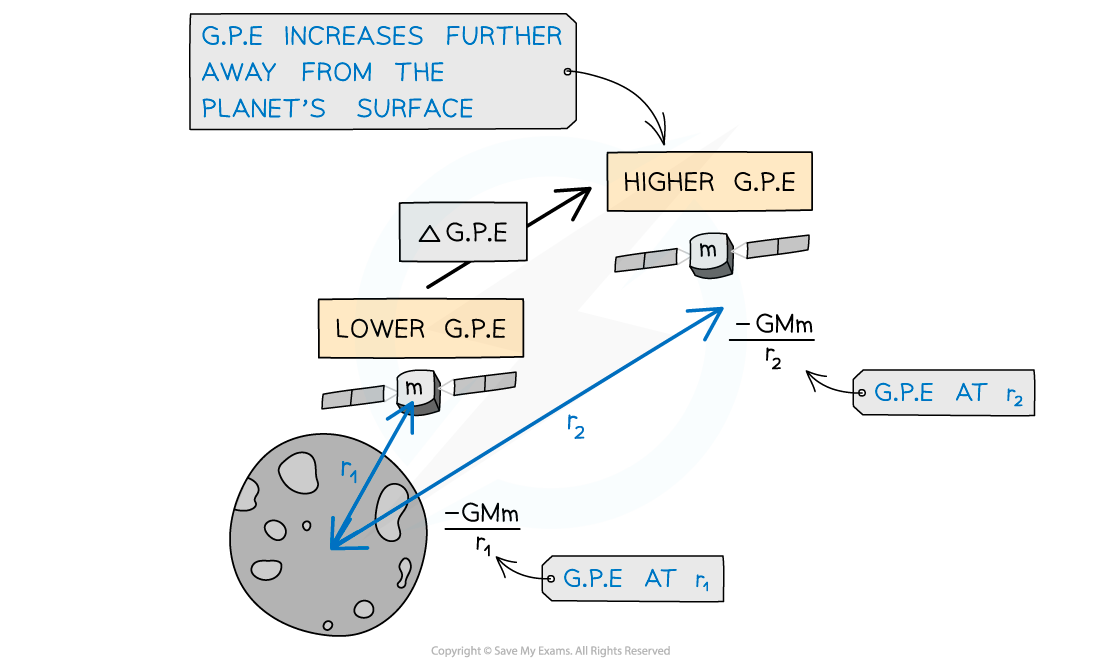
Gravitational potential energy increases as a satellite leaves the surface of the Moon (of mass M)
Recall that Newton's Law of Gravitation relates the magnitude of the force F between two masses M and m:
Therefore, a force-distance graph would be a curve, because F is inversely proportional to r2, or:
The product of force and distance is equal to work done (or energy transferred)
Therefore, the area under the force-distance graph for gravitational fields is equal to the work done
In the case of a mass m moving further away from a mass M, the potential increases
Since gravity is attractive, this requires work to be done on the mass m
The area between two points under the force-distance curve, therefore, gives the change in gravitational potential energy of mass m
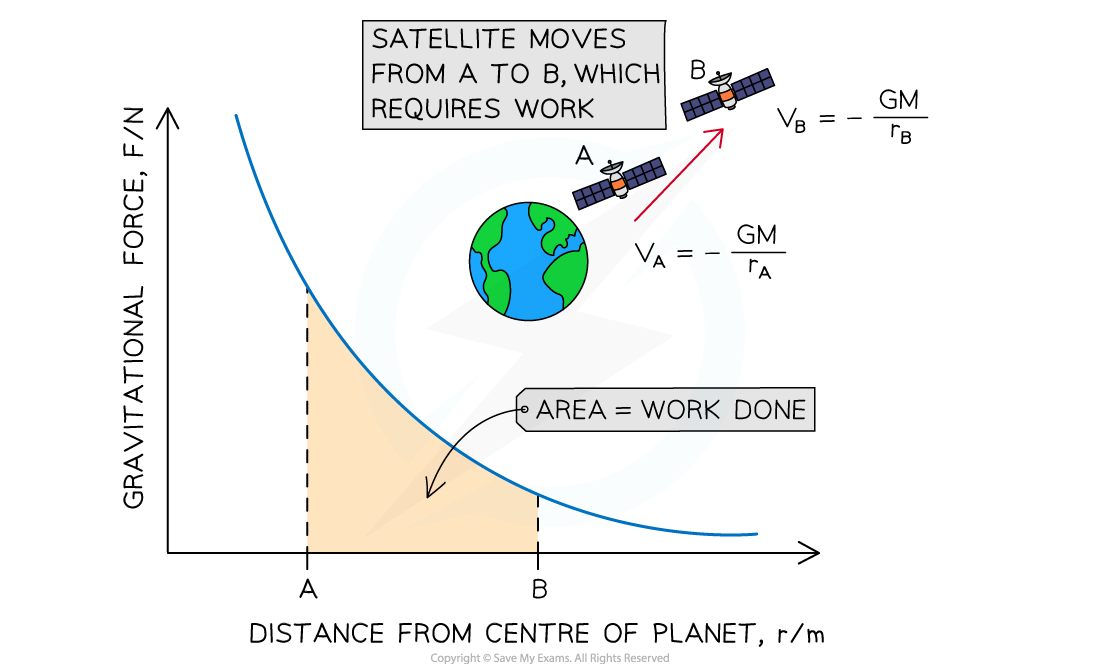
Work is done on the satellite of mass m to move it from A to B, because gravity is attractive. The area under the curve represents the magnitude of energy transferred
Change in Gravitational Potential Energy
Two points at different distances from a mass will have different gravitational potentials
This is because the gravitational potential increases with distance from a mass
Therefore, there will be a gravitational potential difference ΔV between the two points
Where:
= initial gravitational potential (J kg–1)
= final gravitational potential (J kg–1)
The change in work done against a gravitational field is equal to the change in gravitational potential energy (GPE)
When V = 0, then the GPE = 0
It is usually more useful to find the change in the GPE of a system
For example, a satellite lifted into space from the Earth’s surface
The change in GPE when a mass moves towards, or away from, another mass is given by:
Where:
m1 = mass that is producing the gravitational field (e.g. a planet) (kg)
m2 = mass that is moving in the gravitational field (e.g. a satellite) (kg)
r1 = first distance of m2 from the centre of m1 (m)
r2 = second distance of m2 from the centre of m1 (m)
The change in potential ΔVg is the same, without the mass of the object m2:
Work is done when an object in a planet's gravitational field moves against the gravitational field lines i.e. away from the planet
Worked Example
A spacecraft of mass 300 kg leaves the surface of Mars up to an altitude of 700 km.
Calculate the work done by the spacecraft.
Radius of Mars = 3400 km
Mass of Mars, m1 = 6.40 × 10²³ kg
Answer:
The change in GPE is equal to
Where
r1 = radius of Mars = 3400 km
r2 = radius + altitude = 3400 + 700 = 4100 km
Work done by satellite: (2 s.f.)
Worked Example
A satellite of mass 1450 kg moves from an orbit of 980 km above the Earth’s surface to a lower orbit of 480 km.
Calculate the change in gravitational potential energy of the satellite.
Mass of the Earth = 5.97 × 1024 kg
Radius of the Earth = 6.38 × 10⁶ m
Answer:
Step 1: Write down the known quantities
Initial height above Earth’s surface, h1 = 980 km
Final height above Earth’s surface, h2 = 480 km
Mass of the satellite, m1 = 1450 kg
Mass of the Earth, m2 = 5.97 × 1024 kg
Radius of the Earth, R = 6.38 × 10⁶ m
Step 2: Write down the equation for change in gravitational potential energy
Step 3: Convert distances into standard units and include Earth radius
Distance from centre of Earth to higher orbit:
= (980 × 103) + (6.38 × 10⁶) = 7.36 × 10⁶ m
Distance from centre of Earth to lower orbit:
= (480 × 103) + (6.38 × 10⁶) = 6.86 × 10⁶ m
Step 4: Substitute values into the equation
Change in gravitational potential energy: ΔEp = 5.72 × 10⁹ J
Examiner Tips and Tricks
Make sure to not confuse the ΔEp equation with ΔE = mgΔh, they look similar but refer to quite different situations.
The more familiar equation is only relevant for an object lifted in a uniform gravitational field, meaning very close to the Earth’s surface, where we can model the field as uniform.
The new equation for Ep does not include g. The gravitational field strength, which is different on different planets, does not remain constant as the distance from the surface increases. Gravitational field strength falls away according to the inverse square law.
The change in gravitational potential energy is the work done.

Unlock more, it's free!
Join the 100,000+ Students that ❤️ Save My Exams
the (exam) results speak for themselves:

Was this revision note helpful?
Build on this topic
