Electromotive Force & Internal Resistance (DP IB Physics: HL): Revision Note

Electromotive Force
When a charge passes through a power supply such as a battery, it gains electrical energy
The electromotive force (e.m.f.) is defined as
The energy converted from other forms (such as chemical energy) into electrical energy per coulomb of charge passing through the source
Cells and batteries provide a source of e.m.f.
E.m.f. is measured in volts (V) and can be calculated using:
E.m.f. is also the potential difference across the cell when no current is flowing
The e.m.f. of a cell can be measured by connecting a high-resistance voltmeter across the terminals of the cell in an open circuit

E.m.f. is measured using a voltmeter connected in parallel with the cell
Internal Resistance
All power supplies have some resistance between their terminals
This is called internal resistance (r)
This internal resistance causes the charge circulating to dissipate some electrical energy from the power supply itself
This is why the cell becomes warm after a period of time
The internal resistance, therefore, causes a loss of voltage or energy in a power supply
A cell can be considered as a source of e.m.f. with an internal resistance connected in series
This is shown in the circuit diagram below:
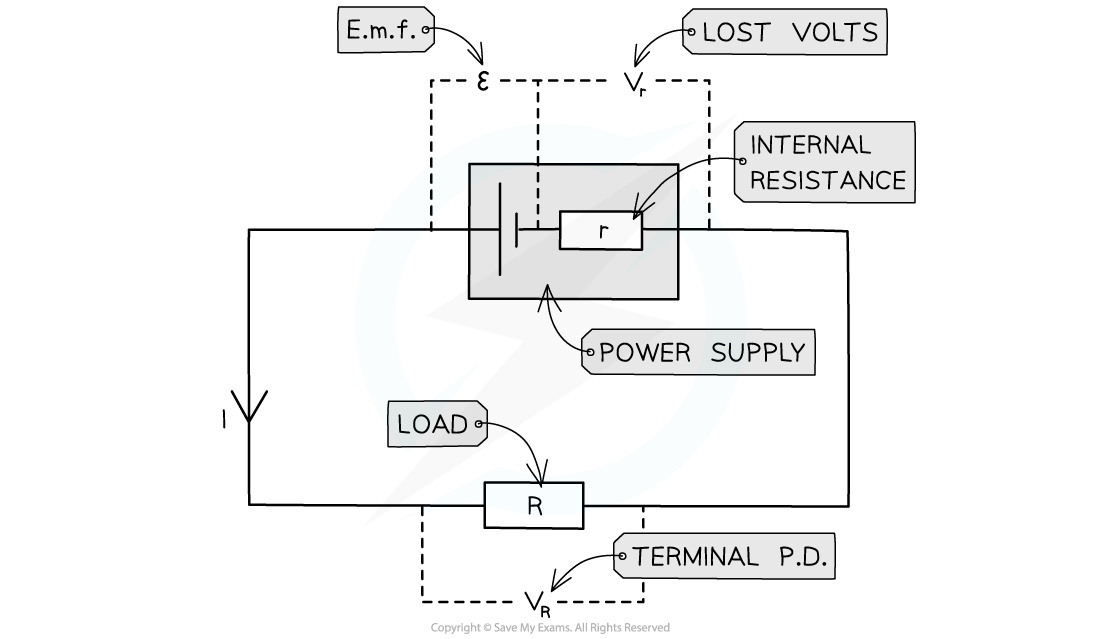
Circuit showing the e.m.f and internal resistance of a power supply
Where:
Resistor R is the ‘load resistor’
r is the internal resistance
ε is the e.m.f
Vr is the lost volts
VR is the p.d across the load resistor, which is the same as the terminal p.d
Vr is called the 'lost volts' as it's the potential difference 'lost' due to the internal resistance in the cell
The e.m.f. is the sum of these potential differences, giving the equation below:
Where:
ε = electromotive force (emf) (V)
I = current (A)
R = resistance available to the rest of the circuit (Ω)
r = internal resistance (Ω)
E.m.f. is, therefore, the total, or maximum, voltage available to the circuit
Worked Example
A battery of e.m.f 7.3 V and internal resistance r of 0.3 Ω is connected in series with a resistor of resistance 9.5 Ω.

Determine:
(a) the current in the circuit
(b) the lost volts from the battery
Answer:
Part (a)
Step 1: List the known quantities
e.m.f of battery,
Load resistance,
Internal resistance,
Step 2: Calculate the current in the circuit
Part (b)
Step 1: Recall the definition of lost volts
The lost volts are the voltage lost due to internal resistance,
Step 2: Calculate the lost volts from the battery
Examiner Tips and Tricks
Make sure you substitute the correct resistance into the e.m.f. equation. R is the resistance available to the rest of the circuit and can vary depending on what components are in the circuit (e.g. adding or taking away resistors). The internal resistance r is a property of the cell and cannot change.

Unlock more, it's free!
Join the 100,000+ Students that ❤️ Save My Exams
the (exam) results speak for themselves:

Was this revision note helpful?
Build on this topic