Angular Impulse (DP IB Physics: HL): Revision Note

Angular Impulse
In linear motion, the resultant force on a body can be defined as the rate of change of linear momentum:
This leads to the definition of linear impulse:
An average resultant force acting for a time produces a change in linear momentum
Similarly, the resultant torque on a body can be defined as the rate of change of angular momentum:
Where:
= resultant torque on a body (N m)
= change in angular momentum (kg m2 s−1)
= time interval (s)
This leads to the definition of angular impulse:
An average resultant torque acting for a time produces a change in angular momentum
Angular impulse is measured in kg m2 s−1, or N m s
This equation requires the use of a constant resultant torque
If the resultant torque changes, then an average of the values must be used
Angular impulse describes the effect of a torque acting over a time interval
This means a small torque acting over a long time has the same effect as a large torque acting over a short time
Angular Impulse on a Torque-Time Graph
The area under a torque-time graph is equal to the angular impulse or the change in angular momentum

When the torque is not constant, the angular impulse is the area under a torque–time graph
Worked Example
The graph shows the variation of time t with the net torque on an object which has a moment of inertia of 5.0 kg m2.
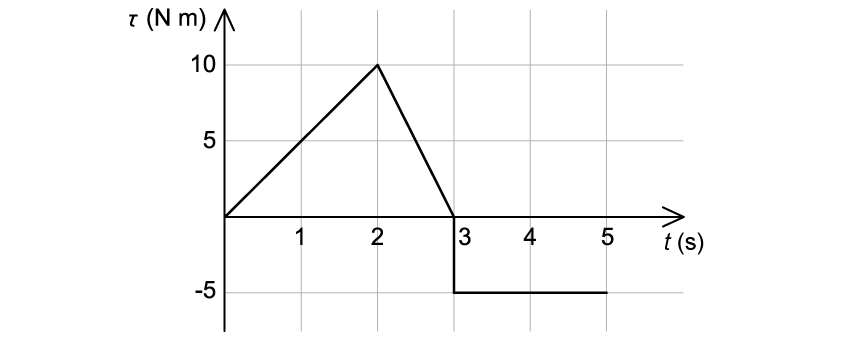
At t = 0, the object rotates with an angular velocity of 2.0 rad s−1 clockwise.
Determine the magnitude and direction of rotation of the angular velocity at t = 5 s.
In this question, take anticlockwise as the positive direction.
Answer:
Step 1: Use the graph to determine the angular impulse
The area under a torque-time graph is equal to angular impulse, or the change in angular momentum
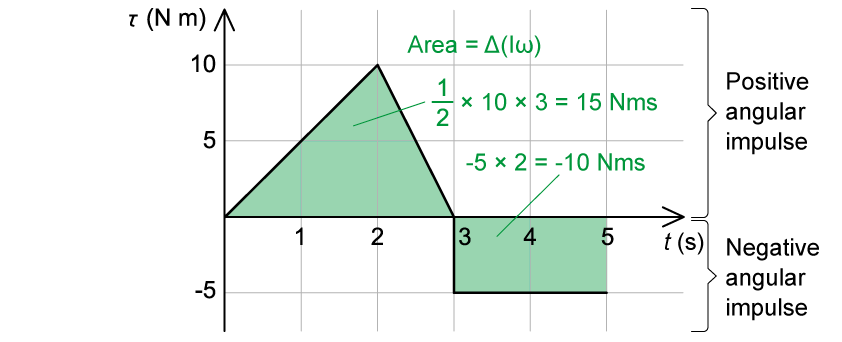
The area under the positive curve (triangle) =
The area under the negative curve (rectangle) =
Therefore, the angular impulse, or change in angular momentum is
Step 2: Write an expression for the change in angular momentum
The change in angular momentum is equal to
Where
Moment of inertia, = 5.0 kg m2
Initial angular velocity, = −2.0 rad s−1 (clockwise is the negative direction)
Step 3: Calculate the final angular velocity
Therefore, when t = 5 s, the angular velocity is
= −1.0 rad s−1 in the clockwise direction

Unlock more, it's free!
Join the 100,000+ Students that ❤️ Save My Exams
the (exam) results speak for themselves:

Was this revision note helpful?
Build on this topic
