Lorentz Transformations (DP IB Physics: HL): Revision Note

Lorentz Transformation Equations
To relate measurements from one reference frame to another in Galilean relativity, we used Galilean transformations
However, Galilean transformations can no longer be used to describe distances, times and speeds for objects travelling close to the speed of light
Einstein's postulates of special relativity lead to the Lorentz transformation equations for the coordinates of an event in two inertial reference frames
The Lorentz Factor
Lorentz transformations are a correction of the Galilean transformations for speeds close to the speed of light, by multiplying by a scaling factor called the Lorentz factor,
As v will always be less than c ( since nothing can travel faster than the speed of light), this means that will always be greater than 1
This is especially important for time dilation and length contraction
Lorentz Transformation Equations
Again we have the reference frame S measuring with co-ordinates (x, y, t), and S' with co-ordinates (x', y', t')
Person F is moving away from Person E in their rocket ship at speed v which is close to the speed of light c
Person E is a stationary observer on Earth
Both Person E and Person F witness a loud bang some distance away
Person F measures the loud bang to be a distance x' away
Person E measures the loud bang to be a distance x = γ(x' + vt') away
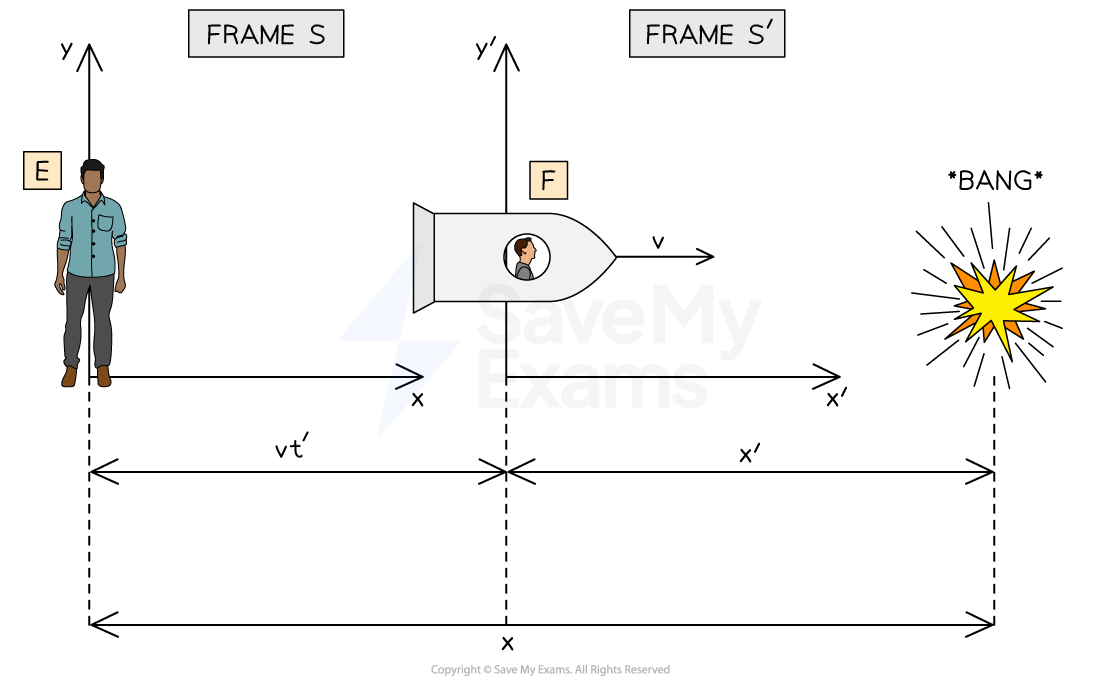
People E measures the loud bang to be at a different distance to person F
However, motion is relative
According to Person F, they are stationary and Person E is moving away from them at a velocity v in the opposite direction
So from Person F's point of view:
Person E's velocity is -v
Therefore, Person F measures the bang to happen at a distance x' = γ(x - vt) away
But, the time the bang happens is not the same in both frames of reference! t ≠ t'
These are the exact same equations as the Galilean transformation equations, just with the added Lorentz factor
In summary, the Lorentz equations from frame S → S' are:
Where:
(x, y, z, t) = the co-ordinates measured from one reference frame
(x', y', z', t') = the co-ordinates measured from another reference frame moving at speed v relative to it
Galilean vs. Lorentz Transformations
Lorentz (v ≈ c) | Galilean (v << c) |
|---|---|
Notice that time is different between reference frames t and t' for objects travelling close to the speed of light, whilst in Galilean transformations, time was absolute (it doesn't change) between reference frames
Worked Example
A rocket of proper length 150 m moves to the right with speed 0.91c relative to the ground.
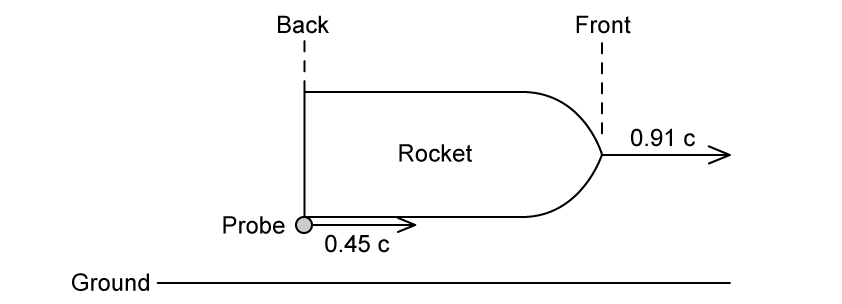
A probe is released from the back of the rocket at speed 0.45c relative to the rocket.
Determine the time it takes the probe to reach the front of the rocket according to an observer
(a) At rest in the rocket.
(b) At rest on the ground.
Answer:
(a)
Step 1: List the known quantities
Length of the rocket, l = 150 m
Speed of the probe, v' = 0.40c
Step 2: Analyse the situation
In the reference frame of an observer at rest in the rocket, they are stationary
Therefore, the probe travels at a constant speed 0.45c across the full length of the rocket of 150 m
t' and v' are used because they are the times and velocity of the moving object in the reference frame of the observer at rest
(b)
Step 1: List the known quantities
Length of the rocket, l = 150 m
Speed of the rocket, v = 0.91c
Time taken for the probe to reach the front of the rocket, t' = 1.11 × 10⁻⁶ s
Step 2: Analyse the situation
In reference to an observer at rest on the ground, they will see the probe taking longer to reach the front of the ship
Since object in question, the probe, is moving in both reference frames, we need to use a Lorentz transformation
Step 3: Calculate the gamma factor
Step 4: Substitute values into the Lorentz transformation
Since the observer is at rest, the Lorentz equation for time t must be used
Examiner Tips and Tricks
Always check that your value of is greater than 1.
You will often be given a speed v in terms of c e.g. v = 0.90c etc. When you put this value into the gamma factor, this is squared. Therefore, you do not need to put in 3.0 × 10⁸ at all into your calculator, as the c2 will cancel.
E.g.
The equations for x', t' and are given in your data booklet, but you must remember the sign change if you want to calculate x or t (from the rest frame) instead!
Some textbooks may go further into this for your understanding, you will not be expected to derive these equations in your exam. You will only be assessed on how to use them.

Unlock more, it's free!
Join the 100,000+ Students that ❤️ Save My Exams
the (exam) results speak for themselves:

Was this revision note helpful?
Build on this topic