Standing Waves (DP IB Physics: SL): Revision Note

Standing Waves
Standing waves are produced by two waves as they travel in opposite directions
This is usually achieved when a travelling wave superimposes its reflection
The superposition produces a wave pattern where the crests and troughs only move vertically
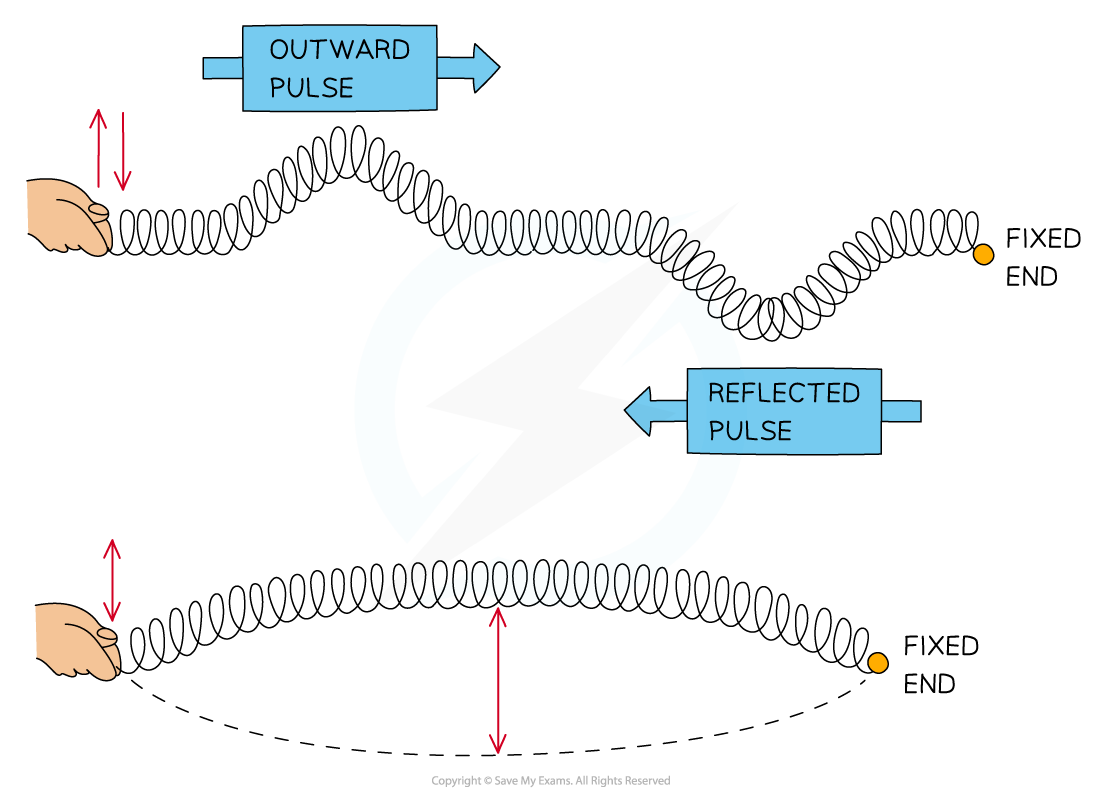
Formation of a stationary wave on a stretched spring fixed at one end
Formation of Standing Waves
Standing waves are formed from the principle of superposition. This is when:
Two waves travelling in opposite directions along the same line with the same frequency superpose
The principle of superposition applies to all types of waves i.e. transverse and longitudinal, progressive and stationary
The waves must have:
the same wavelength
a similar amplitude
As a result of superposition, a resultant wave is produced
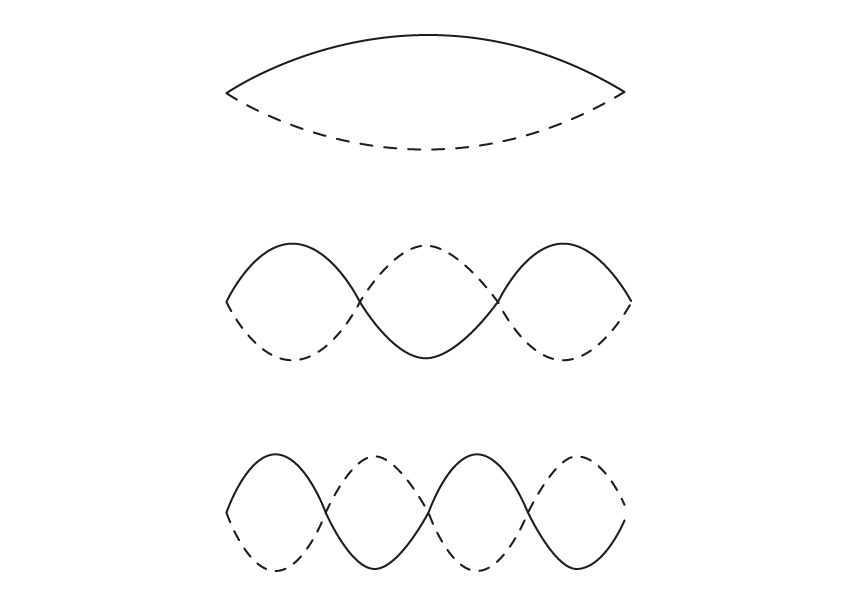
Standing waves produced at varying frequencies
Comparing progressive and standing waves
Standing waves (or stationary waves) store energy
Progressive waves (or travelling waves) transfer energy
The table below outlines the main differences between progressive and stationary waves
Table of differences between progressive and stationary waves

Worked Example
A travelling wave is incident on a barrier. The wave profile is shown below.

The travelling wave reflects off the barrier. The reflected and incident waves superimpose.
State and explain whether or not a standing wave is formed.
Answer:
For standing waves to be formed, the half-cycles of the wave profile must be symmetrical (i.e. the same but inverted)
For this wave, the half-cycles are not symmetrical
The leading edge is straight
The trailing edge is sinusoidal
When the incident and reflected waves superimpose, they will not cancel out at any point
Therefore, a standing wave is not formed

Unlock more, it's free!
Join the 100,000+ Students that ❤️ Save My Exams
the (exam) results speak for themselves:

Was this revision note helpful?
Build on this topic
