Time Period of a Simple Pendulum (DP IB Physics: SL): Revision Note

Time Period of a Simple Pendulum
A simple pendulum consists of a string and a bob at the end
The bob is a weight, generally spherical and considered a point mass
The bob moves from side to side
The string is light and inextensible remaining in tension throughout the oscillations
The string is attached to a fixed point above the equilibrium position
The time period of a simple pendulum for small angles of oscillation is given by:
Where:
T = time period (s)
L = length of string (from the pivot to the centre of mass of the bob) (m)
g = gravitational field strength (N kg-1)
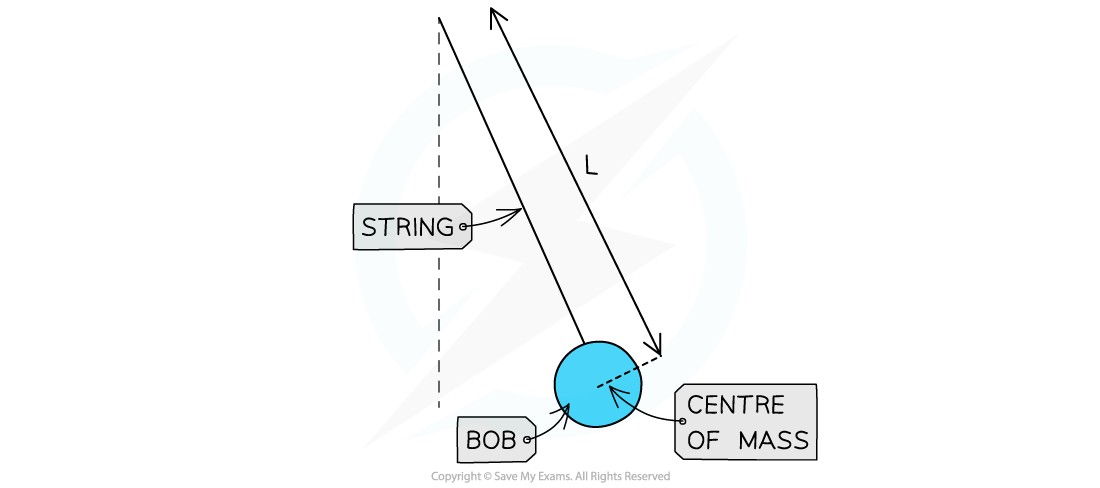
A simple pendulum
The time period of a pendulum depends on gravitational field strength
Therefore, the time for a pendulum to complete one oscillation would be different on the Earth and the Moon
Small Angle Approximation
This formula for time period is limited to small angles (θ < 10°) and therefore small amplitudes of oscillation from the equilibrium point
The restoring force of a pendulum is equal to the component of weight acting along the arc of the circle towards the equilibrium position
It is assumed to act at an angle θ to the horizontal
Using the small angle approximation: sin θ ≅ θ
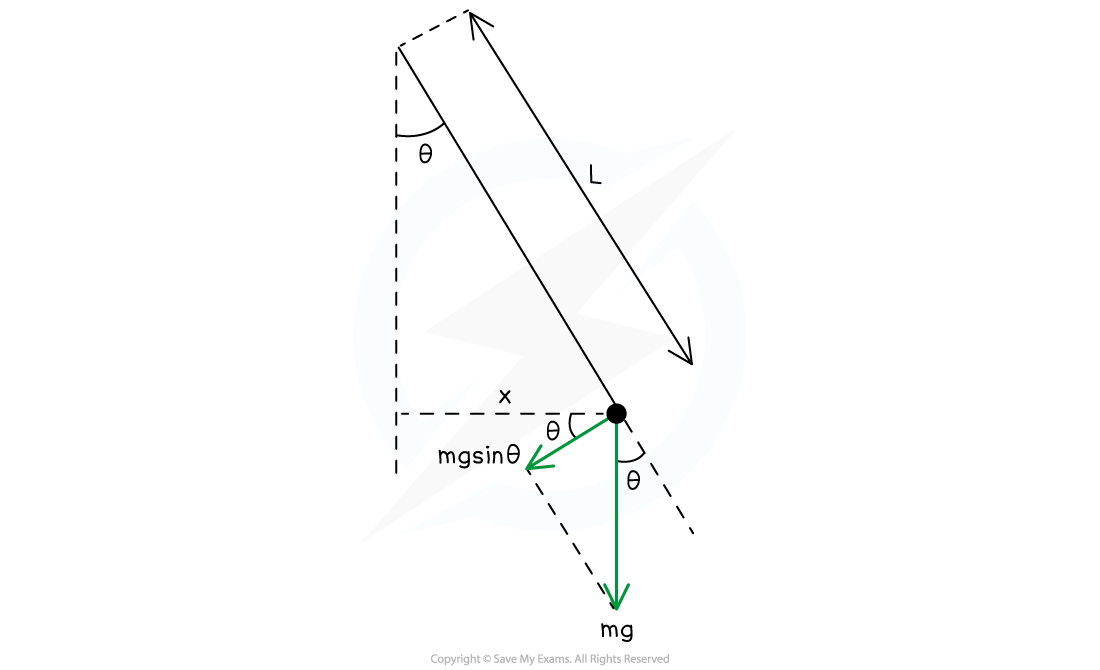
Forces on a pendulum when it is displaced. Assuming θ < 10°, the small angle approximation can be used to describe the time period of a simple pendulum
Worked Example
A swinging pendulum with a length of 80.0 cm has a maximum angle of displacement of 8°.
Determine the angular frequency of the oscillation.
Answer:
Step 1: List the known quantities
Length of the pendulum, L = 80 cm = 0.8 m
Acceleration due to gravity, g = 9.81 m s−2
Step 2: Write down the relationship between angular frequency, ω, and period, T
Step 3: Write down the equation for the time period of a simple pendulum
This equation is valid for this scenario since the maximum angle of displacement is less than 10°
Step 4: Equate the two equations and rearrange for ω
Step 5: Substitute the values to calculate ω
= 3.50 rad s−1
Angular frequency: ω = 3.5 rad s−1
Note: angular frequency ω is also known as angular speed or velocity

Unlock more, it's free!
Join the 100,000+ Students that ❤️ Save My Exams
the (exam) results speak for themselves:

Was this revision note helpful?
Build on this topic