Boundary Conditions for Standing Waves (DP IB Physics: SL): Revision Note

Boundary Conditions
Stationary waves can form on strings or in pipes
In both cases, progressive waves travel in a medium (i.e. the string or air) and superimpose with their reflections
The number of nodes and antinodes that fit within the available length of medium depends on:
The frequency of the progressive waves
The boundary conditions (i.e. whether the progressive waves travel between two fixed ends, two free ends or a fixed and a free end)
Standing Waves on Stretched Strings
When guitar strings are plucked, they can vibrate with different frequencies
The frequency with which a string vibrates depends on:
The tension, which is adjusted using rotating 'tuning pegs'
The mass per unit length, which is the reason why a guitar has strings of different thicknesses
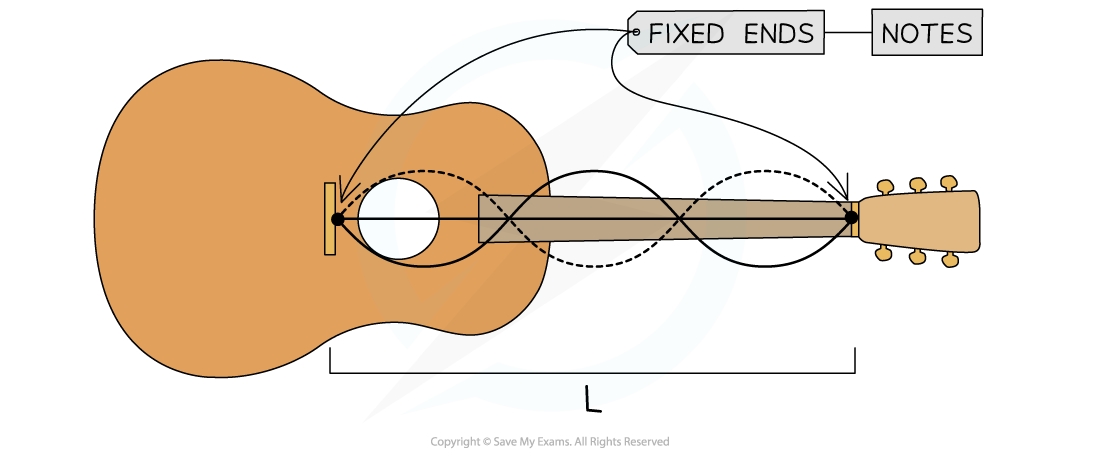
Standing wave on a guitar string
For a string, the boundary condition can be
Fixed at both ends
Free at both ends
One end fixed, the other free
At specific frequencies, known as natural frequencies, an integer number of half wavelengths will fit on the length of the string
As progressive waves of different natural frequencies are sent along the string, standing waves with different numbers of nodes and antinodes form
Standing Waves in Pipes
When the air within a pipe vibrates, longitudinal waves travel along the pipe
Simply blowing across the open end of a pipe can produce a standing wave in the pipe
For a pipe, there is more than one possible boundary condition, theses are pipes that are:
Closed at both ends
Open at both ends
Closed at one end and open on the other
Nodes & Antinodes
When a progressive wave travels towards a free end for a string, or open end for a pipe:
The reflected wave is in phase with the incident wave
The amplitudes of the incident and reflected waves add up
A free end is a location of maximum displacement - i.e. an antinode
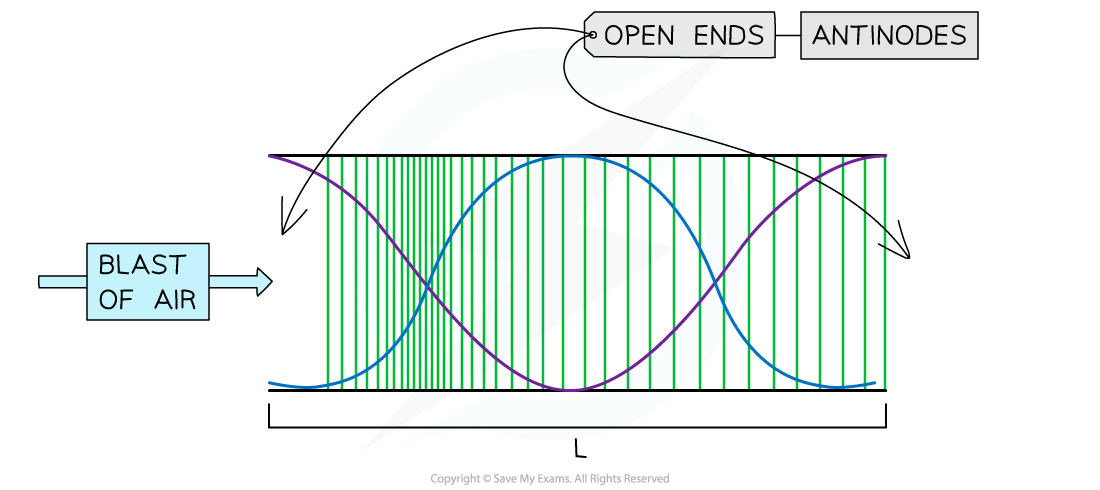
Standing wave inside a pipe open at both ends
When a progressive wave travels towards a fixed end for a string, or closed end for a pipe:
The reflected wave is in anti-phase with the incident wave
The two waves cancel out
A fixed end is a location of zero displacement - i.e. a node
The open end is therefore a location of maximum displacement - i.e. an antinode
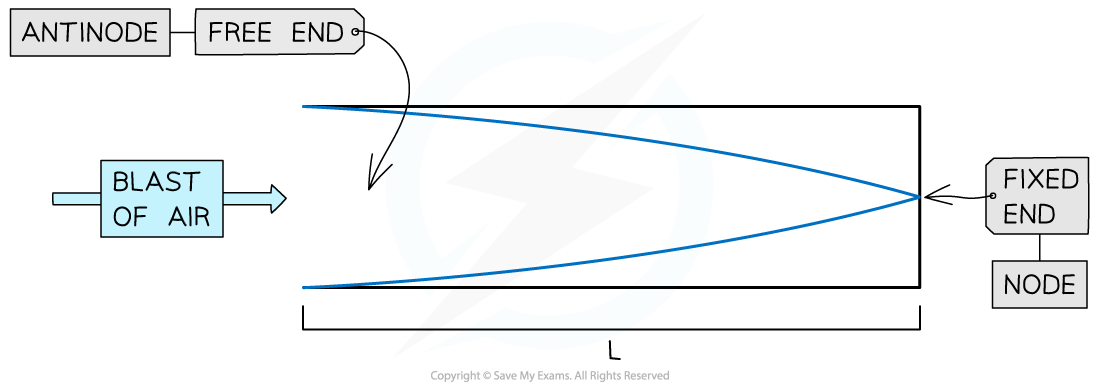
Standing wave inside a pipe open at both ends

Unlock more, it's free!
Join the 100,000+ Students that ❤️ Save My Exams
the (exam) results speak for themselves:

Was this revision note helpful?
Build on this topic
