Centripetal Acceleration (DP IB Physics: SL): Revision Note

Calculating Centripetal Acceleration
Centripetal acceleration is defined as:
The acceleration of an object towards the centre of a circle when an object is in motion (rotating) around a circle at a constant speed
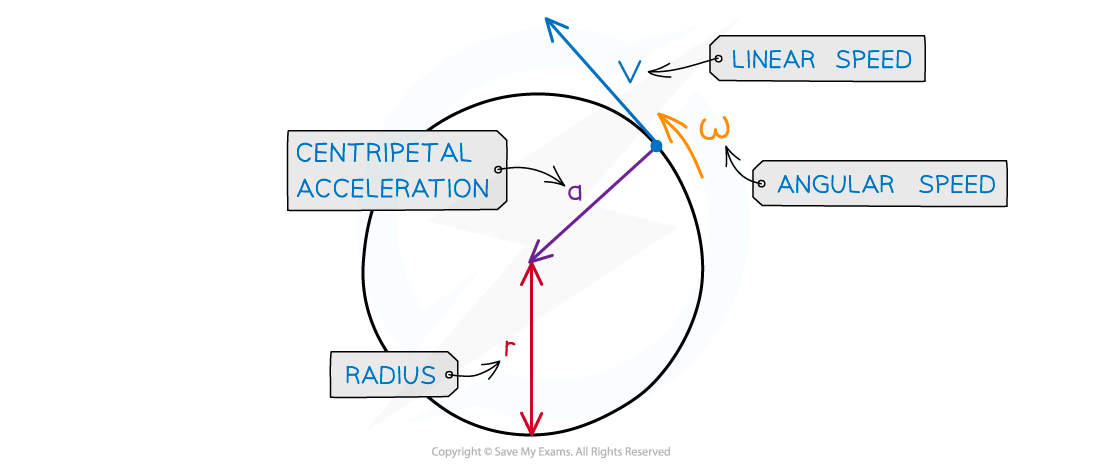
Centripetal acceleration is always directed toward the centre of the circle, and is perpendicular to the object’s velocity
It is directed towards the centre of the circle as it is in the same direction as the centripetal force
It can be defined using the radius r and linear speed v:
Where:
a = centripetal acceleration (m s–2)
v = linear speed (m s–1)
r = radius of the circular orbit (m)
Using the equation relating angular speed ω and linear speed v:
Where:
ω = angular speed (rad s–1)
These equations can be combined to give another form of the centripetal acceleration equation:
Alternatively, since we know angular velocity is:
Where:
f = frequency (Hz)
T = time period (s)
This means the centripetal acceleration can also be written as:
This equation shows how the centripetal acceleration relates to the linear speed and the angular speed
Worked Example
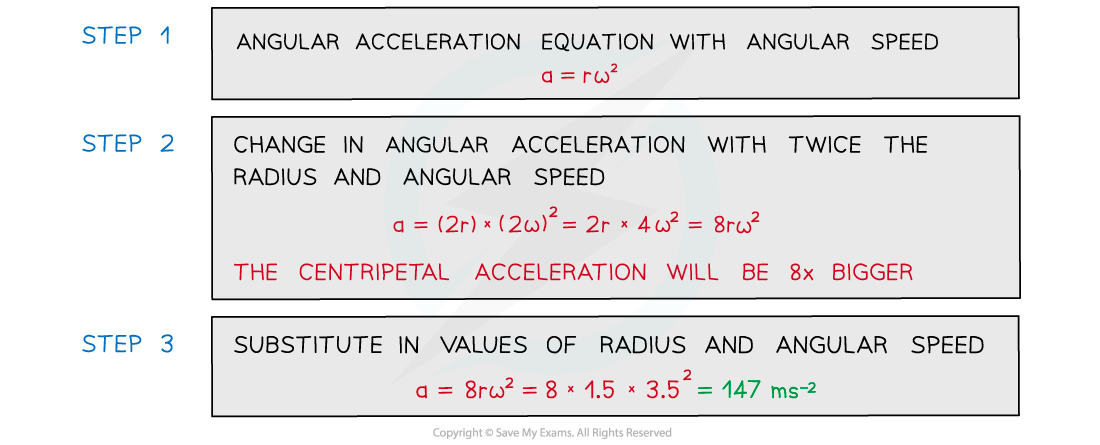
A ball tied to a string is rotating in a horizontal circle with a radius of 1.5 m and an angular speed of 3.5 rad s−1.
Calculate its centripetal acceleration if the radius were twice as large and the angular speed were twice as fast.
Answer:
Examiner Tips and Tricks
The equations for centripetal acceleration are given on your data sheet in multiple forms. Which form you use depends on what you're given in the question i.e. v or ω

Unlock more, it's free!
Join the 100,000+ Students that ❤️ Save My Exams
the (exam) results speak for themselves:

Was this revision note helpful?
Build on this topic