Stellar Parallax (DP IB Physics: SL): Revision Note

Astronomical Unit Conversions
Astronomical distances are very large and as a result, are usually measured using:
Astronomical Units (AU)
Light–years (ly)
Parsecs (pc)
Astronomical Unit (AU)
The astronomical unit (AU) is defined as
The mean distance from the centre of the Earth to the centre of the Sun
As the Earth’s orbit around the Sun is elliptical, it will be slightly closer to the Sun in January (1.471 × 10¹¹ m) than it is in July (1.521 × 10¹¹ m)
Calculating the mean of these two values gives:
= 1.496 × 10¹¹ m
Therefore, 1 astronomical unit = 1.496 × 10¹¹ m ≈ 1.5 × 10¹¹ m
The astronomical unit is useful for studying distances on the scale of the solar system

Light–year (ly)
A light-year is defined as:
The distance travelled by light in one year
This can be calculated using the equation:
distance = speed × time
Where:
the speed of light is 3 × 10⁸ m s–1
1 year = 60 × 60 × 24 × 365 = 3.15 × 10⁷ s
Hence, the distance travelled by light in one year = (3 × 108) × (3.15 × 107) = 9.46 × 10¹⁵ m
Therefore, 1 light–year ≈ 9.5 × 10¹⁵ m
Parsec (pc)
Angles smaller than 1 degree can be measured in arcminutes or arcseconds
1 degree = 60 arcminutes
1 arcminute = 60 arcseconds
Therefore, 1 degree = 60 x 60 = 3600 arcseconds
1 arcsecond = 1/3600 degree
The parsec is defined as:
A unit of distance that gives a parallax angle of 1 second of an arc (of a degree), using the radius of the Earth’s orbit (1 AU) as the baseline of a right–angled triangle
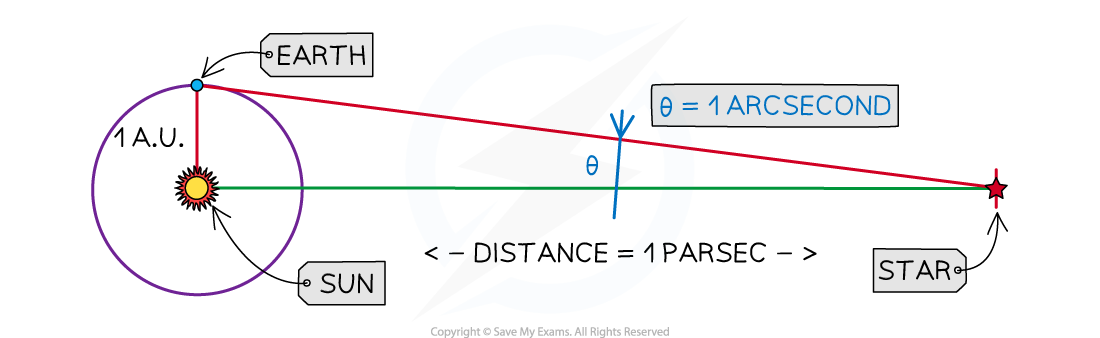
Given that 1 AU = 1.496 × 10¹¹ m, trigonometry can be used to express 1 parsec in metres:
= 3.09 × 10¹⁶ m
Therefore, 1 parsec ≈ 3.1 × 10¹⁶ m
The parsec (1 pc = 3.1 × 10¹⁶ m) and the light-year (1 ly = 9.5 × 10¹⁵ m) are much greater in size than the astronomical unit (1 AU = 1.496 × 10¹¹ m)
This makes them useful when studying interstellar distances
For example, on the scale of distances between the Earth and stars, or neighbouring galaxies
Worked Example
The closest star to Earth is a triple–star system called Alpha Centauri, which is approximately 4.35 light-years from Earth.
Calculate the distance between the Earth and Alpha Centauri in:
(a) astronomical units (AU)
(b) parsecs (pc)
One astronomical unit is equivalent to 1.496 × 10¹¹ m.
Answer:
(a)
Step 1: List the known quantities
1 light-year ≈ 9.5 × 10¹⁵ m (from data booklet)
1 AU = 1.496 × 10¹¹ m
Distance to Alpha Centauri = 4.35 ly
Step 2: Convert 4.35 light–years into metres
4.35 ly = 4.35 × (9.5 × 1015) = 4.13 × 10¹⁶ m
Step 3: Convert from metres into AU
4.13 × 10¹⁶ m = = 2.8 × 10⁵ AU (to 2 s.f)
(b)
Step 1: List the known quantities
1 parsec ≈ 3.1 × 10¹⁶ m (from data booklet)
4.35 ly = 4.13 × 10¹⁶ m (from part a)
Step 2: Convert from metres into parsecs
4.13 × 10¹⁶ m = = 1.3 pc (to 2 s.f)
Examiner Tips and Tricks
You do not need to learn all of the conversion factors for astronomical distances, you just need to know how to use them! The following are given in the data booklet:
1 light year (ly) = 9.46 × 10¹⁵ m
1 parsec (pc) = 3.26 ly
1 astonomical unit (AU) = 1.50 × 10¹¹ m
Parallax Calculations
The principle of parallax is based on how the position of an object appears to change depending on where it is observed from
For example, when an observer measures the volume of liquid in a measuring cylinder, they may read different values of volume depending on their view of the lowest point of the meniscus
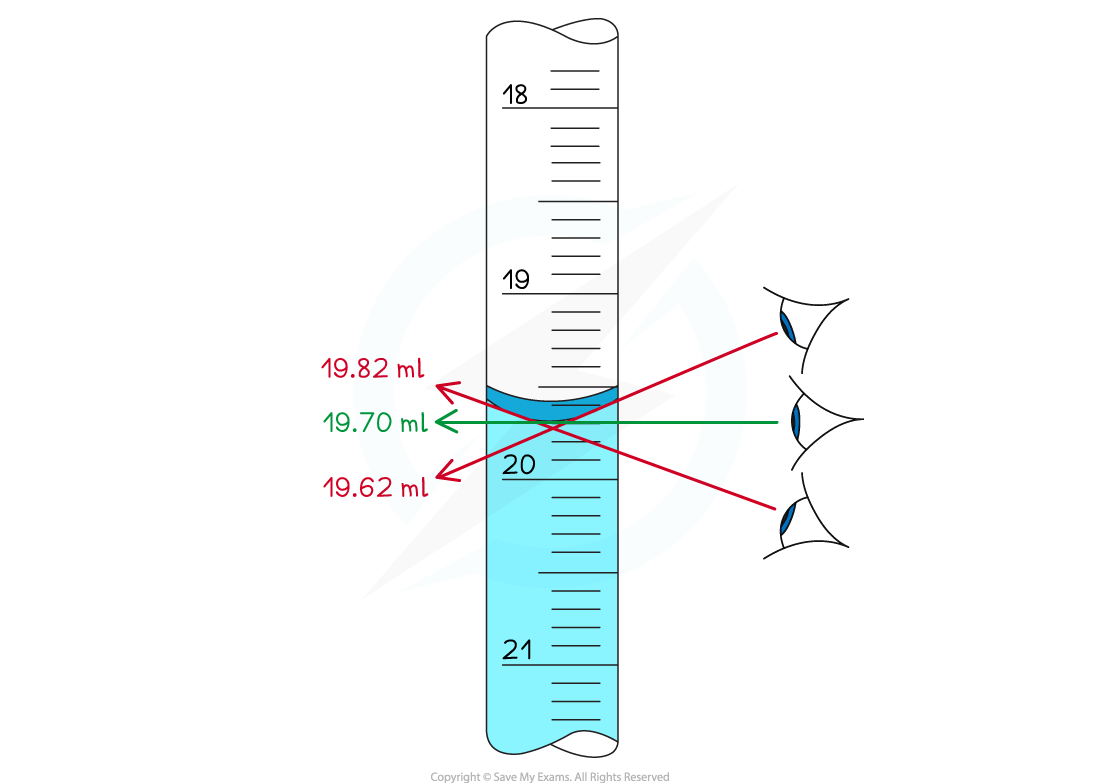
Parallax error describes the false readings that can be made by taking measurements from different angles
Stellar parallax can be used to measure the distance to nearby stars
Stellar parallax is defined as:
The apparent shifting in position of a nearby star against a background of distant stars when viewed from different positions of the Earth, during the Earth’s orbit about the Sun
It involves observing how the position of a nearby star changes over a period of time against a fixed background of distant stars
To an observer, the position of distant stars does not change with time
If a nearby star is viewed from the Earth at 6 months intervals (e.g. once in January and once again in July), the Earth will be at a different position in its orbit around the Sun
The nearby star will appear in a different position compared to the backdrop of distant stars
The distant stats will appear to not have moved
This apparent movement of the nearby star is called the stellar parallax
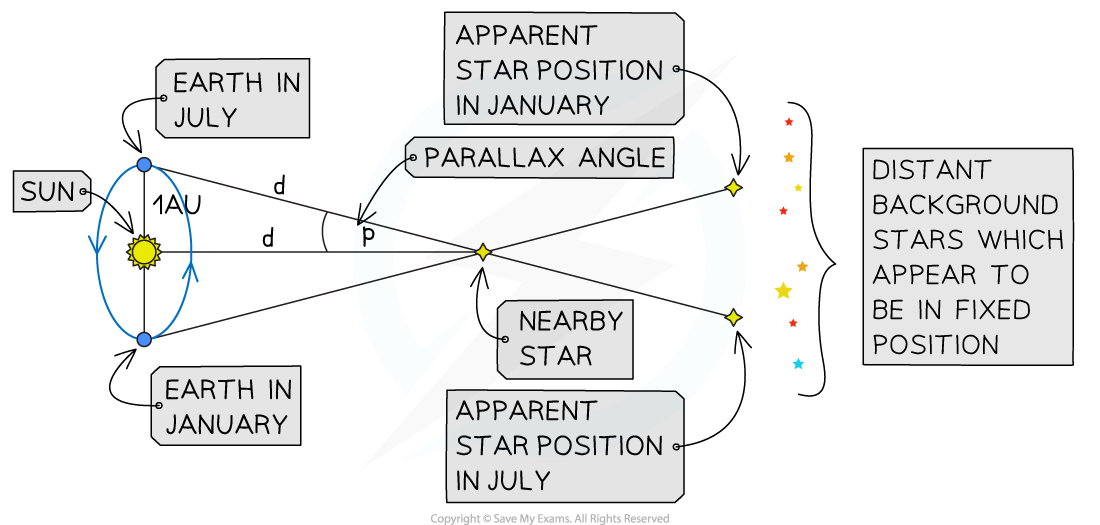
Applying trigonometry to the parallax equation:
Where:
1 AU = radius of the Earth's orbit around the sun
p = parallax angle from Earth to the nearby star
d = distance to the nearby star
For small angles, expressed in radians, , therefore:
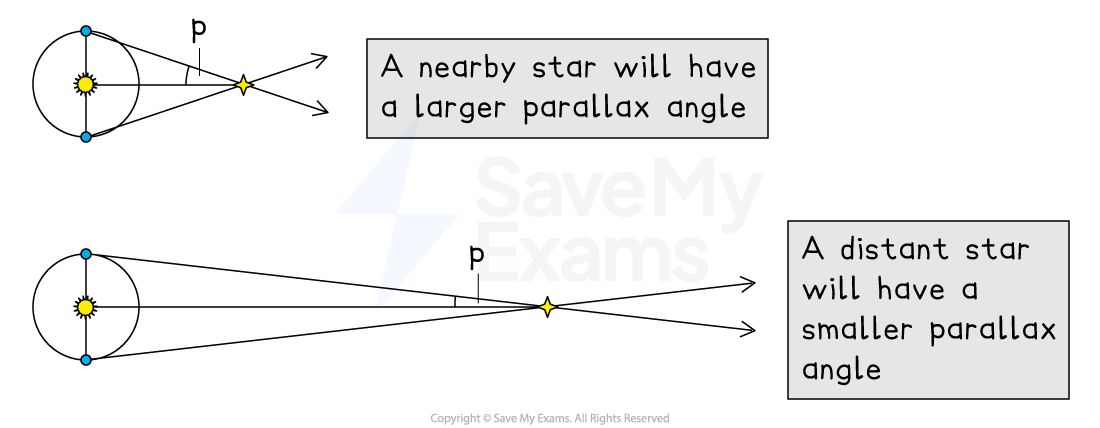
If the distance to the nearby star is to be measured in parsecs, then it can be shown that the relationship between the distance to a star from Earth and the angle of stellar parallax is given by
Where:
p = parallax (")
d = the distance to the nearby star (pc)
This equation is accurate for distances of up to 100 pc
For distances larger than 100 pc, the angles involved are so small that they are too difficult to measure accurately
Worked Example
The nearest star to Earth, Proxima Centauri, has a parallax of 0.768 seconds of arc.
Calculate the distance of Proxima Centauri from Earth
(a) in parsecs
(b) in light–years
Answer:
(a)
Step 1: List the known quantities
Parallax, p = 0.768"
Step 2: State the parallax equation
Step 3: Rearrange and calculate the distance d
(b)
Step 1: State the conversion between parsecs and metres
From the data booklet:
1 parsec ≈ 3.1 × 10¹⁶ m
Step 2: Convert 1.30 pc to m
1.30 pc = 1.30 × (3.1 × 1016) = 4.03 × 10¹⁶ m
Step 3: State the conversion between light–years and metres
From the data booklet
1 light–year ≈ 9.5 × 10¹⁵ m
Step 4: Convert 4.03 × 10¹⁶ m into light–years
= 4.2 ly (to 2 s.f)
Examiner Tips and Tricks
Make sure you know the units for arc seconds (") and arc minutes (')
1 arcminute is denoted by 1'
1 arcsecond is denoted by 1"

Unlock more, it's free!
Join the 100,000+ Students that ❤️ Save My Exams
the (exam) results speak for themselves:

Was this revision note helpful?
Build on this topic
