Pythagoras Theorem (Edexcel GCSE Maths: Higher): Revision Note
Exam code: 1MA1

Pythagoras theorem
Who is Pythagoras?
Pythagoras was a Greek mathematician who lived over 2500 years ago
He is most famous for Pythagoras’ theorem, which includes the important formula for right-angled triangles
What is Pythagoras' theorem?
Pythagoras' theorem is a formula that links the lengths of the three sides of a right-angled triangle
The longest side of a right-angled triangle is called the hypotenuse
The hypotenuse will always be the side opposite the right angle
Pythagoras' theorem states that
is the length of the hypotenuse
and are the lengths of the two shorter sides
It does not matter which is labelled and which is labelled

How do I use Pythagoras’ theorem to find the length of the hypotenuse?
To find the length of the hypotenuse
Square the lengths of the two shorter sides
Add these two numbers together
Take the positive square root
This can be written as
This is just a rearrangement of the formula to make the subject
Note that when finding the hypotenuse you add inside the square root
How do I use Pythagoras’ theorem to find the length of a shorter side?
To find the length of a shorter side
Square the lengths of the hypotenuse and the other shorter side
Subtract these numbers to find the difference
Take the positive square root
This can be written as
This is just a rearrangement of the formula to make the subject
Note that when finding one of the shorter sides you subtract inside the square root
Can I use Pythagoras’ theorem with other shapes?
You can use Pythagoras' theorem with any shape that can be split into right-angled triangles
You can find the length of the diagonal of a rectangle or square
Use its diagonal to split the shape into two identical right-angled triangles
The diagonal is now the hypotenuse of the right-angled triangles
Examiner Tips and Tricks
If the hypotenuse ends up being shorter than another side in your answer then you have made a mistake somewhere.
Make sure that you subtract the smaller value from the bigger value when finding the length of a shorter side.
Otherwise you will get a "Math Error" when trying to find the square root of a negative number
Examiner Tips and Tricks
In questions with multiple steps:
Leave your answer as an exact answer
Do not round until the very end of the question
Worked Example
In the following diagram:
is a straight line, with and
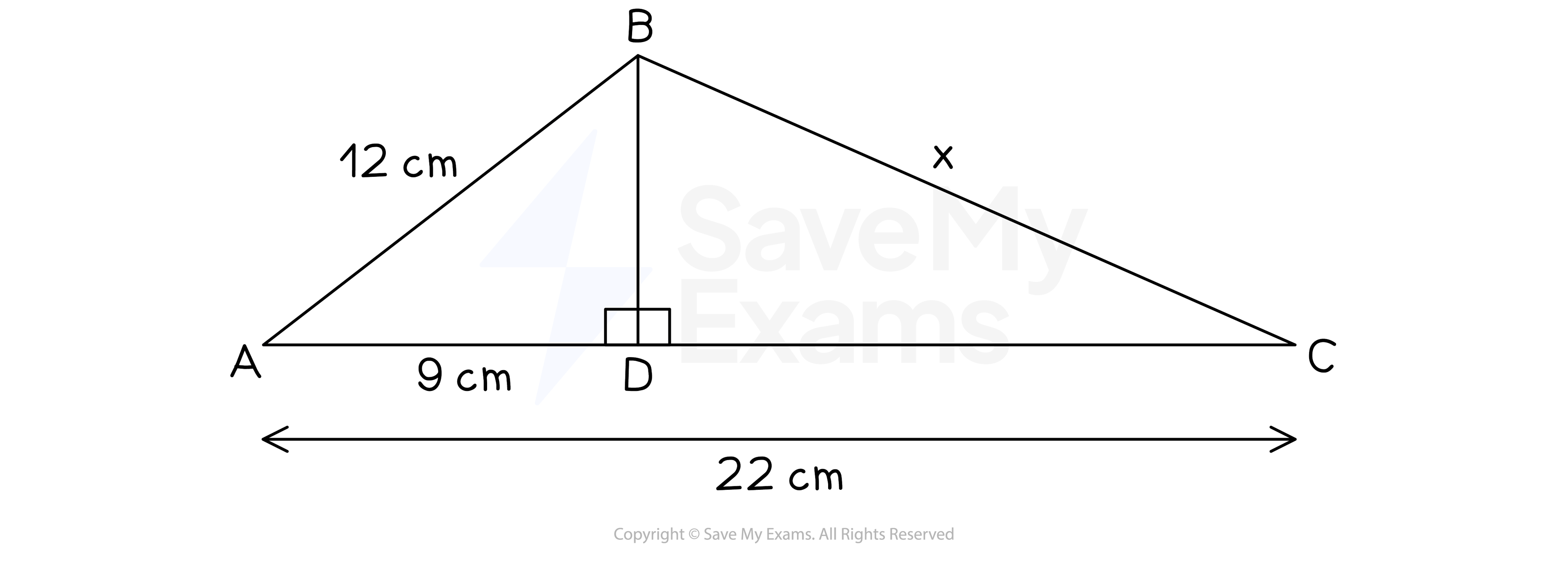
Find , the length of side Give your answer to 1 decimal place.
Answer:
To find , we first need to find the length of using triangle
Note that is a shorter side
Apply Pythagoras' theorem,
It is best to leave rounding until the very end, use (or if this is what your calculator has given you) in subsequent working
Find the length of by subtracting the length of from the length of
Now we can find using triangle
Note that is the hypotenuse
Apply Pythagoras' theorem,
Round to 1 decimal place

Unlock more, it's free!
Join the 100,000+ Students that ❤️ Save My Exams
the (exam) results speak for themselves:

Was this revision note helpful?
Build on this topic