Circular Motion (Edexcel GCSE Physics): Revision Note
Exam code: 1PH0

Circular Motion
Higher Tier Only
Velocity is a vector quantity, and the velocity of an object is its speed in a given direction
When an object travels along a circular path, its velocity is always changing
The speed of the object moving in a circle might be constant - that is, it is travelling the same distance every second
However, the direction of travel is always changing as the object moves along the circular path
This means that an object moving in circular motion travels at a constant speed but has a changing velocity
The image below shows an example of a famous object that moves in a circular path with a constant speed but changing direction:

The International Space Station’s velocity is always changing - it whizzes around the Earth at a constant speed of about 7660 m/s but is always changing direction
Examiner Tips and Tricks
You may be asked to explain why motion in a circle involves constant speed but changing velocity, so remember to mention that velocity is a vector quantity, so both magnitude and direction are important. Even though the magnitude (speed) doesn’t change, its direction does - so the velocity itself is changing.
Centripetal Force
Higher Tier Only
An object moving in a circle is not in equilibrium as it has a resultant force acting upon it
This is known as the centripetal force and is what keeps the object moving in a circle
The centripetal force (F) is defined as:
The resultant perpendicular force towards the centre of the circle required to keep a body in uniform circular motion
The centripetal force is shown by the arrow labelled F in the diagram below:

Centripetal force is always perpendicular to the direction of travel and is directed towards the centre of the circle
Note: centripetal force and centripetal acceleration act in the same direction
This is due to Newton’s Second Law
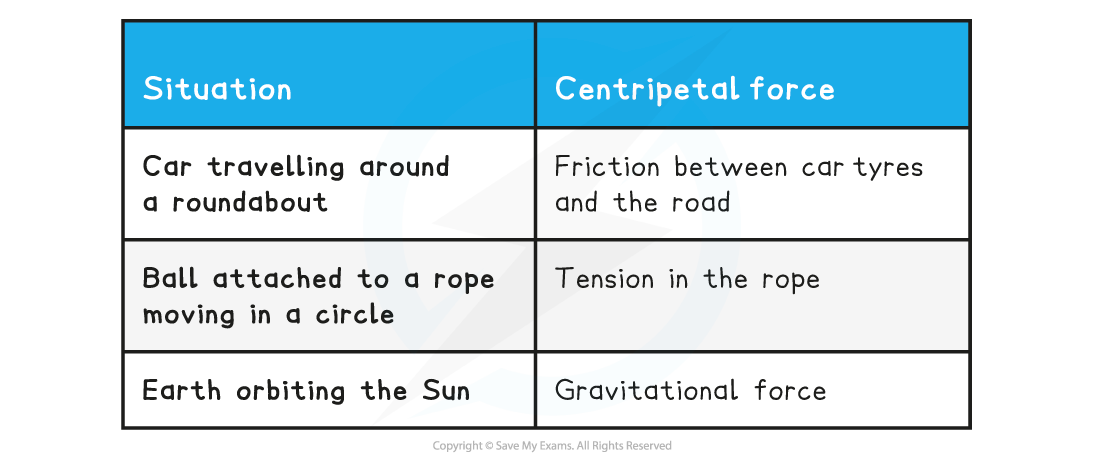
The centripetal force is not a separate force of its own
It can be any type of force, depending on the situation, which keeps an object moving in a circular path
Examples of Centripetal Force Table

Unlock more, it's free!
Join the 100,000+ Students that ❤️ Save My Exams
the (exam) results speak for themselves:

Was this revision note helpful?
Build on this topic