Kinetic Energy (Edexcel GCSE Physics): Revision Note

Exam code: 1PH0

Leander Oates

Written by: Leander Oates

Reviewed by: Caroline Carroll

Updated on

Kinetic Energy


  • Energy in an object's kinetic store is defined as:

    The amount of energy an object has as a result of its mass and speed

  • This means that any object in motion has energy in its kinetic energy store
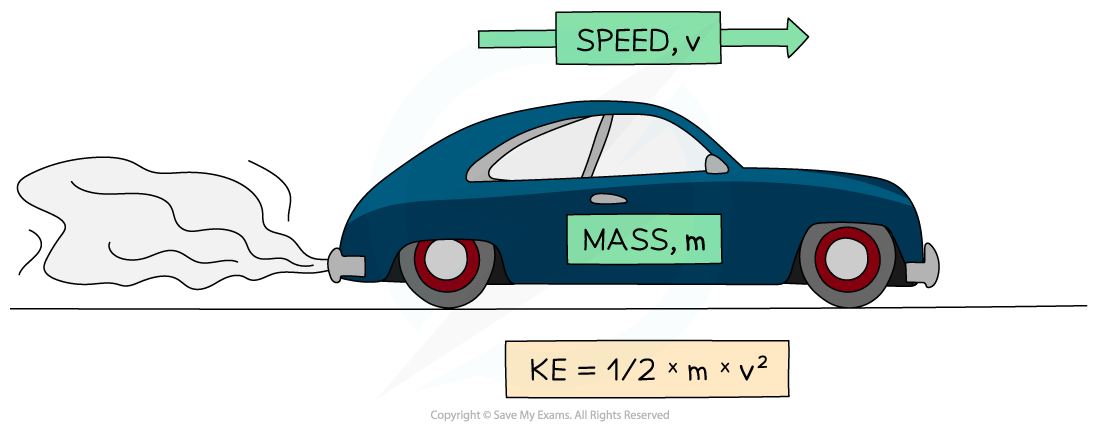
Kinetic Energy Car, downloadable AS & A Level Physics revision notes
  • Kinetic energy can be calculated using the equation:

KE = 12 × m × v2

  • Where:

    • KE = kinetic energy in joules (J)

    • m = mass of the object in kilograms (kg)

    • v = speed of the object in metres per second (m/s)

Worked Example

Calculate the kinetic energy stored in a vehicle of mass 1200 kg moving at a speed of 27 m/s.

Answer: 

Step 1: List the known quantities

  • Mass of the vehicle, m = 1200 kg

  • Speed of the vehicle, v = 27 m/s

Step 2: Write down the equation for kinetic energy

KE = 12 × m × v2

Step 3: Calculate the kinetic energy

KE = 12 × 1200 × (27)2

KE = 437 400 J

Step 4: Round the final answer to 2 significant figures

KE = 440 000 J

Examiner Tips and Tricks

When performing calculations using the kinetic energy equation, always double-check that you have squared the speed. Forgetting to do this is the most common mistake that students make.

Unlock more, it's free!

Join the 100,000+ Students that ❤️ Save My Exams

the (exam) results speak for themselves:

Build on this topic

Leander Oates

Author: Leander Oates

Expertise: Development Editor

Leander graduated with First-class honours in Science and Education from Sheffield Hallam University. She won the prestigious Lord Robert Winston Solomon Lipson Prize in recognition of her dedication to science and teaching excellence. After teaching and tutoring both science and maths students, Leander now brings this passion for helping young people reach their potential to her work at SME.

Caroline Carroll

Reviewer: Caroline Carroll

Expertise: Head of Content Delivery

Caroline graduated from the University of Nottingham with a degree in Chemistry and Molecular Physics. She spent several years working as an Industrial Chemist in the automotive industry before retraining to teach. Caroline has over 12 years of experience teaching GCSE and A-level chemistry and physics. She is passionate about delivering high-quality resources to help students achieve their full potential.
