Electric Potential for a Radial Field (Edexcel International A Level (IAL) Physics): Revision Note
Exam code: YPH11

Electric Potential for a Radial Field
Electric Potential Energy
In order to move a positive charge closer to another positive charge, work must be done to overcome the force of repulsion between them
Similarly, to move a positive charge away from a negative charge, work must be done to overcome the force of attraction between them
Energy is therefore transferred to the charge that is being pushed upon
This means its potential energy increases
If the positive charge is free to move, it will start to move away from the repelling charge
As a result, its potential energy decreases back to 0
This is analogous to the gravitational potential energy of a mass increasing as it is being lifted upwards and decreasing as it falls
The electric potential at a point is defined as:
The work done per unit charge in bringing a positive test charge from infinity to that point
Electric potential is a scalar quantity
This means it doesn’t have a direction
However, you will still see the electric potential with a positive or negative sign. This is because the electric potential is:
positive around an isolated positive charge
negative around an isolated negative charge
zero at infinity
Positive work is done to move a positive test charge from infinity to a point around a positive charge and negative work is done to move it to a point around a negative charge. This means:
When a positive test charge moves closer to a negative charge, its electric potential decreases
When a positive test charge moves closer to a positive charge, its electric potential increases
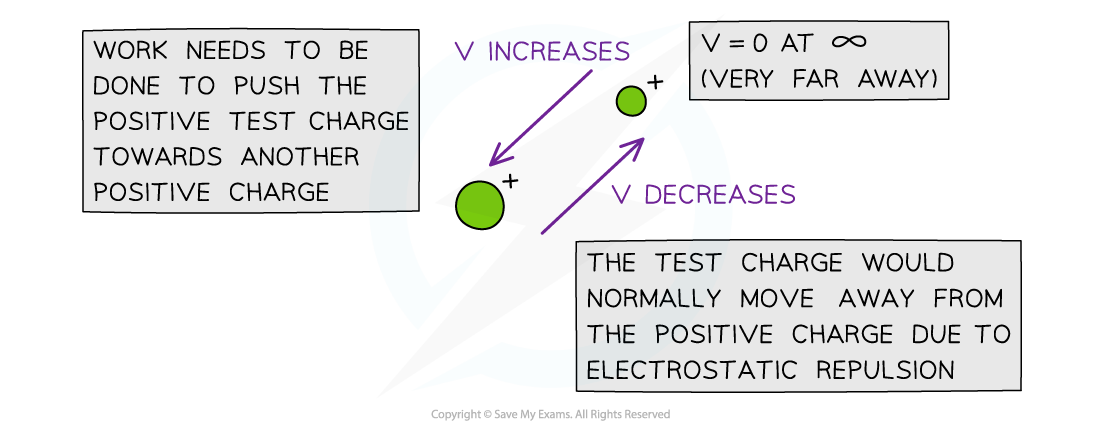
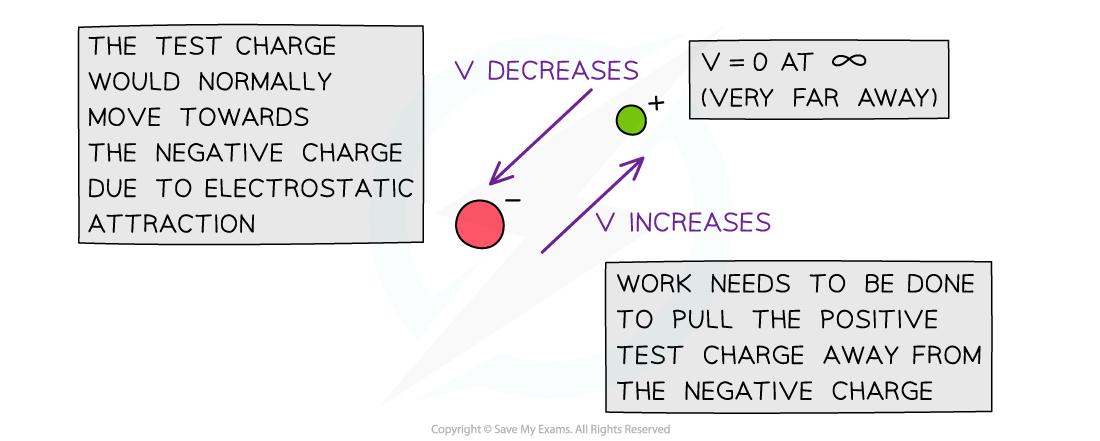
The electric potential V is positive at all points around a positive charge and negative at all points around a negative charge, and its magnitude increases closer to the charge
Electric Potential due to a Point Charge
The electric potential in the radial field due to a point charge is defined as:
Where:
V = the electric potential (V)
Q = the point charge producing the potential (C)
ε0 = permittivity of free space (F m-1)
r = distance from the centre of the point charge (m)
The sign of V depends on the charge Q producing the potential, not on any test charge placed in the field:
For a positive charge Q, the potential is positive and increases (becomes more positive) as the distance r decreases
For a negative charge Q, the potential is negative and decreases (becomes more negative) as the distance r decreases
Unlike the gravitational potential equation, the electric potential can be positive or negative, because Q can be positive or negative
The electric potential varies according to 1 / r
Note, this is different to electric field strength, which varies according to 1 / r2
Worked Example
The electric potential at a distance r from a proton is V.
What is the value of the electric potential at a distance three times farther?
Answer:
Step 1: Write the equation for electric potential
The electric potential is given by the equation:
Step 2: Write the transformed equation for a distance three times as large
The charge Q remains constant (due to the proton)
The potential V becomes V'
The distance r becomes 3r
Hence the transformed equation becomes:
Step 3: Write a conclusion
Therefore, when the distance from a charge Q gets three times larger, the value of the electric potential decreases by a factor of 1/3, because the potential is inversely proportional to distance r
Examiner Tips and Tricks
Remember these variations, and make sure you can describe them in words:
Electric potential V is inversely proportional to radial distance,
Electric field strength E is inversely proportional to radial distance squared,
One way to remember whether the electric potential increases or decreases with respect to the distance from the charge is by the direction of the electric field lines. The potential always decreases in the same direction as the field lines and vice versa.

Unlock more, it's free!
Join the 100,000+ Students that ❤️ Save My Exams
the (exam) results speak for themselves:

Was this revision note helpful?
Build on this topic