Equation of a Quadratic Graph (SQA National 5 Maths): Revision Note
Exam code: X847 75

Determining the equation of a quadratic from its graph
How do I determine the equation of a quadratic in the form y = kx2 from its graph?
The graph of a quadratic with equation will always have its turning point at the origin (0, 0)
will be its axis of symmetry
If is positive it will be an 'up' or -shaped parabola
If is negative it will be a 'down' or -shaped parabola
If you are given a quadratic graph with its turning point at the origin and need to find its equation
The equation will be of the form
You just need to find the value of k by using the coordinates of another point on the graph
For example, if a quadratic graph has its turning point at the origin and goes through the point
Substitute and into
And solve to find the value of
The equation is
How do I determine the equation of a quadratic in the form y = k(x+a)2+b from its graph?
The graph of a quadratic with its equation in completed square form will have its turning point at (-a, b)
will be its axis of symmetry
If is positive it will be an 'up' or -shaped parabola
If is negative it will be a 'down' or -shaped parabola
If you are given a quadratic graph with its turning point not at the origin and need to find its equation
The equation will be of the form
You can get the values of and from the coordinates of the turning point (-a, b)
Remember to switch the sign of the -coordinate to get a
You can find the value of k by using the coordinates of another point on the graph
If that other point is the -intercept remember that that point has an -coordinate of 0
For example, if a quadratic graph has its turning point at and goes through the point
From the turning point, and
From the point , substitute and into
And solve to find the value of
The equation is
If you have found the values of and in , and need to find the coordinates of the -intercept
Remember that the -intercept has coordinates for some value of
Substitute into the equation and solve to find the value of
For example, for
The -intercept is at
Examiner Tips and Tricks
Be careful with the two different forms of a quadratic, and .
has its -intercept at
But does not have its -intercept at
Worked Example
The graph below shows part of a parabola of the form .
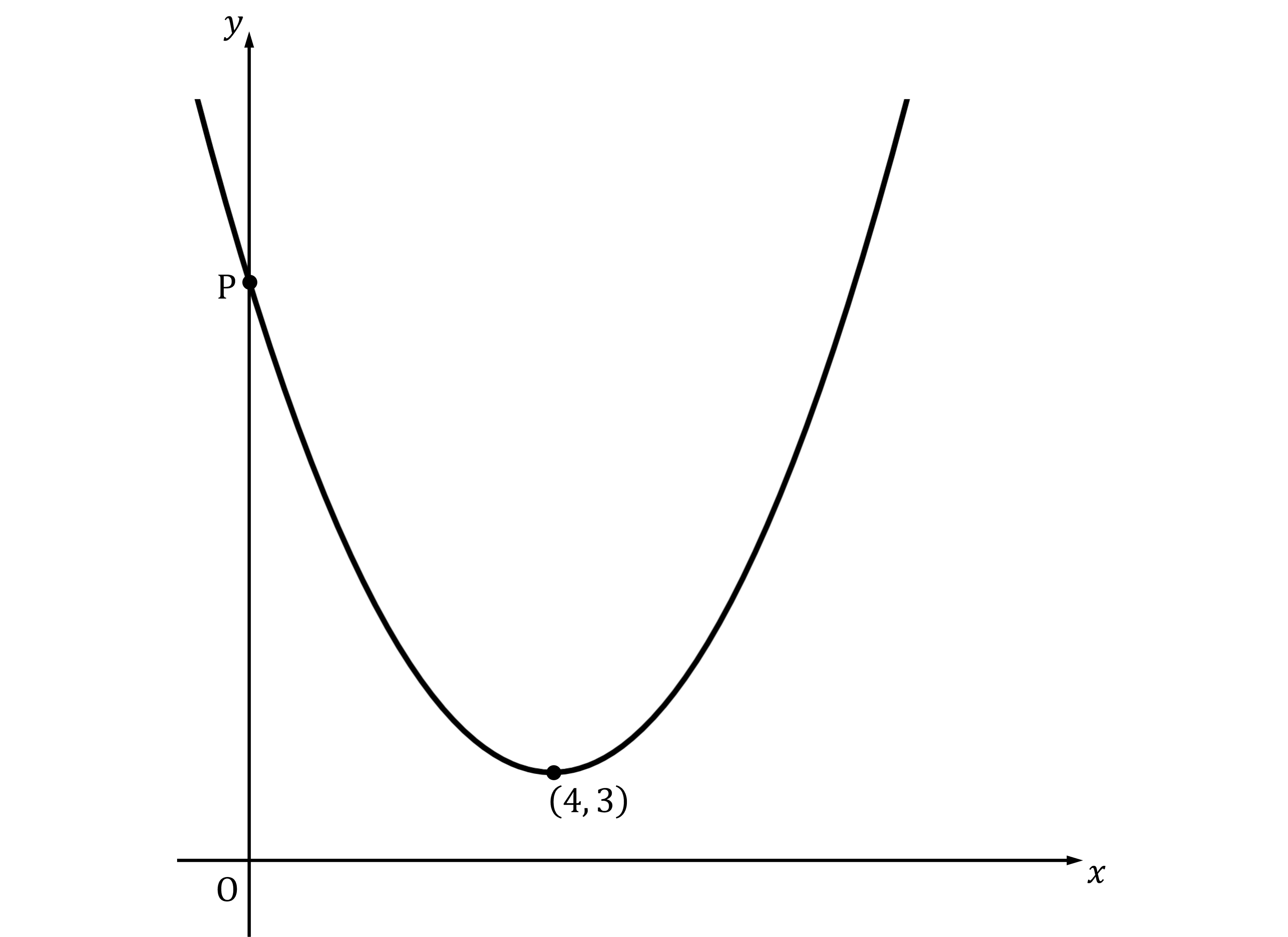
(a) Write down the equation of the axis of symmetry of the graph.
(b) State the values of and .
(c) is the point . Find the value of .
Answer:
Part (a)
The axis of symmetry of a quadratic always goes through its turning point
Part (b)
A quadratic with equation in the form will have its turning point at
Part (c)
The equation of the parabola is
The curve goes through the point , so when
Substitute those values into the equation and solve for

Unlock more, it's free!
Join the 100,000+ Students that ❤️ Save My Exams
the (exam) results speak for themselves:

Was this revision note helpful?
Build on this topic