Combinations of Transformations (SQA National 5 Maths): Revision Note
Exam code: X847 75

Combinations of transformations
Exam questions will usually include multiple transformations of a trigonometric graph
So you need to know how to combine the various single transformations
Examiner Tips and Tricks
When combining transformations, vertical transformations (change of amplitude, vertical translation) and horizontal transformations (multiple angle, phase angle) are independent of each other
If you combine a vertical transformation with a horizontal transformation, it doesn't matter what order you make the changes to the graph
However transformations of the same sort (vertical or horizontal) do affect each other
So if you combine two vertical transformations, for example, you have to make the changes to the graph in the correct order to get the correct result
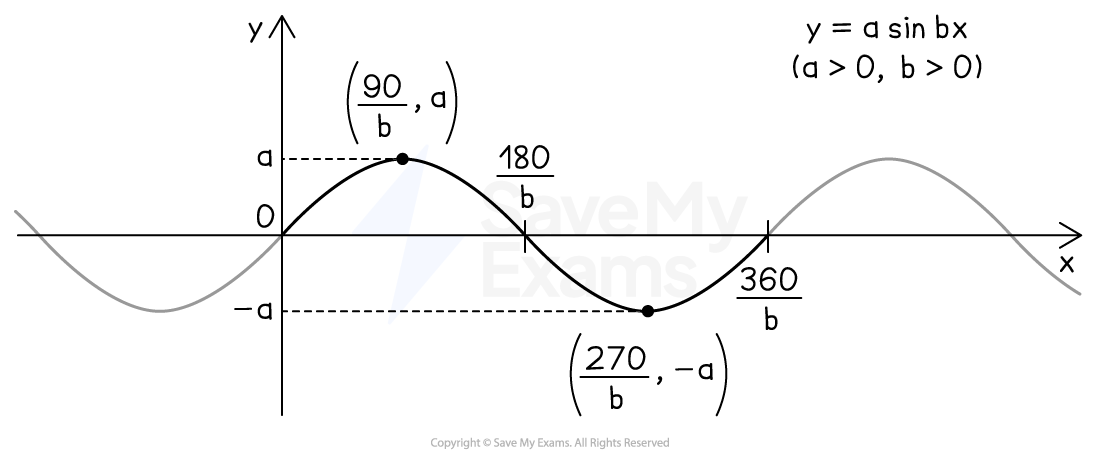
asinbx and acosbx
Transformations of this form combine a change of amplitude (vertical stretch) and a multiple angle (horizontal stretch)
The amplitude and the y-coordinates of minimum and maximum turning points are the same as for and
The period and the x-coordinates of roots and minimum and maximum turning points are the same as for and
For example, the graph of looks like this:
asin(x+d) and acos(x+d)
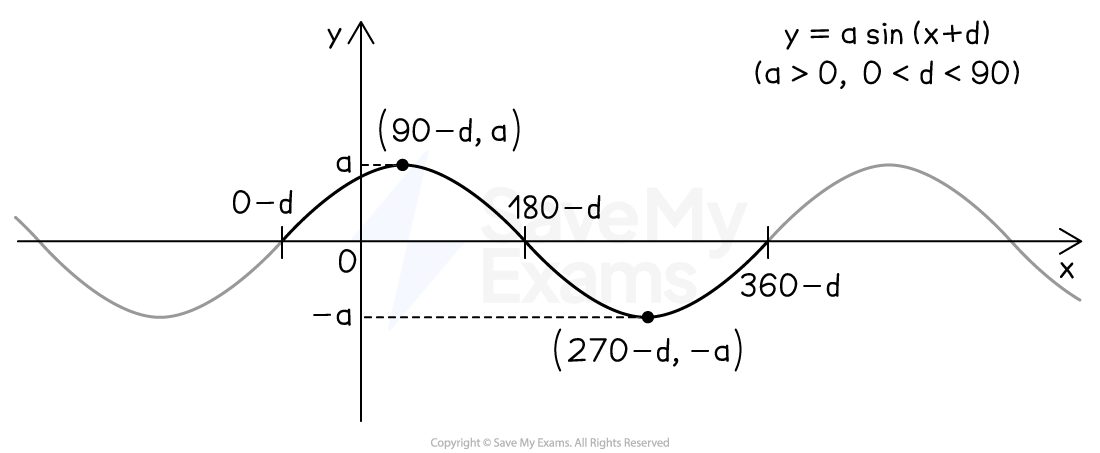
Transformations of this form combine a change of amplitude (vertical stretch) and a phase angle (horizontal translation)
The period is 360°
The amplitude and the y-coordinates of minimum and maximum turning points are the same as for and
The x-coordinates of roots and minimum and maximum turning points are the same as for and
For example, when is positive the graph of looks like this
In this case,
Remember, positive causes a shift to the left (while negative would cause a shift to the right)
sin(x+d)+c and sin(x+d)+c
Transformations of this form combine a vertical translation and a phase angle (horizontal translation)
The period is 360°
The amplitude is 1
The y-coordinates of minimum and maximum turning points and of the 'middle line' are the same as for and
The x-coordinates of roots and minimum and maximum turning points are the same as for and
sin(bx)+c and cos(bx)+c
Transformations of this form combine a vertical translation and a multiple angle (horizontal stretch)
The amplitude is 1
The y-coordinates of minimum and maximum turning points and of the 'middle line' are the same as for and
The period and the x-coordinates of roots and minimum and maximum turning points are the same as for and
asinx+c and acosx+c
Transformations of this form combine a change of amplitude (vertical stretch) and a vertical translation
Both transformations are vertical
The change of amplitude happens before the vertical translation
For example, for
There is a stretch by a factor of 2, then a translation 4 units down
The amplitude is 2 (vertical translation doesn't affect amplitude)
The period is 360° (vertical changes don't affect the period)
To find coordinates of important points, multiply the y-coordinate by 2, then add 4 (the x-coordinates don't change)
The graph 'starts' at
The first maximum turning point occurs at
sin(bx+d) and cos(bx+d)
Transformations of this form combine a multiple angle (horizontal stretch) and a phase angle (horizontal translation)
Both transformations are horizontal
The horizontal translation (phase angle) happens before the horizontal stretch (multiple angle)
For example, for
There is a translation 30° left, then a stretch by a factor of
The amplitude is 1 (horizontal changes don't affect amplitude)
The period is =180° (horizontal translation doesn't affect period)
To find coordinates of important points, subtract 30 from the x-coordinate by 2, then divide by 2 (the y-coordinates don't change)
The graph 'starts' at
The first minimum turning point occurs at
Examiner Tips and Tricks
It is possible to combine more than two transformations, although as of 2025 there are no examples of this occurring on an exam.
If you need to combine more than two transformations, follow the procedures above remembering that
for two vertical transformations, change of amplitude happens before vertical translation
for two horizontal transformations, horizontal translation (phase angle) happens before horizontal stretch (multiple angle)
Finding equations or coordinates of transformed graphs
How do I find equations or coordinates of points from transformed trigonometric graphs?
On the exam, questions on this topic are usually of one of two forms
You are given a graph with definite coordinates, and asked to find the corresponding equation in a certain form
You are given the trigonometric equation and asked to find the coordinates for a particular point on the corresponding graph
Finding equations
To find an equation, the key is to
compare features of the graph (for example the period, the amplitude, or the coordinates of a turning point)
with what those features should be in terms of the variables in the equation
For example, if you know the equation is in the form , and you can see that the graph has a maximum turning point at (0, 7) and completes two cycles between 0 and 360°
The graph of has been vertically stretched by a factor of and horizontally stretched by a factor of to get the graph of
The amplitude of is , and it should therefore have a maximum point at
So
The period of is and the period of the graph is 180° (2 cycles in 360°)
So
The equation is
Finding coordinates
To find coordinates
determine what the coordinates of the point on the graph should be
based on the numbers used in the equation
For example, if you know that the equation is , and you are asked to find the coordinates of the first maximum point
The graph of has been vertically stretched by a factor of 3 and horizontally translated 60° to the right to get the graph of
So instead of being at (90°, 1), the first maximum point should be at
Worked Example
Part of the graph of is shown.
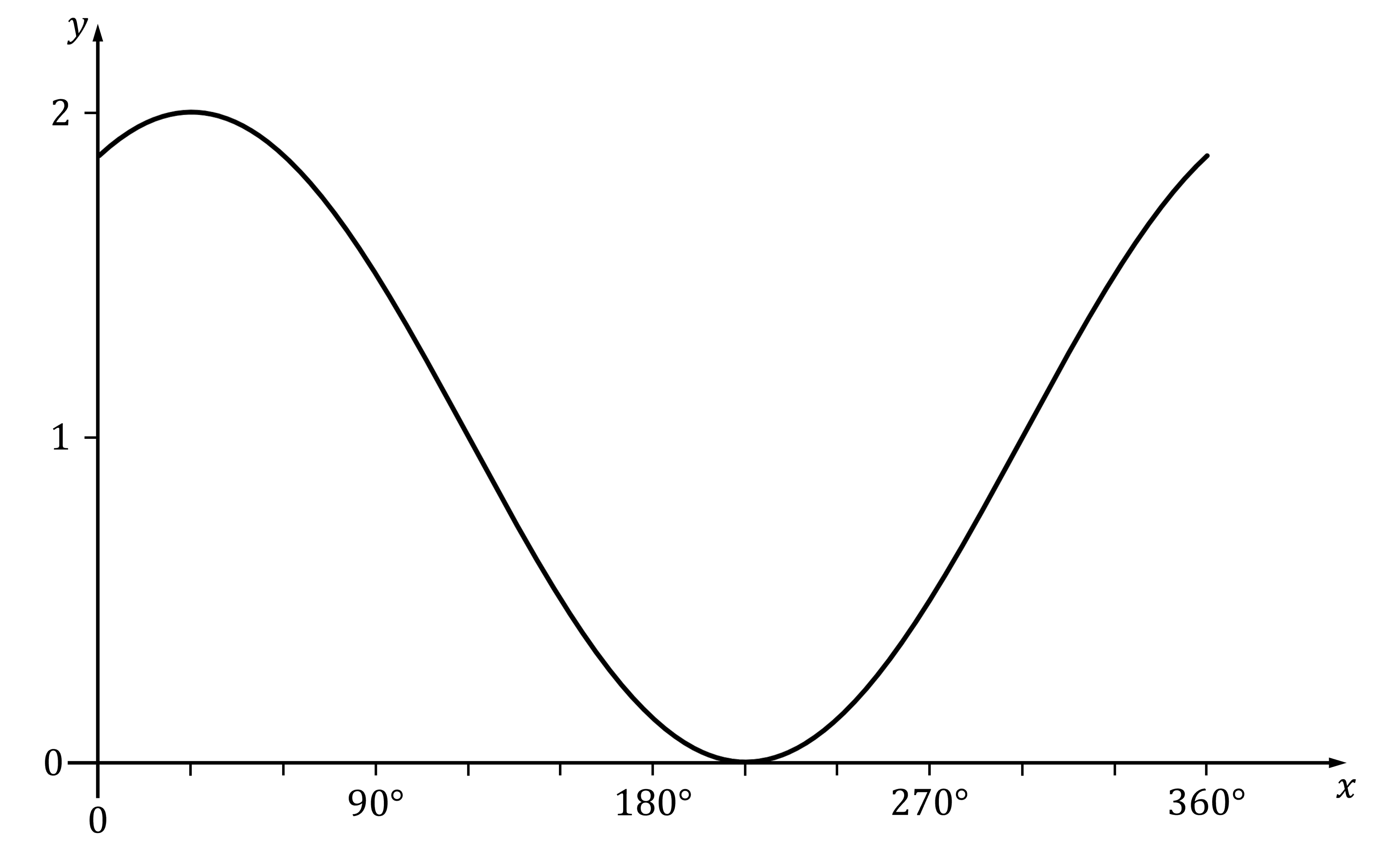
(a) State the value of .
(b) State the value of .
Answer:
The key here is to note the coordinates of the minimum turning point at
Compared to , the graph of involves
a horizontal translation by |a|° (to the left if a is positive, and to the right if a is negative)
a vertical translation by |b| units (up if b is positive, and down if b is negative)
The graph of has its first minimum point at ; compared to that the minimum point on has
moved 60° to the left (so a is positive)
moved 1 unit up (so b is also positive)
Part (a)
a = 60
(Adding or subtracting 360, or a multiple of 360, also gives a valid answer for a. So a = -300, for example, would also earn the mark here)
Part (b)
b = 1

Unlock more, it's free!
Join the 100,000+ Students that ❤️ Save My Exams
the (exam) results speak for themselves:

Was this revision note helpful?
Build on this topic
