Sine Rule (SQA National 5 Maths): Revision Note
Exam code: X847 75

Using sine rule to find a length
What is the sine rule?
The sine rule is used in non right-angled triangles
It allows you to find missing side lengths or angles
It states that for any triangle with angles A, B and C
Where
is the side opposite angle A
is the side opposite angle B
is the side opposite angle C
Examiner Tips and Tricks
The Sine Rule formula is given to you on the Formulae List in the exam paper.
How do I use the sine rule to find missing lengths?
Use the sine rule
when you have opposite pairs of sides and angles in the question
a and A, or b and B, or c and C
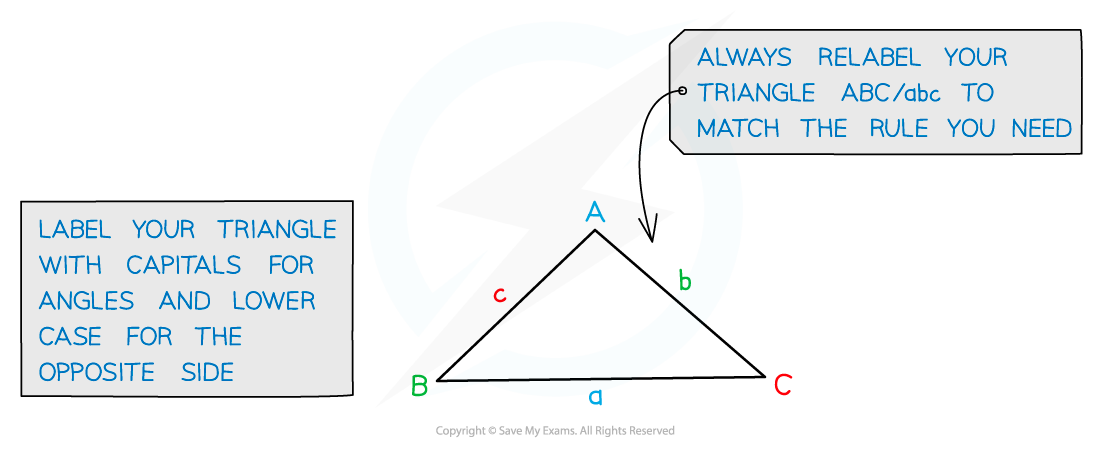
Start by labelling your triangle with the angles and sides
Angles have upper case letters
Sides opposite the angles have the equivalent lower case letter
To find a missing length, substitute numbers into the formula
You only need to have two parts equal to each other (not all three)
Then solve to find the side you need
Using sine rule to find an angle
How do I use the sine rule to find missing angles?
To find a missing angle, it is easier to rearrange the formula first by flipping each part
The angles are now in the numerators of the fractions
Substitute the values you have into the formula and solve
You will need to use inverse sine in your calculator,
Worked Example
The diagram shows triangle ABC.
Angle ACB = 25°
Angle BAC = °
AB = 8.1 cm
BC = 12.3 cm
AC = cm
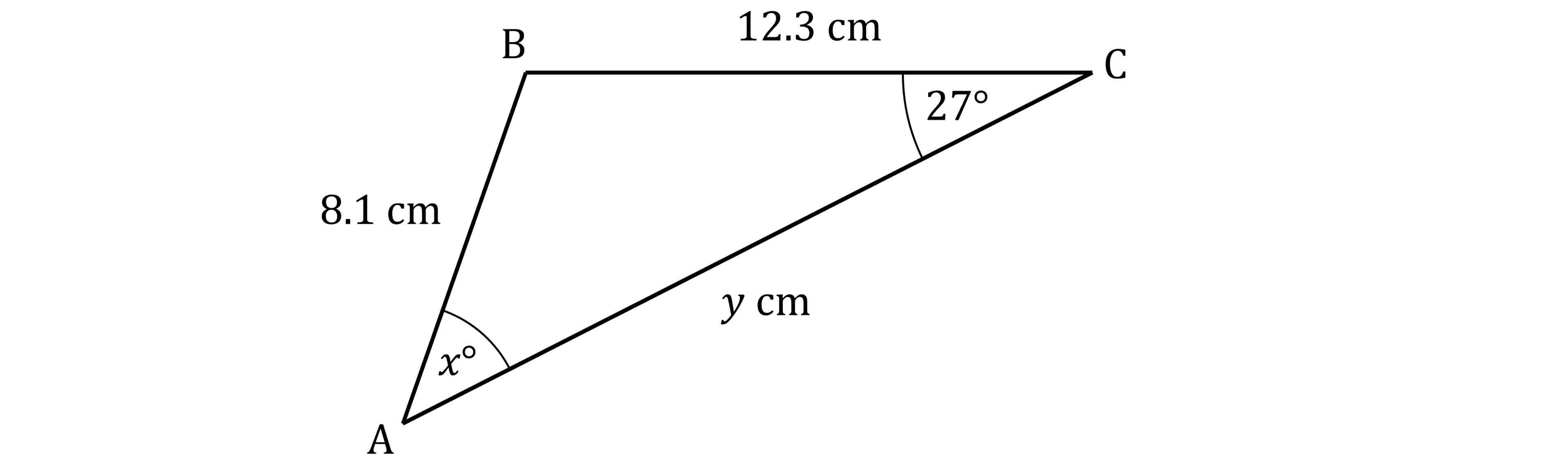
a) Calculate the value of .
b) Calculate the value of .
Answer:
Part (a)
Label the sides of the triangle
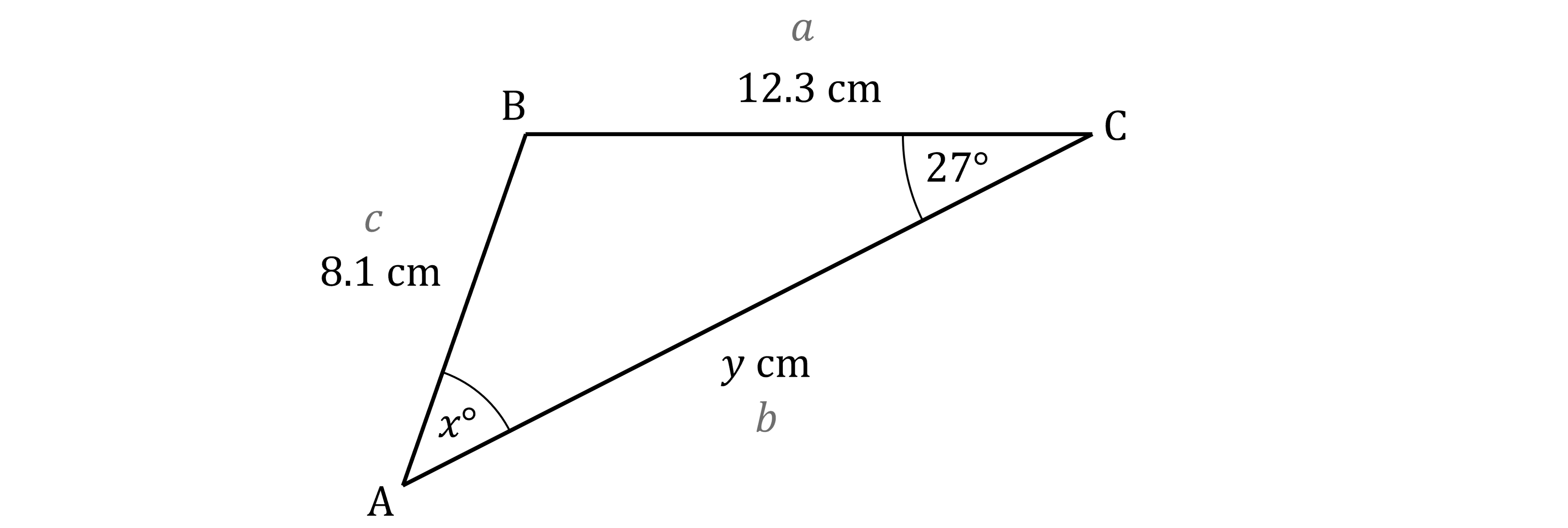
x is an angle so use the sine rule with the angles on top
In questions, you only need to equate two of these three parts
Round to a sensible degree of accuracy
Unless a question tells you otherwise, 1 decimal place is usually a good choice for angles
Part (b)
To find y you need to know the angle opposite (angle ABC)
You know 27 and x from above, so subtract these from 180
y is a length so use the sin rule with the sides on the top
(You could also use the Cosine Rule to find y, but the Sine Rule is a much simpler formula!)
Round to a sensible degree of accuracy
Unless a question tells you otherwise, 3 significant figures is usually a good choice
What is the ambiguous case of the sine rule?
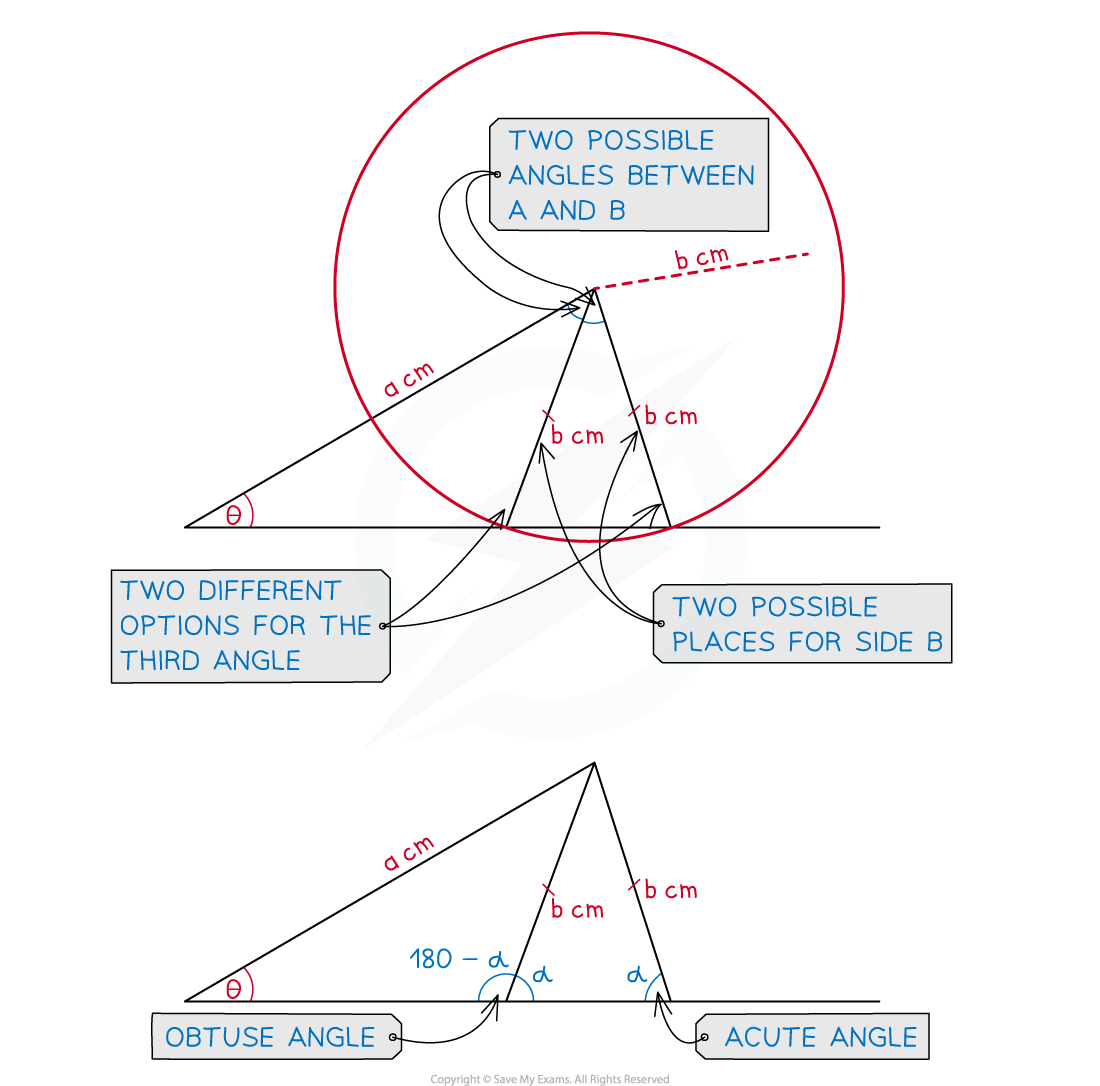
Given information about a triangle, there may be two different ways to draw it
In the diagram below, the lengths of two sides are given, a and b
A base angle is also given, , but no angle near b is given
It turns out that there are two possible ways to arrange b to complete the triangle!
Both triangles have the correct values of a, b and
The other base angle could either be obtuse or acute
After using the sine rule, using sin-1 on your calculator only gives the acute angle
You need to check the diagram or the other information given in the question to see if the angle you need is actually obtuse
If it is, use this rule: obtuse angle = 180 - acute angle
Examiner Tips and Tricks
A case of the ambiguous sine rule is unlikely to appear on your exam.
However knowing that the sine of an acute angle is equal to the sine of 180° minus that acute angle is an important skill for solving trigonometric equations.

Unlock more, it's free!
Join the 100,000+ Students that ❤️ Save My Exams
the (exam) results speak for themselves:

Was this revision note helpful?
Build on this topic
