Trigonometric Equations (SQA National 5 Maths): Revision Note
Exam code: X847 75

Solving trigonometric equations
What are trigonometric equations?
Trigonometric equations are equations involving , and
They often have multiple solutions
A calculator gives the first solution
You need to use periods and related angles to find the others
The solutions you find must lie in the interval (range) of given in the question, e.g.
How do I solve sin x = ...?
Find the first solution of the equation by taking the inverse sin function on your calculator (or using an exact trig value if you know them)
E.g. For the first solution of the equation for
This gives
Use the symmetry of the sine function and related angles to find other solutions
If is a solution, then by symmetry is another solution
If necessary you can also use the period of to find additional solutions
Adding or subtracting 360° to a solution gives another solution
You can use a calculator to check the solutions
E.g. For the equation for
Substitute and in to the calculator
and both give a value of , so are correct
Examiner Tips and Tricks
In general, if is an acute solution to (i.e. if )
then is an obtuse solution to the same equation.
How do I solve cos x = ...?
Find the first solution of the equation by taking the inverse cos function (or using an exact trig value if you know them)
E.g. For the first solution of the equation for
This gives
Use the symmetry of the cosine function and related angles to find other solutions
If is a solution, then by symmetry is another solution
If necessary you can also use the period of to find additional solutions
Adding or subtracting 360° to a solution gives another solution
You can use a calculator to check the solutions
E.g. For the equation for
Substitute and in to the calculator
and both give a value of so are correct
Examiner Tips and Tricks
In general, if is a solution to
then is another solution to the same equation
How do I solve tan x = ...?
Find the first solution of the equation by taking the inverse tan function (or using an exact trig value if you know them)
E.g. For the first solution of the equation for
This gives
Use the period of the tan function to find other solutions
Adding or subtracting 180° to a solution gives another solution
If is a solution, then by symmetry is another solution
You can use a calculator to check the solutions
E.g. For the equation for
Substitute and in to the calculator
and both give a value of so are correct
Examiner Tips and Tricks
In general, if is a solution to
Then is another solution to the same equation
How do I rearrange trig equations?
Trig equations may be given in a different form
Equations may require rearranging first
E.g. can be rearranged to
They can then be solved as usual
What do I do if the first solution from my calculator is negative?
Sometimes the first solution given by the calculator for will be negative
E.g
In that case, use the period to find a positive solution
The period of is 360°
So is another solution
Once you have a positive solution, you can use related angles to find any other positive solutions in the interval
Examiner Tips and Tricks
Know how to use the inverse functions on your calculator (sin-1, cos-1 and tan-1).
Remember you can check your solutions by substituting them back into the original equation.
Worked Example
Solve the equation , for .
Answer:
Start by rearranging the equation into form
Use sin-1 in your calculator to find the first solution
Use the symmetry of the sine curve and related angles to find any other solutions
Sketch the graph of
Mark on (roughly) where and would be
Draw a vertical line up to the curve
Draw another line horizontally across to the next point on the curve
Bring a line vertically back down to the x-axis
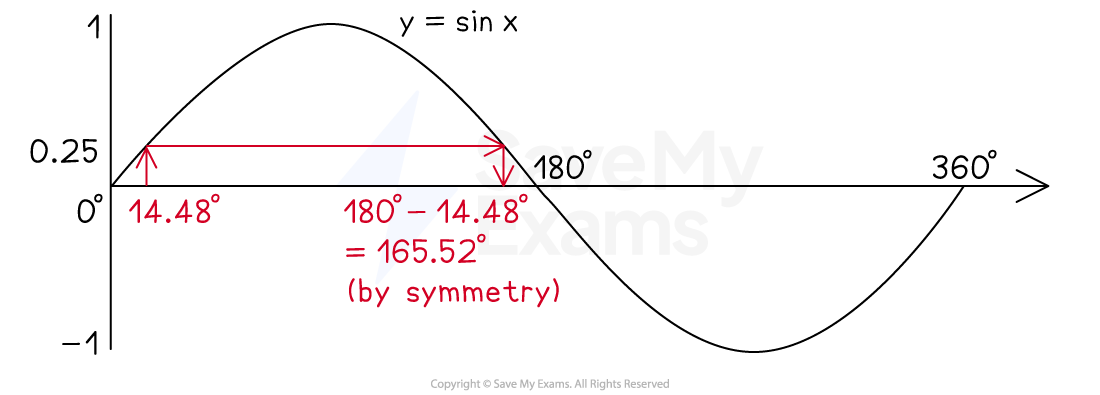
Find this value using by subtracting your first solution 180
Round to a sensible degree of accuracy
Unless a question tells you otherwise, 1 decimal place is usually a good choice for angles

Unlock more, it's free!
Join the 100,000+ Students that ❤️ Save My Exams
the (exam) results speak for themselves:

Was this revision note helpful?
Build on this topic
