Component Vectors in 2D and 3D (SQA National 5 Maths): Revision Note
Exam code: X847 75

Vectors in 2 dimensions
What are vectors?
A vector is a type of number that has both a size and a direction
There are several different notations for vectors
Vectors may be indicated by bold lower-case letters
, etc.
In an exam you can underline the letter to show it is a vector
a, b, r, s, etc.
Vectors can be indicated by two upper-case letters with an arrow on top
is the vector that starts at point and ends at point
is the vector that starts at point and ends at point
and are not equal
They have the same size
But different directions (one points from to , and the other points from to
Vectors can also be written in component form
This indicates precise distances and directions in two dimensions or three dimensions
How do I write a two-dimensional vector in component form?
A vector in component form can be used to describe how to get from one point to another point
The two-dimensional vector means
6 units to the right (i.e. in the positive x direction)
and 3 units up (i.e. in the positive y direction)

How do I find the component form of a vector between two points?
To find a vector between two points in component form:
E.g. vector , for points and
Subtract the coordinates for the first point () from the coordinates for the second point ()
You can check that this makes sense
Going 5 to the right and 7 up from does indeed get you to
If you reverse the order of the points, the components of the vector change sign
E.g. vector , for points and
Vectors and coordinates in 3 dimensions
What are 3D coordinates?
Vectors in component form can also be used in three dimensions
Normally the three dimensions are labelled x, y, and z
The z-axis is perpendicular to the x- and y-axes
If you draw standard two-dimensional x- and y-axes on a sheet of paper
then the z-axis will go through the origin, perpendicular to the sheet of paper
The positive z direction will be up out of the sheet of paper
The coordinate point (x, y, z) indicates
the distance from the origin along the x-axis
the distance from the origin along the y-axis
and the distance from the origin along the z-axis
How do I write a three-dimensional vector in component form?
In three dimensions, a vector in component form has a third number to indicate distances in the z direction
The three-dimensional vector means
2 units in the positive x direction
3 units in the negative y direction
and 4 units in the positive z direction
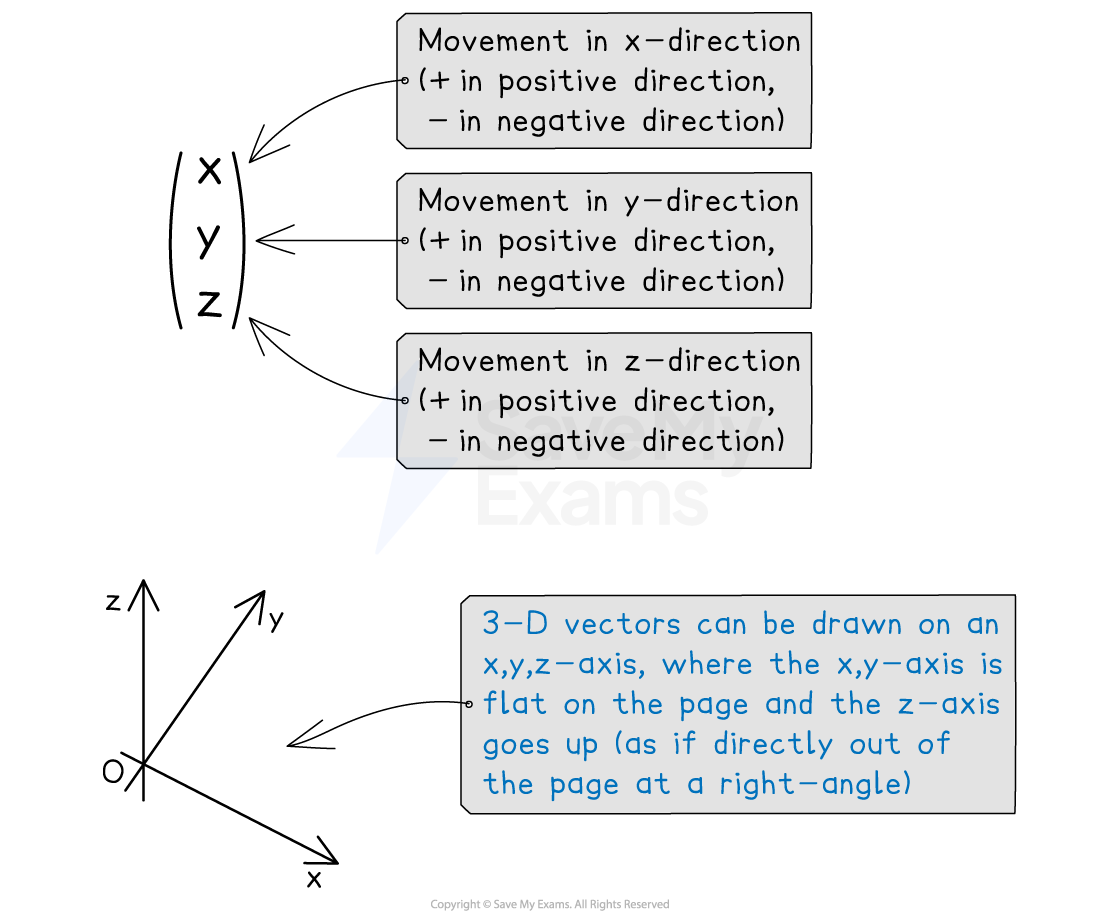
Finding the component form of a vector between two points works exactly the same as in two dimensions
E.g. vector , for points and
Subtract the coordinates for the first point () from the coordinates for the second point ()

Unlock more, it's free!
Join the 100,000+ Students that ❤️ Save My Exams
the (exam) results speak for themselves:

Was this revision note helpful?
Build on this topic
