Working with 3D coordinates (SQA National 5 Maths): Revision Note
Exam code: X847 75

Determining coordinates of points on 3D diagrams
How do I determine missing coordinates of points on 3D diagrams?
An exam question may ask you to find missing coordinates of points on a 3D diagram
Usually these will be vertices or other points on the surface of a regular solid
You need to be familiar with the properties of regular solids
For example spheres, cones and pyramids
You should also be familiar with cubes, cuboids, prisms and cylinders from your National 4 Maths course
In particular look for faces of the solid that are parallel to each other and have the same size
For example the two 'end faces' of a prism
These both have the same shape and size (which is the cross-section of the prism)
And they are at a distance from each other equal to the length of the prism
You may also need to use the properties of triangles and quadrilaterals to work out some of the coordinates
Worked Example
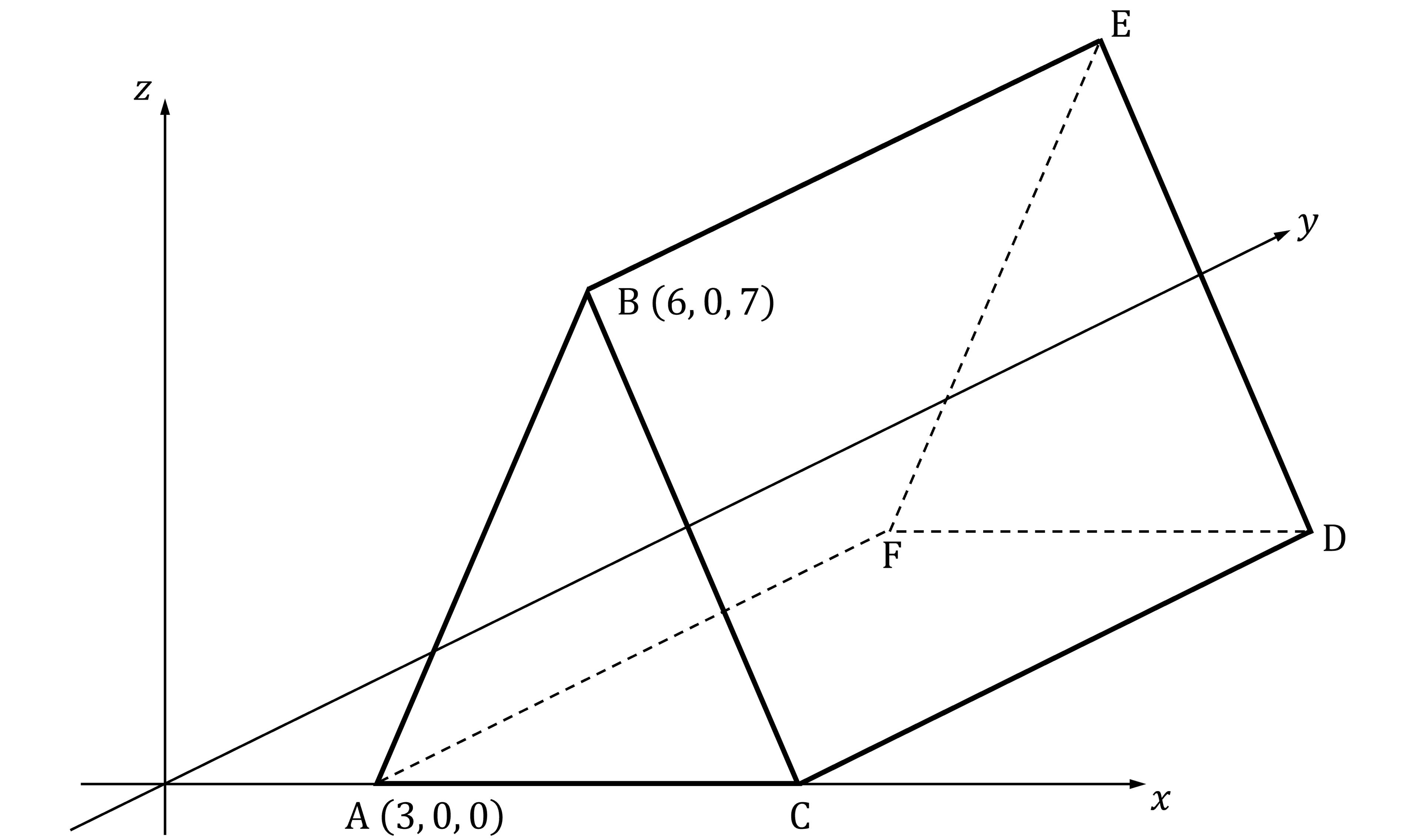
The diagram shows a triangular prism , relative to the coordinate axes.
.
.
Edges and are parallel to the -axis.
a) Write down the coordinates of and .
b) Write the vector in component form.
Answer:
Part (a)
Because ABCDEF is a triangular prism, the three edges and all have the same length (10 units)
Because is parallel to the -axis
will have the same and coordinates as
Only the coordinate will change (increase by 10)
Because , triangle is isosceles
This means it is symmetrical around its perpendicular height
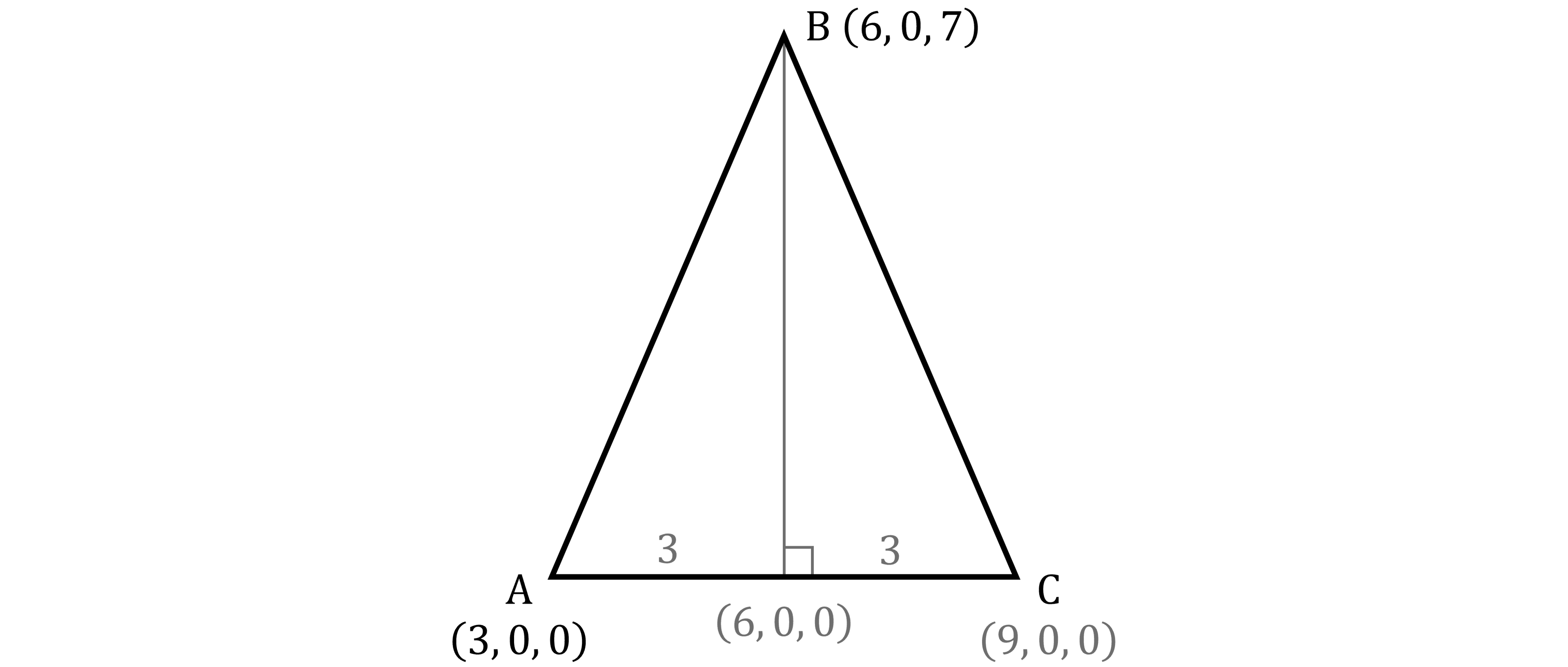
Then because is parallel to the -axis
will have the same and coordinates as
Only the coordinate will change (increase by 10)
Part (b)
To find vector in component form
subtract the coordinates for the first point () from the coordinates for the second point ()

Unlock more, it's free!
Join the 100,000+ Students that ❤️ Save My Exams
the (exam) results speak for themselves:

Was this revision note helpful?
Build on this topic
