Period & Related Angles (SQA National 5 Maths): Revision Note
Exam code: X847 75

Period & related angles
What are the periods of the trigonometric functions?
The periods of the basic trigonometric functions are discussed at Graphs of Basic Trigonometric Functions
has a period of 360° (it repeats every 360°)
If has some value for
then it has that same value for etc.
and also for etc.
E.g.
so is also equal to
also has a period of 360° (it repeats every 360°)
If has some value for
then it has that same value for etc.
and also for etc.
E.g.
so is also equal to
has a period of 180° (it repeats every 180°)
If has some value for
then it has that same value for etc.
and also for etc.
E.g.
so is also equal to
What are related angles?
The sin and cos functions are both symmetric
This symmetry allows you to find other values for x that give the same values of sin or cos
These 'other values of ' are known as related angles
How do I use related angles with sin x?
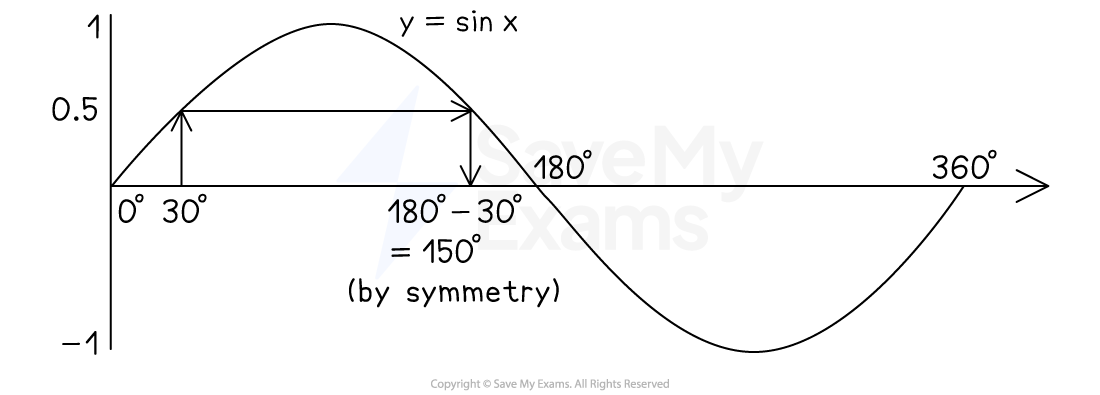
Sketch the sine graph for the given interval
Identify the first value on the graph
then use the symmetry of the graph to find additional values
E.g. if you know and want to find other values of for which , where
Sketch the graph for
Draw on
By symmetry, another value of is
is also equal to 0.5
How do I use related angles with cos x?
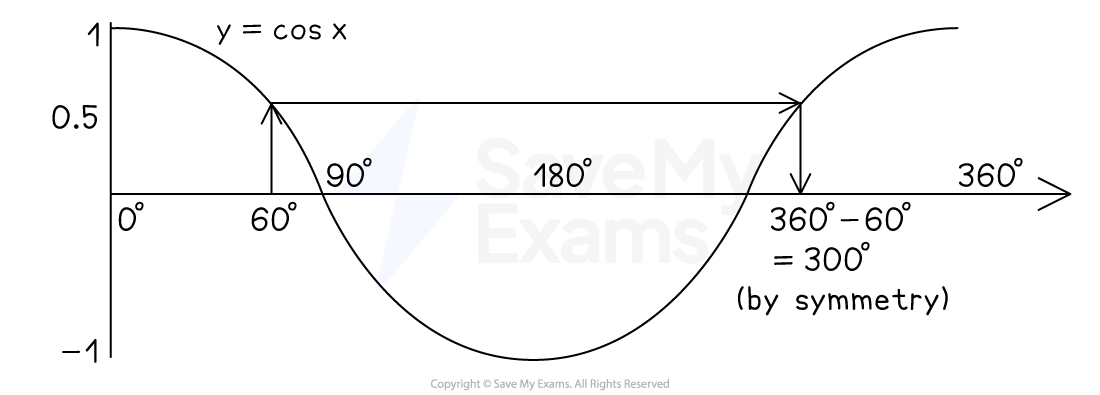
Sketch the cosine graph for the given interval
Identify the first value on the graph
then use the symmetry of the graph to find additional values
E.g. if you know and want to find other values of for which , where
Sketch the graph for
Draw on
By symmetry, another value of is
is also equal to 0.5
Worked Example
Given that , state the value of .
Answer:
Sketch and use symmetry to work out the value of
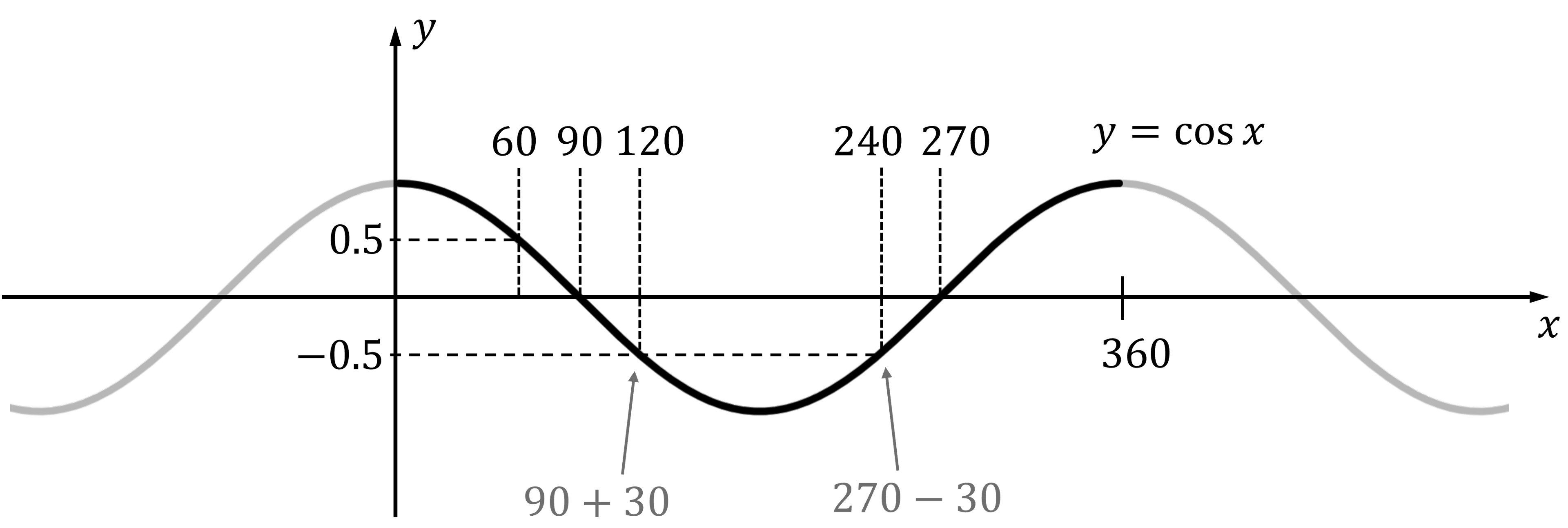
, and 60° is 30° to the left of 90°
so 30° to the right of 90°, is equal to
i.e.
120° is 30° to the right of 90°
so 30° to the left of 270°, is also equal to
i.e.

Unlock more, it's free!
Join the 100,000+ Students that ❤️ Save My Exams
the (exam) results speak for themselves:

Was this revision note helpful?
Build on this topic