Simplification with Surds (SQA National 5 Maths): Revision Note
Exam code: X847 75

Surds & exact values
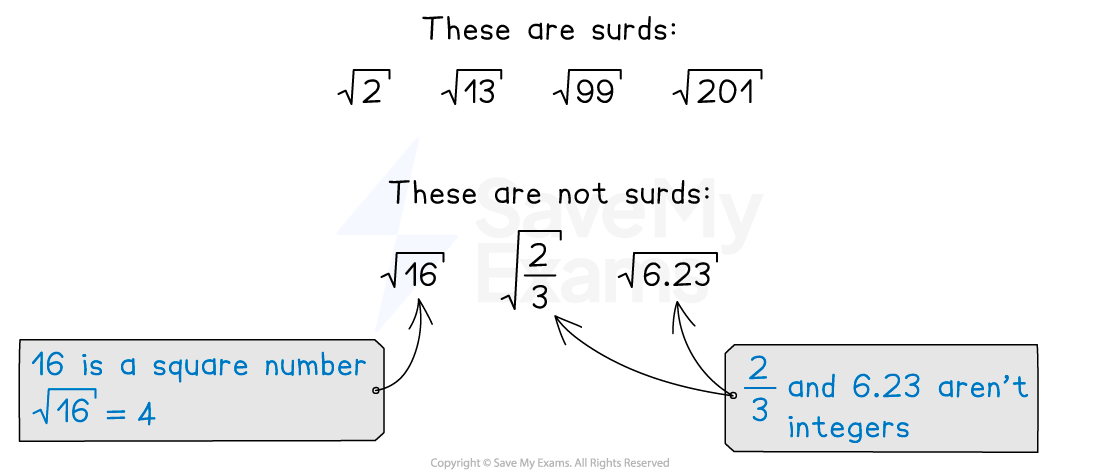
What is a surd?
A surd is the square root of a non-square integer
Using surds lets you leave answers in exact form
e.g. rather than
How do I do calculations with surds?
Multiplying surds
You can multiply numbers under square roots together
Dividing surds
You can divide numbers under square roots
Factorising surds
You can factorise numbers under square roots
Adding or subtracting surds
You can only add or subtract multiples of “like” surds
This is similar to collecting like terms when simplifying algebra
However cannot be combined in this way
You cannot add or subtract numbers under square roots
Consider
This is not equal to
Examiner Tips and Tricks
If your calculator gives an answer as a surd, leave the value as a surd throughout the rest of your working.
This will ensure you do not lose accuracy. You can always convert it to another form at the very end if necessary.
Simplifying surds
How do I simplify surds?
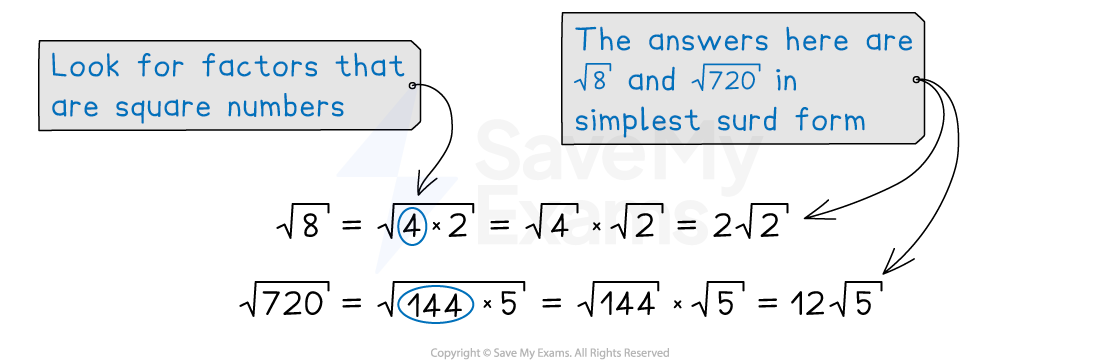
To simplify a surd, factorise the number using a square number, if possible
If multiple square numbers are factors, use the largest
Examiner Tips and Tricks
Be sure that you know the first twelve square numbers:
1, 4, 9, 16, 25, 36, 49, 64, 81, 100, 121, 144
Use the fact that and then work out any square roots of square numbers
E.g.
When simplifying multiple surds, simplify each separately
This may produce surds which can then be collected together
E.g. can be rewritten as
This simplifies to
These surds can then be collected together
You may have to expand brackets containing surds
This can be done in the same way as expanding brackets algebraically, and then simplifying where possible
The property can be used to simplify the expression, once expanded
E.g. expands to
This simplifies to
Or expands to
This simplifies to which gives
Worked Example
Express in its simplest form.
Answer:
Simplify the first two surds separately by finding the highest square number that is a factor of each of them
49 is a factor of 98, so
9 is a factor of 27, so
Simplify the whole expression by collecting the like terms

Unlock more, it's free!
Join the 100,000+ Students that ❤️ Save My Exams
the (exam) results speak for themselves:

Was this revision note helpful?
Build on this topic
