Features of Quadratic Graphs (SQA National 5 Maths): Revision Note
Exam code: X847 75

Turning point & axis of symmetry of a quadratic graph
What does a quadratic graph look like?
A quadratic graph is a smooth curve with a vertical axis of symmetry
If the the equation of the graph is given in the form , then
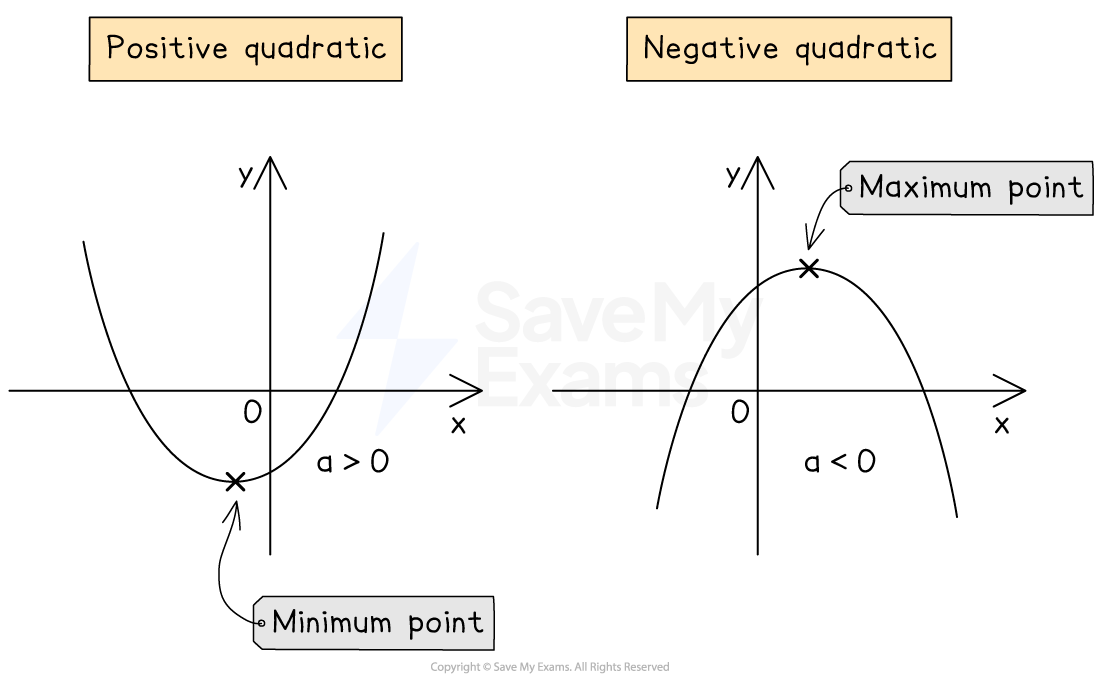
A positive number in front of gives a -shaped curve
A negative number in front of gives a -shaped curve
The shape made by a quadratic graph is known as a parabola
A quadratic graph will always cross the -axis
A quadratic graph intersects the -axis twice, once, or not at all
The points where the graph intersects the -axis are called the roots
If the graph is a -shape, then it has a minimum point
If the graph is a -shape, then it has a maximum point
Minimum and maximum points are both examples of turning points
The turning point of a parabola is sometimes also referred to as its vertex
How can I find the turning point and axis of symmetry of a quadratic graph?
The easiest way to find the turning point and axis of symmetry of a quadratic graph is by completing the square on its equation
On such questions in the exam the equation will be given to you in the form
Complete the square to rewrite the quadratic in the form
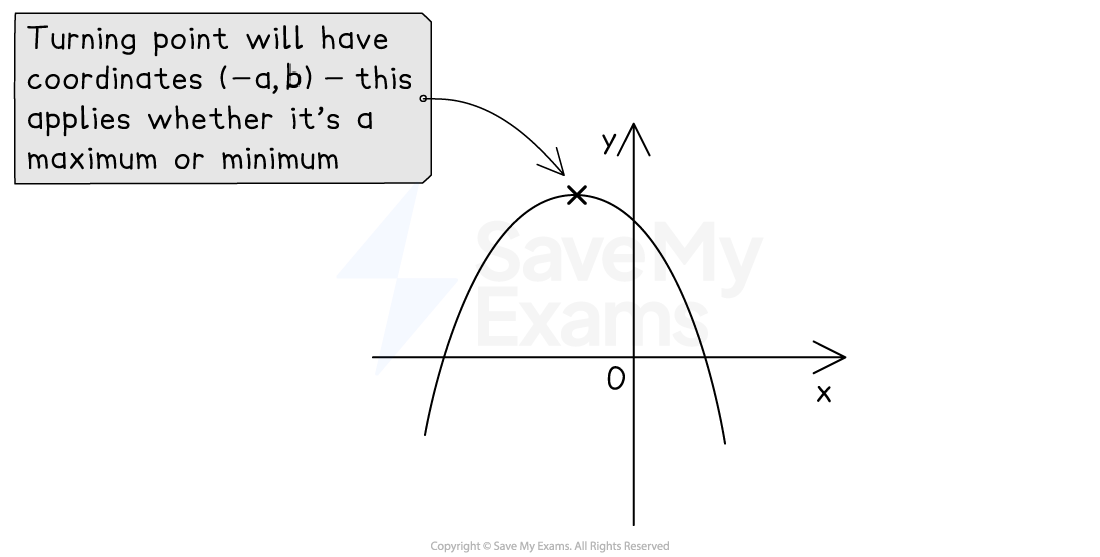
If then the turning point is at
Notice the negative sign with the x-coordinate
This can also help you create the equation of a quadratic when given the turning point
The axis of symmetry of a quadratic graph always goes through the turning point
So if the turning point is , then the axis of symmetry is
Worked Example
(a) Express in the form .
(b) Hence, or otherwise, state the coordinates of the turning point of the graph of .
The diagram shows the graph of .
A line PQ has been drawn parallel to the -axis, where:
P lies on the -axis
P and Q lie on the graph of .
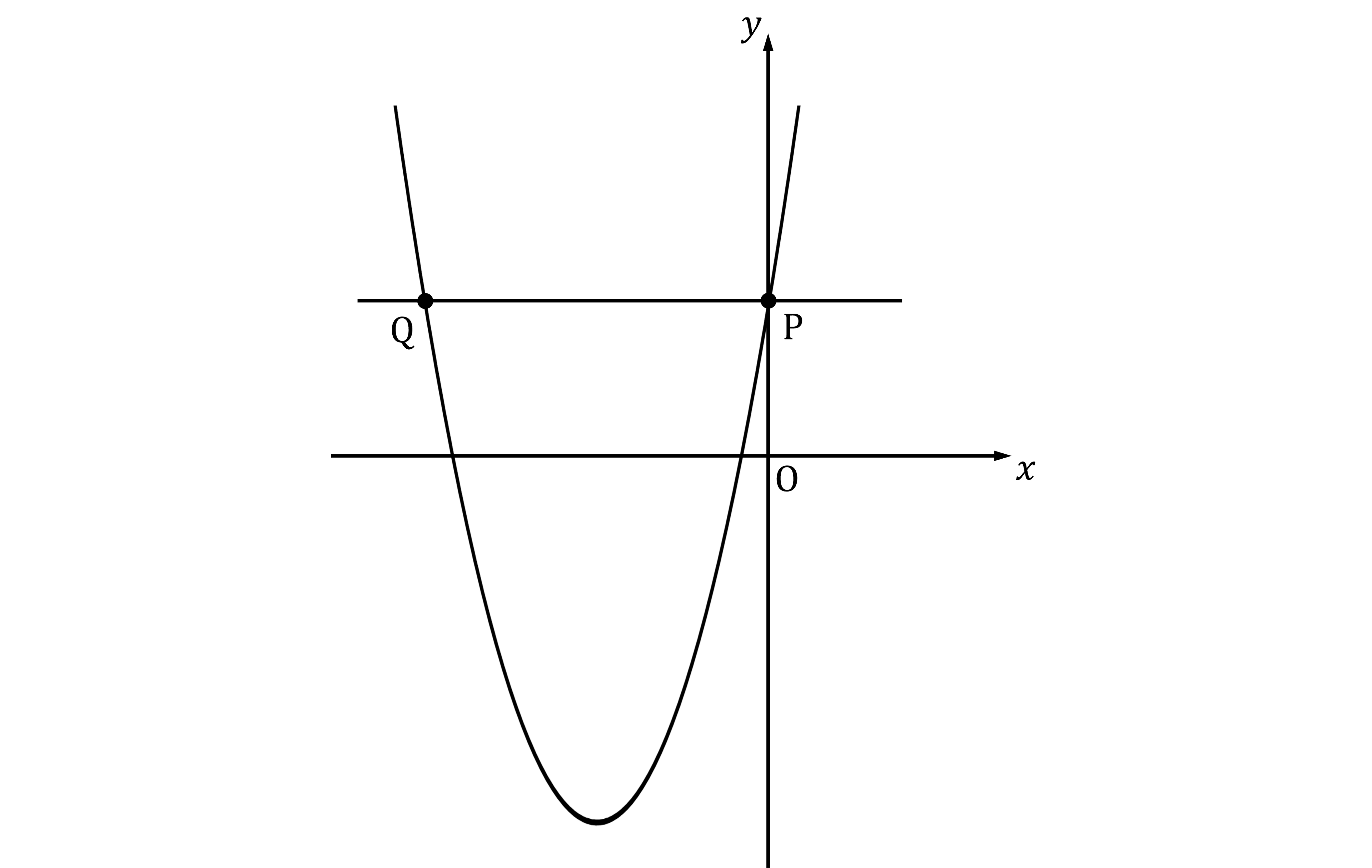
(c) Find the coordinates of Q.
Answer:
Part (a)
Use to rewrite
Here , so
Substitute that back into the original expression
Part (b)
Use the fact that if then the turning point is at
Don't forget the negative sign with the x-coordinate!
Part (c)
Answering this part of the question relies on the symmetry of the parabola
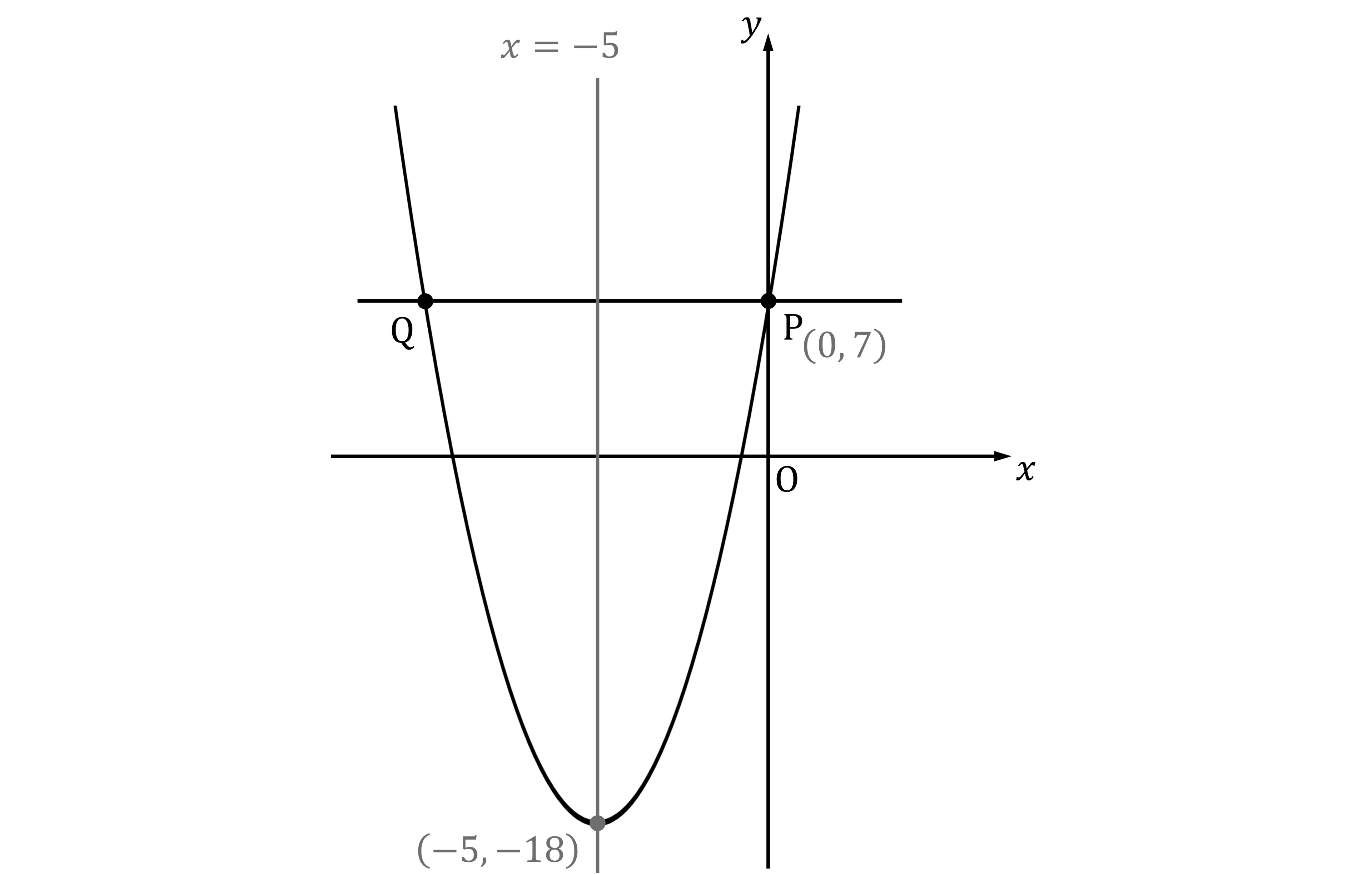
From part (b), you know that the turning point is
That means the axis of symmetry is at
Point P is the -axis intercept of the parabola, with -coordinate 0
You can find its -coordinate by substituting into the equation of the curve
So the coordinates of point P are
Line PQ is parallel to the -axis
So P and Q have the same coordinate
And point P is 5 units to the right of the axis of symmetry
So by the symmetry point Q will be five units to the left of the axis of symmetry
Point Q has coordinates (-10, 7)

Unlock more, it's free!
Join the 100,000+ Students that ❤️ Save My Exams
the (exam) results speak for themselves:

Was this revision note helpful?
Build on this topic
