Conflict (DP IB Global Politics: HL): Revision Note
What is conflict?
Conflict refers to a state of disagreement or struggle between two or more parties, ranging from hidden tensions to open violence
It occurs at every level of global politics - within communities, between governments and between states
Conflict exists on a spectrum
It can be latent (unspoken and unacknowledged)
It can be overt (open and visible)
It can escalate from one to the other if underlying causes are not addressed
Different political traditions and theories interpret the causes, nature and significance of conflict in contrasting ways
Understanding these perspectives is essential to analysing conflict in global politics
Latent conflict
Latent conflict is a state of tension or disagreement between parties that exists beneath the surface but has not yet broken out into open confrontation
It is sometimes referred to as an unstable peace
Latent conflict is not always easy to identify
Relations between states or groups in society may appear quite peaceful on the surface
Examples of latent conflict may include:
economic inequality in society
Deep-seated resentment amongst groups struggling to get by while wealthier groups enjoy significantly greater resources, opportunities and political influence
racial, gender-based and sexual inequality
Groups feel they are not given the same rights and protection as other groups
Often with latent conflict those with power are unaware or unconcerned
However, latent conflict can be dangerous
It can develop into violent conflict if it continues to be ignored or if an incident sparks an outbreak of violence
Conflict stages
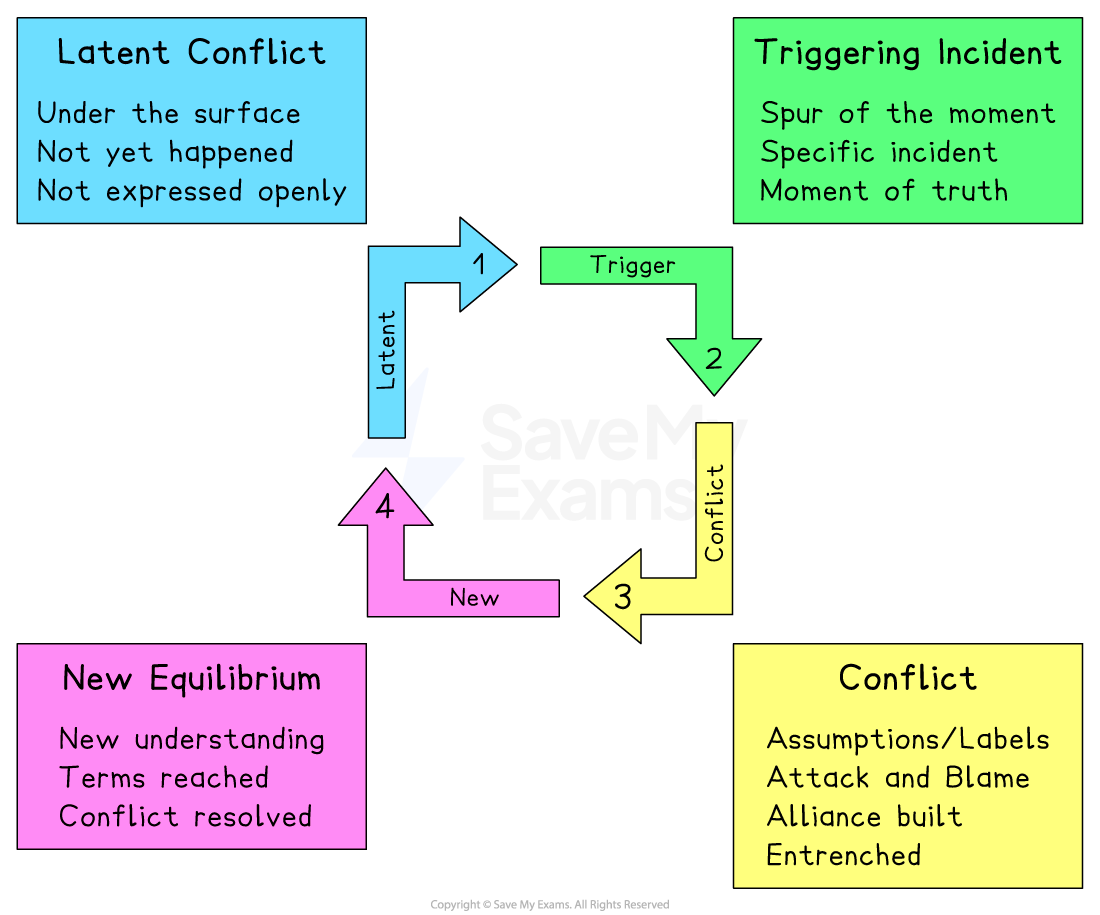
Stage 1: Latent conflict
Tension exists beneath the surface
Conflict has not yet happened openly
Not expressed or acknowledged by those involved
Stage 2: Triggering incident
A spur-of-the-moment event or specific incident acts as the spark
Sometimes described as a moment of truth - the point at which hidden tensions become impossible to ignore
Stage 3: Conflict
Assumptions and labels are applied to the other party
Attacks and blame escalate
Alliances form between those involved
Positions become entrenched and harder to resolve
Stage 4: New equilibrium
A new understanding is reached between the parties
Terms are agreed
The conflict is potentially - though not necessarily permanently - resolved
If the underlying causes of conflict are not fully addressed at this stage, the cycle can begin again, with new latent tensions building toward the next triggering incident
Case Study
Tunisia and the Arab Spring (2010–2011)
Tunisia under President Ben Ali appeared stable for over two decades
Beneath the surface, however, deep economic inequality and political repression had created conditions of latent conflict that those in power failed to recognise
The latent conflict
Youth unemployment stood at approximately 30%, with wealth concentrated among Ben Ali's family and political associates
Political freedoms were severely restricted
Censorship and suppression of dissent meant public discontent had no legitimate outlet
Resentment was widespread but largely invisible to those in power, who maintained the appearance of stability through authoritarian control
The spark
On 17 December 2010, Mohamed Bouazizi, a 26-year-old street vendor, set himself on fire after police confiscated his produce and publicly humiliated him
The incident reflected the daily experience of millions of Tunisians and triggered nationwide protests within days
From latent to open conflict
President Ben Ali fled on 14 January 2011, ending his 23 years in power
Protests spread rapidly across the region, triggering the wider Arab Spring in Egypt, Libya, Syria and beyond
In several states, latent conflict escalated into prolonged civil war
Overt conflict
Overt conflict is open, visible confrontation in which disagreements are expressed through direct action — and sometimes through violence
It occurs across multiple levels of global politics
The International Court of Justice (ICJ) provides one mechanism through which states can resolve disputes peacefully, preventing overt conflict from becoming violent
Local level
Overt conflict within communities can be violent or non-violent
Non-violent overt conflict can bring about positive change
For example, social movements and peaceful protest have driven significant political and social reform
National level
Governments and sub-national bodies regularly engage in non-violent overt conflict over policies, resource allocation or funding priorities
This is a normal feature of political life within states
International level
Overt conflict between states is not unusual and takes many forms, including:
trade disputes
disagreements over water rights and shared natural resources
border disputes
It is essential to address these conflicts before they escalate into interstate war
Conflict in different political and theoretical contexts
Conflict is a multi-dimensional concept
Different interpretations of conflict provide an understanding of this complex concept
Understanding of conflict | Key theories and theorists that support this view |
|---|---|
|
|
|
|

Unlock more, it's free!
Join the 100,000+ Students that ❤️ Save My Exams
the (exam) results speak for themselves:

Was this revision note helpful?
