Non-State Actors (DP IB Global Politics: HL): Revision Note
What are non-state actors?
Non-state actors are individuals, groups and organisations that are not part of a state government but are capable of influencing conflict and peace at local, national and international levels
They can be either violent or non-violent
Non-state actors can both cause and help resolve conflict
Understanding their role is essential to analysing how peace and conflict play out in the modern world
Unlike state actors, non-state actors often operate outside formal political structures
This given them both greater freedom of action and, in some cases, less accountability
Violent non-state actors
Violent non-state actors include armed groups, terrorists and criminal gangs
A state with actors using violence to challenge the authority of the government threatens regional and, in some cases, global security
They threaten state sovereignty by violating the principle that the state has the exclusive use of force
A conflict between a state and a violent non-state actor is known as an intrastate conflict
Most political theorists argue that, whether or not a state government is performing well or treating its citizens fairly, violent groups do not generally improve the situation
Examples of violent non-state actors threatening state sovereignty
Group | State (s) threatened | Impact |
|---|---|---|
Naxalite/Maoist |
|
|
Islamic State and other groups |
|
|
Drug trafficking cartels and transnational criminal organisations |
|
|
In some cases government officials, police forces and powerful individuals are corrupt and cooperate with violent groups to maintain power or profit personally
Non-violent non-state actors
Actors who are not affiliated with the state can help reduce conflict
Such actors include religious groups, civil society and NGOs, sports teams and artistic groups
Examples of non-violent non-state actors reducing conflict
Civil society and NGOs
Can advocate to end discrimination against marginalised groups, which can reduce the likelihood of conflict
For example, NGO Human Rights Watch conducts in-depth investigations and publishes results which shame states and their governments
Religious groups or leaders
Can attempt to broker peace between states
For example, Pope Leo has called for a ceasefire in the Gaza-Israel war and criticised the United States' military strikes near Venezuela
Cultural and sports exchanges
Encourage collaboration between states that can help ease hostilities
For example, the International Olympic Committee says it brings warring states together and thereby fosters dialogue and peace
Case Study
Pope Francis and the South Sudan peace process
In April 2019, Pope Francis used the moral authority of the Catholic Church to intervene at a critical moment in South Sudan's fragile peace process, showing how religious non-state actors can exert influence where political negotiations fall short
Background
South Sudan's civil war (2013 onwards) killed an estimated 400,000 people and displaced approximately 4 million
A peace agreement was signed in September 2018, but its implementation was fragile and at risk of collapse
The Vatican retreat
Pope Francis invited President Kiir and Vice President Machar to a two-day spiritual retreat at the Vatican
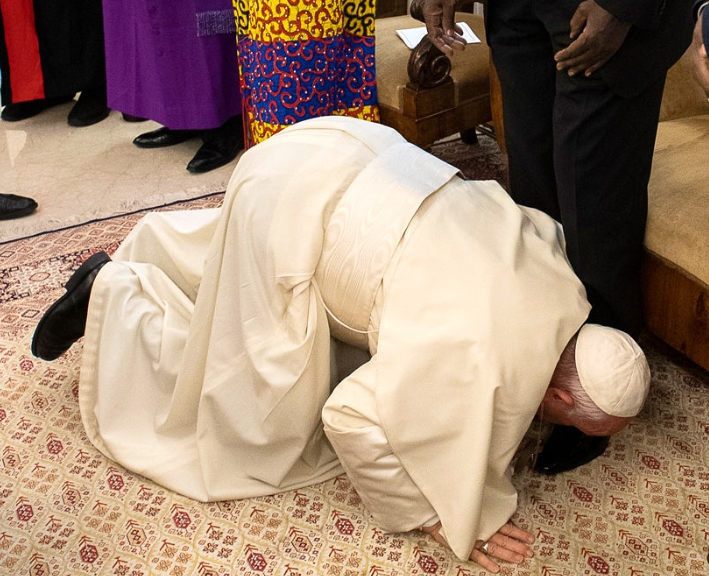
At its close, the Pope knelt and kissed the feet of each leader in turn, urging them personally not to return their state to war
The gesture drew global attention and applied significant moral pressure on both leaders to honour their commitments
Significance
As a non-state actor, the Pope had no military or economic leverage - his influence was entirely moral and symbolic
South Sudan has maintained a fragile but largely intact peace since 2018
The example demonstrates that religious non-state actors can influence conflict resolution through moral authority alone, without resorting to force or sanctions

Unlock more, it's free!
Join the 100,000+ Students that ❤️ Save My Exams
the (exam) results speak for themselves:

Was this revision note helpful?
