Political Factors Impacting Pathways to Development (DP IB Global Politics: HL): Revision Note

The impact of political factors
The political environment within a state has a direct impact on its ability to develop economically, socially and environmentally
Political factors, including the ideology of those in power, the presence or absence of conflict and levels of accountability and transparency, can either open up or close off pathways to development
States with stable, accountable governance tend to be better placed to pursue long-term sustainable development
Where political factors restrict development, progress in other areas, such as education, healthcare and infrastructure, is also likely to be limited
Ideology
Political ideology refers to different sets of ideas and beliefs about how society should be organised and how political power should be used
They can impact how governments prioritise government spending on development
Some political ideologies restrict human rights and freedoms, thereby limiting multiple pathways to development
Political ideologies and their impact on development
Ideology | Basic beliefs |
|---|---|
Liberalism |
|
Neo-Liberalism |
|
Realism |
|
Nationalism |
|
Fascism |
|
Authoritarianism |
|
Post-colonialism |
|
Feminism |
|
Persistence of conflict
Conflict refers to disagreements or a clash of interests, values or power between individuals, groups or states
Conflict can be violent or non-violent
Some argue that non-violent conflict can contribute to change and development, but all agree that violent conflict restricts development
Non-violent conflict
Non-violent conflict can contribute to important changes in society which contribute to development
Social movements can highlight social inequality and lead to improved conditions for marginalised groups
Protest movements can challenge government policies or government corruption, leading to political development
Violent conflict
Violent conflict and development are in opposition to each other and do not ordinarily coexist
Violent intrastate and interstate conflicts divert attention and resources away from development as the government must prioritise ending the conflict
Violent conflict often destroys infrastructure, educational institutions and companies, and disrupts attempts to improve society
People’s basic needs are threatened by food shortages, water contamination and violence
Marginalised groups, in particular women, are often the most vulnerable to violence in armed conflict
Case Study
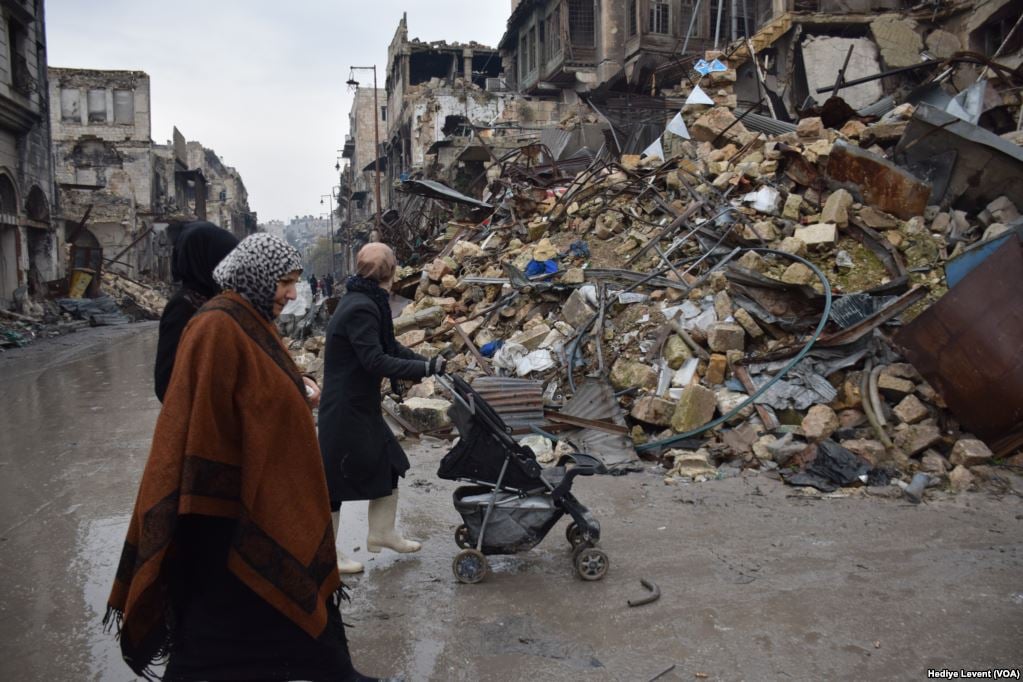
Syria – Conflict and its impact on development
Syria provides a clear example of how ongoing conflict severely restricts development
Since 2011, it has experienced a prolonged civil war, involving both internal and external actors
Non-violent conflict
The conflict began with peaceful protests during the Arab Spring
Protesters called for:
political reform
reduced corruption
greater freedoms
The shift to violent conflict
Protests escalated into a violent civil war
Multiple groups and foreign powers became involved
The conflict has continued for over a decade
The impact of violent conflict on development
Economic development
The economy has collapsed, with widespread poverty
Trade and investment have declined
Social development:
Education systems have been disrupted
Millions have been displaced or forced to flee
Around 90% of Syrians are impoverished, surviving on less than $2.15 a day (Source: World Food Programme, 2025)
Infrastructure destruction:
Homes, hospitals and schools have been destroyed
Development progress has been reversed
Basic needs:
Millions require humanitarian aid
Access to food, water and healthcare is limited
Impact on vulnerable groups:
Women and children are most affected
Children face long-term physical and mental harm from conflict
Accountability and transparency
Accountability is the requirement for individuals or governments to explain their actions and be held responsible for their decisions
Governments should be accountable to their citizens, and prepared to justify decisions and policies
Transparency means the government does not deliberately hide things from its citizens
Accountability, transparency and development
A lack of accountability and transparency is related to corruption
Money needed for development may be diverted for personal gain by government officials and their associates
Government officials at all levels may feel able to abuse their power due to a lack of accountability, which can negatively affect the daily lives of citizens
For example:
police may intimidate or mistreat individuals
public officials may demand bribes to deliver basic services
Other states, IGOs and TNCs may be less willing to invest or do business with a state where there is little or no accountability or transparency

Unlock more, it's free!
Join the 100,000+ Students that ❤️ Save My Exams
the (exam) results speak for themselves:

Was this revision note helpful?