Equality (DP IB Global Politics: HL): Revision Note
Equality in global politics
A set of topic areas is presented for the study of global political challenges to facilitate your explorations. These should not be seen as fully discrete or disconnected topics, but rather as overlapping areas of study that can contribute to understanding and addressing global challenges.
You can conduct an in-depth study of two of the topic areas—for example, security and health—or you may choose to explore the interconnections of multiple topic areas based on a selected case study.
What equality means
Equality is a contested but central concept in global politics - it shapes how states, groups and individuals interact and how political systems distribute power, rights and resources
The concept of equality is complex and takes several forms:
Formal equality - equal treatment under the law, regardless of personal characteristics
Substantive equality - equal outcomes in practice, recognising that different groups may need different treatment to achieve genuine equality
Equality of opportunity - fair access to the conditions needed to succeed, regardless of background
Equality of outcome - equal distribution of resources, power or welfare across groups
Why is equality a global political challenge?
Inequality creates power imbalances within and between political systems
Those with more power can shape rules and institutions in their favour, perpetuating further inequality
Economic inequality can lead to social and political instability, with consequences that extend across borders
Equality is central to human rights, social justice and development
Recognised in the UN's Universal Declaration of Human Rights and embedded in the Sustainable Development Goals
The meaning of equality is deeply contested
Different political actors and cultural traditions disagree about what equality requires, how it should be measured and who is responsible for achieving it
Global institutions and trade rules can entrench existing inequalities between states rather than reduce them
Key terms and concepts
Term | Definition |
|---|---|
Equality |
|
Equity |
|
Discrimination |
|
Institutionalised inequality |
|
Intersectionality |
|
CEDAW |
|
CERD |
|
Affirmative action |
|
Social movement |
|
Structural racism |
|
A useful analytical lens: intersectionality
One of the most productive ways to read an equality case study is through intersectionality - particularly any case where multiple axes of disadvantage interact
It won't be the right lens for every case, but it has analytical traction on most of them
Intersectionality is a theoretical framework developed by legal scholar Kimberlé Crenshaw in 1989
It argues that different forms of inequality (race, gender, class, disability, sexual orientation) do not operate independently of each other
Analysing one dimension of inequality at a time renders other dimensions invisible
E.g. analysing race discrimination without considering gender may miss the specific forms of discrimination faced by women of colour
E.g. analysing poverty without considering disability may overlook the particular barriers faced by disabled people in poverty
Implications for global politics
It challenges single-issue political movements and policies to consider who they include and who they leave behind
It explains why formal equality — equal rights on paper — does not always produce substantive equality in practice
It provides a framework for understanding why some groups remain consistently marginalised despite legal protections
Intersectionality, data and policy
Data recorded by only one variable (e.g. gender) may obscure significant inequalities within that group
Policy interventions that do not account for intersecting disadvantages may benefit the most advantaged members of a marginalised group while leaving the most disadvantaged behind
Criticisms of intersectionality
It can fragment political coalitions by emphasising difference over shared interests
Some argue it has been applied in ways that prioritise academic analysis over practical political action
Current and recent equality challenges
Equality challenges in the contemporary world take many forms and cut across all regions
Gender inequality
Women and girls continue to face discrimination in political representation, economic participation and access to rights
E.g. as of 2023, women hold only 26% of parliamentary seats globally (Inter-Parliamentary Union data)
Racial and ethnic inequality
Racial discrimination produces systematic inequalities in health, wealth, education and justice
E.g. the Black Lives Matter movement and ongoing debates about racial disparities in policing and incarceration in the USA
LGBTQ+ rights
Significant variation in the legal protection and social acceptance of LGBTQ+ people globally
E.g. over 60 states still criminalise same-sex relationships; in others, marriage equality has been legally recognised
Economic inequality
The gap between wealthy and poor individuals, groups and states continues to widen
E.g. Oxfam data showing the richest 1% hold more wealth than the rest of humanity combined
Disability rights
People with disabilities face systematic exclusion from political, economic and social life
E.g. the UN Convention on the Rights of Persons with Disabilities (CRPD, 2006) and the persistent challenges of implementation
Analytical classifications of equality
Formal and legal equality
Equal treatment under the law; the removal of explicitly discriminatory legislation
A necessary but not sufficient condition for substantive equality — laws can be formally equal while producing unequal outcomes in practice
Gender equality
Equal rights, opportunities and representation for women and men; also includes the rights of non-binary and transgender people
Gender equality is embedded in the SDGs (Goal 5) and the Convention on the Elimination of All Forms of Discrimination Against Women (CEDAW, 1979)
Progress has been significant in many contexts but remains uneven globally — particularly in political representation, economic participation and reproductive rights
Racial and ethnic equality
Equal treatment and opportunity regardless of race or ethnicity
Racial inequality is frequently structural — rooted in historical patterns of colonialism, slavery and exclusion that continue to shape present-day outcomes
International frameworks include the Convention on the Elimination of All Forms of Racial Discrimination (CERD, 1965)
Economic equality
Equal distribution of wealth, income and economic opportunity
Closely related to poverty — extreme economic inequality is both a cause and a consequence of other forms of inequality
Measured using tools such as the Gini coefficient
Political equality
Equal participation in political processes; freedom from political discrimination; equal representation in decision-making
Political equality is particularly challenging where economic inequality allows wealthier groups to exercise disproportionate political influence
Equality at different levels
Level | Overview |
|---|---|
Global |
|
Regional |
|
National |
|
Local |
|
Actors and stakeholders
When researching a case study on equality, students should identify a range of actors and stakeholders:
Nation-states
Set anti-discrimination law and equality policy
Enforce (or fail to enforce) constitutional protections
May themselves be sources of institutionalised inequality through biased laws and institutions
International human rights bodies
E.g. the UN Human Rights Council, the CEDAW Committee and the Committee on the Elimination of Racial Discrimination (CERD)
Monitor states' compliance with equality commitments and issue recommendations
NGOs and civil society organisations
E.g. Amnesty International, Human Rights Watch and UN Women
Document inequality, advocate for legal change and support affected communities
Social movements
E.g. Black Lives Matter, feminist movements and LGBTQ+ rights organisations
Mobilise public pressure and challenge existing power structures through protest, advocacy and legal action
Media organisations
Shape public understanding of inequality
Can amplify or marginalise the voices of disadvantaged groups depending on ownership, editorial choices and platform algorithms
Corporations and private sector actors
Employment and pay practices directly shape economic equality
Corporate diversity and inclusion policies are increasingly subject to public and regulatory scrutiny
Marginalised communities
The people most directly affected by inequality
Their political organisation and advocacy is central to achieving change, yet they often face the greatest barriers to political participation
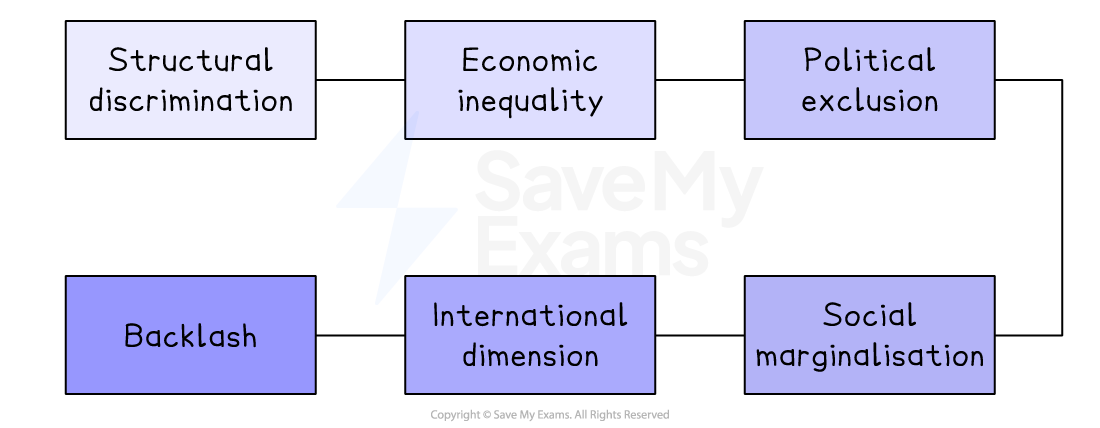
ANALYTICAL MODEL
Inequality is not a single injustice - one form of disadvantage generates and reinforces others in a self-reinforcing chain
Structural discrimination
A group is systematically disadvantaged based on race, gender, class etc
This is encoded in laws, institutions and social norms
Disadvantage is self-reinforcing as individual effort alone cannot overcome structural barriers
Economic inequality
Discriminated groups earn less, own less and inherit less
Wealth gaps compound across generations
Reduced access to health, education and housing deepens multiple dimensions of disadvantage simultaneously
Political exclusion
Less wealth means less political influence
In campaign financing, media access and proximity to decision-makers
Policies that perpetuate inequality face no effective challenge from those they harm most
Social marginalisation
Economically and politically excluded groups are frequently stigmatised in public culture
Shapes expectations, mental health and which grievances are seen as legitimate
International dimension
Global inequalities reflect colonial history
Developing states are marginalised in key international forums
Decisions affecting poorer states are frequently made without their meaningful participation
Backlash
Movements for equality generate resistance from those who perceive their relative advantage as threatened
Progress towards equality is contested, reversible and rarely linear
Example case studies
The following examples illustrate the kinds of case studies students could develop for this topic area
Case study | Outline | Connections to other HL topics |
|---|---|---|
The Rohingya crisis in Myanmar |
|
|
Black Lives Matter |
|
|
The #MeToo movement and gender equality legislation in China |
|
|
Links to earlier course content
The equality topic area connects to all four areas of the IB Global Politics course
Section | Key connections |
|---|---|
Core topics |
|
Rights and justice |
|
Development and sustainability |
|
Peace and conflict |
|
Links to the other HL topic areas
A case study on equality will frequently connect to other HL topic areas - identifying these links is essential for question 3
ccHL topic area | Key connections |
|---|---|
Security |
|
Borders |
|
Identity |
|
Health |
|
Poverty |
|
Technology |
|
Examiner Tips and Tricks
What distinguishes top-band answers is the deployment of named analytical concepts rather than description alone.
Intersectionality is one strong lens for many equality cases - when applying it, name the intersecting axes of inequality in your case study, identify who faces the most compounded disadvantage, and explain why.
The self-reinforcing cycle of inequality is a useful complement: strong answers don't just describe a single form of disadvantage but trace how it ripples through economic, political and social domains.
The syllabus also rewards drawing on the four core concepts (power, sovereignty, legitimacy, interdependence), broader theoretical perspectives (realism, liberalism, feminism, critical race theory), levels of analysis (local to global) and multiple stakeholder perspectives. The right concept depends on your specific case - and many cases reward more than one.

Unlock more, it's free!
Join the 100,000+ Students that ❤️ Save My Exams
the (exam) results speak for themselves:

Was this revision note helpful?
