Security (DP IB Global Politics: HL): Revision Note

Security in global politics
A set of topic areas is presented for the study of global political challenges to facilitate your explorations. These should not be seen as fully discrete or disconnected topics, but rather as overlapping areas of study that can contribute to understanding and addressing global challenges.
You can conduct an in-depth study of two of the topic areas- for example, security and health- or you may choose to explore the interconnections of multiple topic areas based on a selected case study.
In global politics, security refers to freedom from threat - but what counts as a "threat" and who needs to be protected are both contested questions
Traditional approaches to security focused on protecting the state from military attack by other states
More recent approaches have expanded this to include the protection of individuals from a much wider range of threats, including poverty, disease and environmental hazards
Why is security a global political challenge?
Security threats increasingly transcend national borders
Terrorism, cyber attacks, pandemics and climate change cannot be addressed by any single state acting alone
The definition of security is contested
Traditional realist approaches prioritise military threats to the state
Liberal and human security approaches focus on the well-being of individuals
Securitisation
The process by which an issue is framed as a security threat has significant political consequences, often justifying extraordinary measures that would not otherwise be accepted
Security measures can conflict directly with human rights and civil liberties
This tension is one of the central challenges in the topic area
Non-state actors (terrorist groups, criminal organisations, private military companies) have become increasingly significant security actors, complicating the traditional state-centred picture
Key terms and concepts
Term | Definition |
|---|---|
Securitisation |
|
Deterrence |
|
Terrorism |
|
Arms proliferation |
|
Humanitarian intervention |
|
Responsibility to Protect (R2P) |
|
Proxy war |
|
Types of security
Three concentric framings sit at the heart of the topic area. Each defines a different referent object - the thing being secured
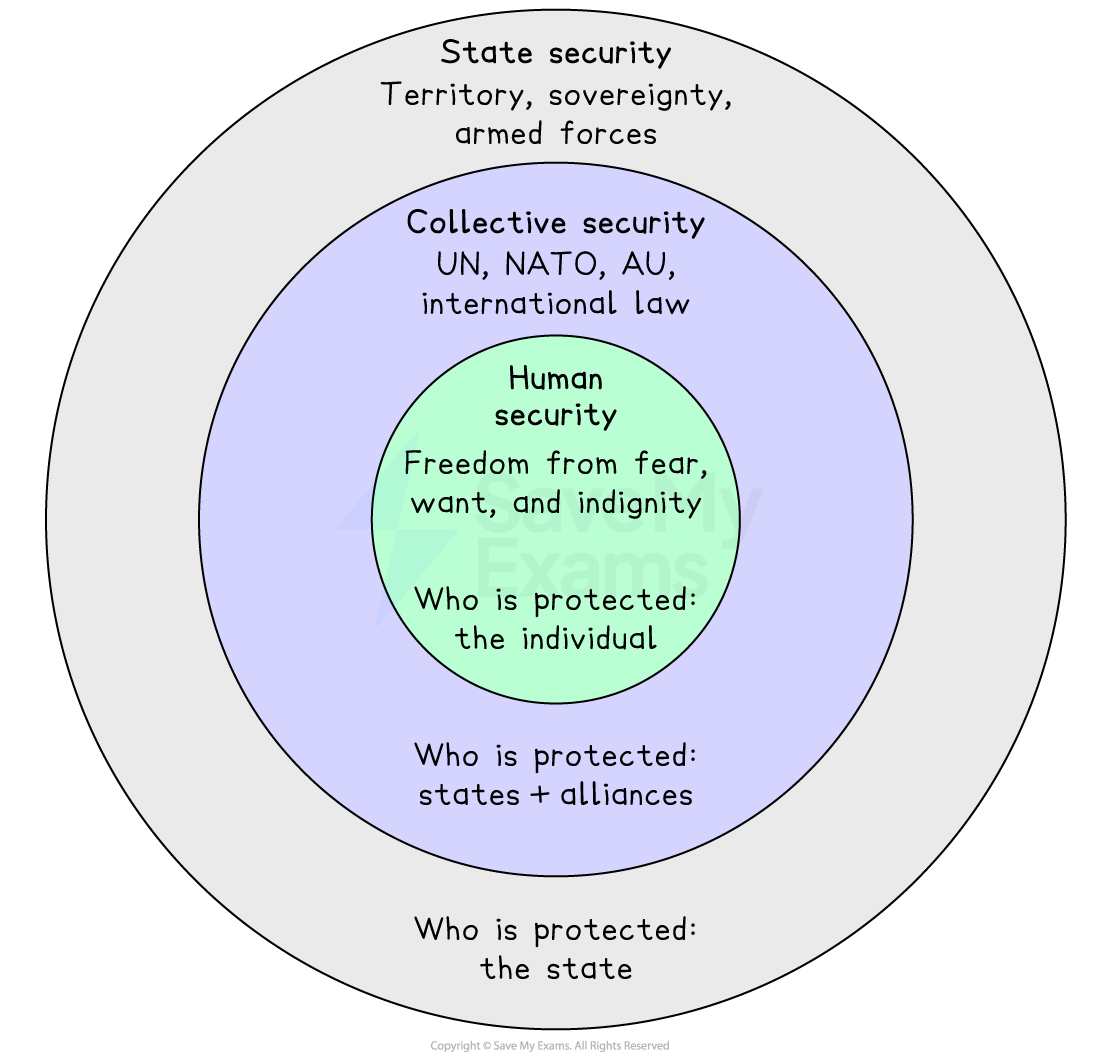
State and national security
Focuses on protecting the state from external military threats
Associated with realist theories of international relations, which see states as the primary actors in global politics
Involves military force, alliances, arms control agreements and deterrence
Referent object: the state
Collective security
Based on the principle that all member states agree to respond collectively to an act of aggression against any one of them
The United Nations (UN) system is built on collective security; the UN Security Council has the authority to authorise the use of force
Regional security organisations such as NATO, the African Union and ASEAN also operate collective security arrangements
Referent object: states and alliances
Human security
Emerged from the 1994 UNDP Human Development Report, which argued that security should focus on individuals, not just states
Identifies seven dimensions of human security: economic, food, health, environmental, personal, community and political security
Associated with liberal and cosmopolitan theories that prioritise individual rights over state sovereignty
Referent object: the individual
A useful analytical lens: the securitisation framework
One of the most productive ways to read a security case study is through securitisation theory. It won't be the right lens for every case, but it has analytical traction on a wide range of them - particularly those involving the framing of new threats or the use of emergency powers.
Securitisation theory was developed by the Copenhagen School of Security Studies, particularly Barry Buzan and Ole Wæver. It argues that security is not an objective condition - something becomes a "security issue" when a political actor successfully presents it as an existential threat requiring emergency action.
Key stages of the securitisation process
A securitising actor (e.g. a government or military leader) identifies a referent object - the thing being threatened (e.g. the state, a population, a way of life)
The actor frames the issue as an existential threat that cannot be addressed through normal political processes
The audience accepts this framing and authorises emergency measures - actions that go beyond what would normally be politically acceptable
Why it matters
Securitisation matters in global politics because it can justify measures that restrict rights and freedoms
After the September 2001 attacks in the USA, terrorism was securitised - justifying military interventions in Afghanistan and Iraq and the suspension of some civil liberties
European governments have securitised migration, justifying increased border enforcement and detention
Climate change is increasingly being securitised, framing environmental degradation as a direct threat to national security
Not all attempts to securitise an issue succeed - the audience must accept the framing for securitisation to take effect. Securitisation can also be reversed through desecuritisation - returning an issue to the realm of normal political debate
Current and recent security challenges
Security challenges in the contemporary world take many forms and involve a wide range of actors
They split into traditional state-based threats and non-traditional human-security threats - though the boundary between the two is increasingly blurred.
Traditional / state-based threats
Interstate conflict - armed conflict between two or more states (e.g. the Russia–Ukraine war)
Intrastate conflict - armed conflict within a single state, often involving non-state armed groups (e.g. the Syrian civil war)
Terrorism - political violence against civilians, increasingly transnational in nature
Non-traditional / human security threats
Cyber attacks - hostile actions in digital space, including attacks on critical infrastructure and political interference
Climate-related insecurity - competition over water, food and land driven by environmental change
Health emergencies - pandemics that cross borders and overwhelm state capacity
Examiner Tips and Tricks
A strong exam paragraph usually argues that the boundary between the two categories is breaking down - e.g. cyber attacks during interstate war, climate stress feeding civil conflict, pandemics triggering border closures
Actors and stakeholders
When researching a case study on security, students should identify a range of actors and stakeholders
Nation-states
Maintain military forces
Enter into security alliances and arms control agreements
Have primary responsibility for the security of their citizens
The UN Security Council
The primary international body responsible for maintaining international peace and security
Has the authority to authorise military action under Chapter VII of the UN Charter
Regional security organisations
E.g. NATO, the African Union (AU) and ASEAN, which coordinate collective security responses among member states
Non-governmental organisations (NGOs)
E.g. Amnesty International and Human Rights Watch, which monitor security-related human rights violations and document abuses
Non-state armed groups
Terrorist organisations, rebel groups and militias, which are increasingly significant security actors in intrastate conflicts
Private military companies (PMCs)
Private organisations contracted to carry out security operations on behalf of states
Civilian populations
Those most directly affected by security failures
Human security frameworks place civilians at the centre of analysis
Example case studies
The following examples illustrate the kinds of case studies students could develop for this topic area
Case study | Outline | Connections to other HL topics |
|---|---|---|
Disputed claims over the South China Sea |
|
|
Securitisation of terrorism: France after the 2015 Paris attacks |
|
|
The conflict in Sudan and displacement |
|
|
Links to earlier course content
The security topic area connects to all four areas of the IB Global Politics course
Section | Key connections |
|---|---|
Power and global politics |
|
Rights and justice |
|
Development and sustainability |
|
Peace and conflict |
|
Links to the other HL topic areas
A case study on security will frequently connect to other HL topic areas - identifying these links is essential for question 3
HL topic area | Key connections |
|---|---|
Borders |
|
Technology |
|
Poverty |
|
Health |
|
Environment |
|
Identity |
|
Examiner Tips and Tricks
What distinguishes top-band answers is the deployment of named analytical concepts rather than description alone.
Securitisation is one strong lens for many security cases - when applying it, look for who framed the issue as a security threat, what emergency measures were justified as a result, and which groups had their rights affected by those measures.
The syllabus also rewards drawing on the four core concepts (power, sovereignty, legitimacy, interdependence), broader theoretical perspectives (realism, liberalism, constructivism), levels of analysis (local to global) and multiple stakeholder perspectives.
The right concept depends on your specific case - and many cases reward more than one.

Unlock more, it's free!
Join the 100,000+ Students that ❤️ Save My Exams
the (exam) results speak for themselves:

Was this revision note helpful?