Choosing Case Studies (DP IB Global Politics: HL): Revision Note

What is a case study in Paper 3?
In Paper 3, a case study is a specific, real-world political situation, event, or process that you have researched independently before the exam
It is your evidence - the material you use to support your arguments and answer all three questions on the paper
Unlike Papers 1 and 2, Paper 3 requires you to bring your own material into the exam room; the examiner will not provide your case study for you
Your case study must connect clearly to one or more of the 8 HL topic areas
How many case studies do you need?
The IB recommends that HL students develop at least 2–3 in-depth case studies for Paper 3
Depth is more important than quantity - a case study you know in detail is far more useful than several you know only superficially
Each case study should be understood well enough to support a full question 3 essay, worth 15 marks
Your case studies should ideally cover different topic areas, giving you flexibility to respond to different questions
What makes a strong case study?
A strong Paper 3 case study:
Clearly illustrates one or more of the 8 HL topic areas
Has a clear political dimension
It involves states, IGOs, NGOs or other political actors making decisions with real consequences
Includes specific, verifiable details
Dates, statistics, names of organisations, policy decisions and outcomes
Has multiple actors and stakeholders, enabling you to address question 2a and 2b as well as question 3
Connects to more than one topic area, making it useful across different exam scenarios
Presents a genuine political challenge, not just a description of an event
What to avoid
Case studies that are too broad or vague
E.g. "climate change in Africa" covers too much to anchor with specific evidence
Cases where the political dimension is unclear
E.g. a natural disaster with no identifiable governance failure or international response is unlikely to score well
Cases that only connect to one topic area, as these limit your flexibility
Cases where your knowledge is superficial - the examiner expects specific evidence, not general statements
Choosing your topic areas
You do not need case studies for all 8 topic areas
Aim to cover at least 2–3 different areas
Build on what you have already studied in your core and thematic coursework
Paper 3 case studies should deepen existing knowledge, not introduce entirely new subject matter
The strongest case studies sit at the intersection of two or more topic areas
E.g. the Rohingya crisis connects Identity, Borders, Security and Equality
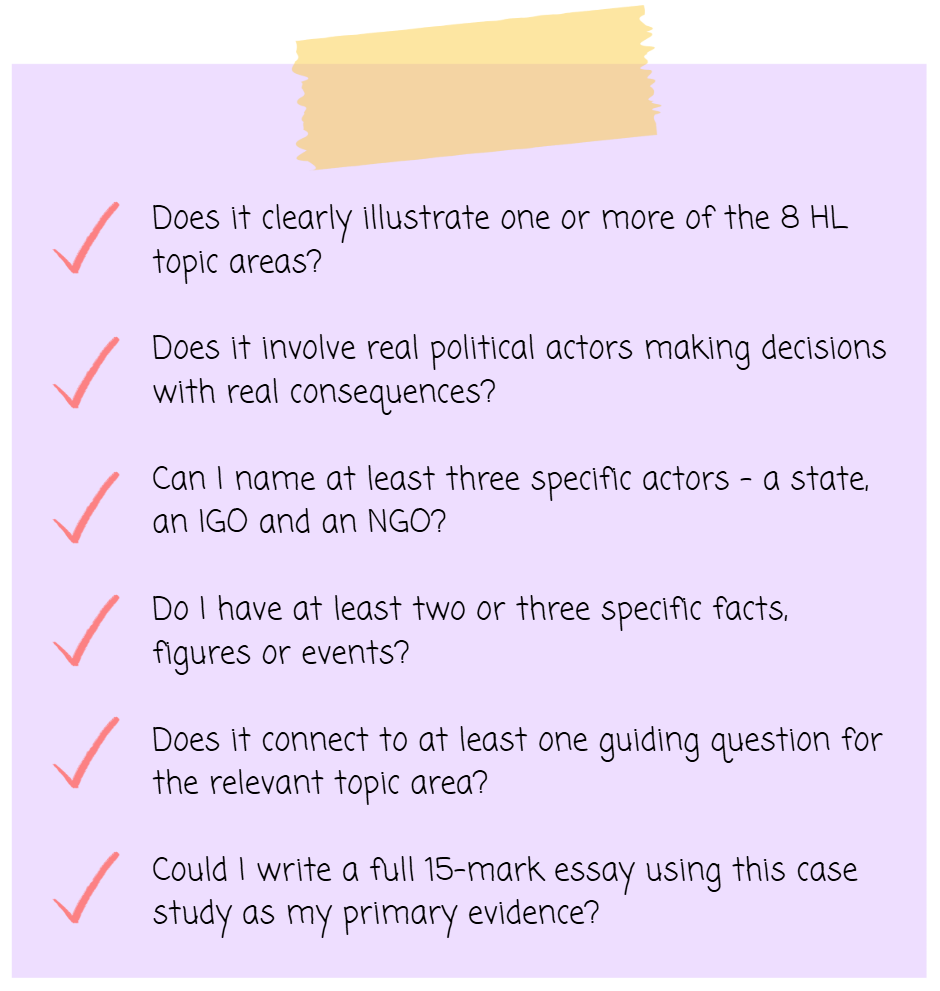
Checklist: Is this a good Paper 3 case study?

Unlock more, it's free!
Join the 100,000+ Students that ❤️ Save My Exams
the (exam) results speak for themselves:

Was this revision note helpful?
