Identity (DP IB Global Politics: HL): Revision Note

Identity in global politics
A set of topic areas is presented for the study of global political challenges to facilitate your explorations. These should not be seen as fully discrete or disconnected topics, but rather as overlapping areas of study that can contribute to understanding and addressing global challenges.
You can conduct an in-depth study of two of the topic areas-for example, security and health-or you may choose to explore the interconnections of multiple topic areas based on a selected case study.
Identity refers to how individuals and groups define themselves and others - through nationality, ethnicity, religion, gender, language, culture or class
Identity shapes political behaviour: it influences how people vote, organise and make demands of the state
Identity can be a source of solidarity and community, but also a driver of exclusion, discrimination and conflict
In global politics, identity is central to debates about sovereignty, self-determination, minority rights and the legitimacy of political systems
Why is identity a global political challenge?
Identity shapes which groups hold political power and which are excluded
States built on narrow definitions of national identity routinely marginalise minorities
Identity-based conflicts are among the most intense and difficult to resolve
They involve fundamental questions of belonging, recognition and survival that cannot easily be negotiated
The principle of state sovereignty frequently conflicts with minority rights and self-determination
States resist international scrutiny of how they treat their own populations
Identity politics is increasingly transnational
Diaspora communities, international social movements and digital platforms mean that identity conflicts cross borders regardless of political boundaries
Globalisation has simultaneously destabilised settled identities- through migration, cultural change, and digital communication - and provoked nationalist backlash against perceived threats to traditional ways of life
Key terms and concepts
Term | Definition |
|---|---|
Identity |
|
Nationalism |
|
Ethnicity |
|
Citizenship |
|
Multiculturalism |
|
Self-determination |
|
Statelessness |
|
Diaspora |
|
Cosmopolitanism |
|
Securitisation of identity |
|
A useful analytical lens: sovereignty vs self-determination
One of the most productive ways to read an identity case study is through the tension between state sovereignty and self-determination - the principle that peoples have the right to determine their own political status and governance
It won't be the right lens for every case, but it has analytical traction on most of them
Self-determination is enshrined in Article 1 of the UN Charter (1945) and in both major international human rights covenants (1966)
Yet self-determination is one of the most contested principles in international law - it directly challenges state sovereignty and territorial integrity
The tension arises because:
States resist any international right that might justify the secession of minority groups from their territory
Minority groups - particularly those facing persecution - argue that they cannot be bound by a state that denies their existence
The international community applies self-determination inconsistently: Kosovo's 2008 declaration of independence was recognised by over 100 states; Catalonia's 2017 referendum was not recognised by any
Key distinctions in self-determination
Internal self-determination - autonomy within an existing state; the right to political participation, cultural recognition and self-governance short of full independence
External self-determination - secession and the creation of a new independent state; accepted in international law primarily in the context of decolonisation or systematic human rights violations
The Responsibility to Protect (R2P)
Adopted at the UN World Summit in 2005, R2P holds that when a state fails to protect its citizens from mass atrocities (e.g. genocide, crimes against humanity, ethnic cleansing, war crimes) the international community has a responsibility to act
Its application is deeply contested
The Russian veto on the UN Security Council has blocked action in Syria
ASEAN's non-interference principle has limited responses to Myanmar
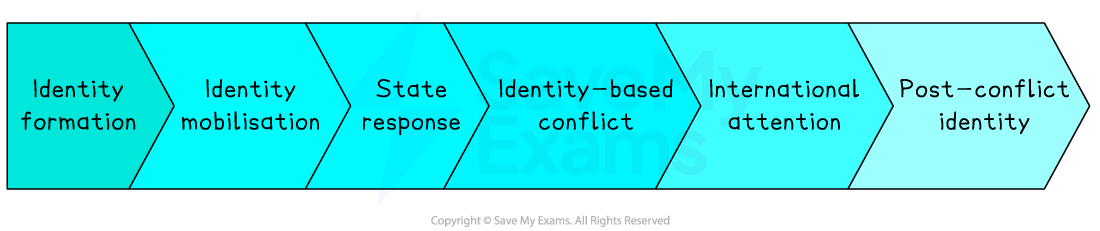
Analytical model: How identity escalates politically
Identity does not operate as an isolated political force - it sets in motion a cascade of consequences that can escalate from formation to full-scale conflict and beyond
Identity formation
Groups develop a shared sense of belonging based on ethnicity, religion, language or culture; collective identity becomes the basis for political claims and demands
Identity mobilisation
Political leaders or movements use identity to organise support and define "in-group" vs "out-group"; identity politics emerges and minority groups face exclusion or marginalisation
State response
States manage diversity through inclusion (multiculturalism) or suppression (assimilation, repression); minority communities either integrate or face systematic discrimination
Identity-based conflict
When identity groups feel excluded, threatened or stateless, conflict can escalate into civil wars, separatist movements, ethnic cleansing or genocide
International attention
Global actors respond through humanitarian intervention, sanctions or recognition of new states; tension emerges between state sovereignty and the international responsibility to protect (R2P)
Post-conflict identity
Peace processes must address identity through power-sharing or constitutional protections; long-term stability depends on inclusive political settlements that recognise diverse identities
Current and recent identity challenges
With those concepts and the sovereignty/self-determination framework in place, the contemporary world presents five major identity challenges:
Nationalist and ethno-nationalist conflict
Nationalism holds that a nation (a group with a shared identity) should have its own state or political recognition
When states are defined in narrow ethnic or religious terms, minorities are excluded from full citizenship and political participation
Ethno-nationalism has driven some of the most destructive conflicts of the 20th and 21st centuries, including the Rwandan genocide, the Balkan wars and the persecution of the Rohingya
E.g. the rise of ethno-nationalist politics across Europe, the Americas and Asia has intensified debates about who "belongs" to a nation; the electoral success of far-right parties in Hungary, Italy and India
Statelessness and contested citizenship
Stateless people have no recognised nationality
They are denied basic rights, including access to education, healthcare, employment and the ability to travel
Statelessness is often the result of deliberate political choices
States may strip citizenship from minorities as a tool of exclusion and control
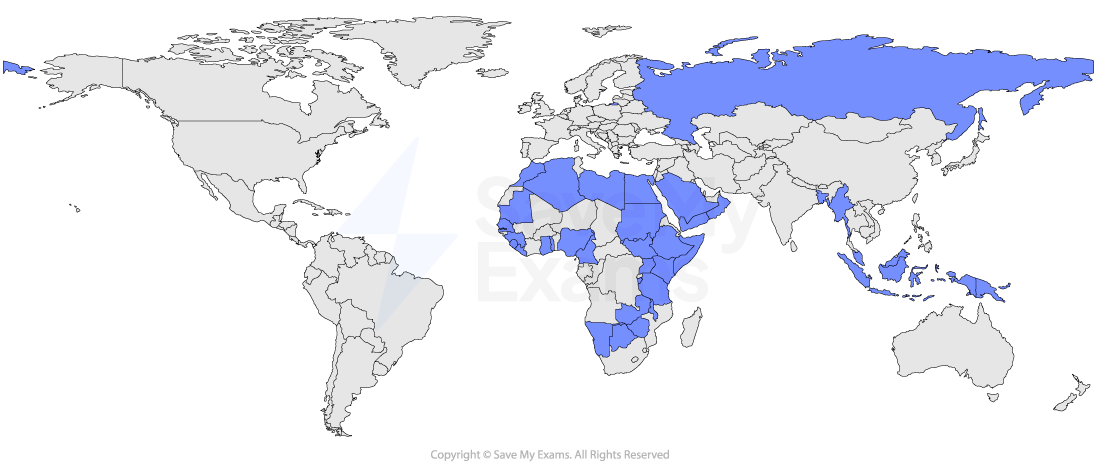
Approximately 4 million people are stateless globally; the Rohingya represent the world's largest stateless community
E.g. the Bidoon in Kuwait; residents stripped of citizenship in the Assam National Register of Citizens process in India
Indigenous rights
Indigenous communities worldwide continue to face dispossession, cultural erasure and political marginalisation
E.g. ongoing land rights disputes and forced assimilation policies affecting First Nations peoples in Canada and Australia
LGBTQ+ identity and rights
The legal and social status of LGBTQ+ people varies enormously across states — from full legal equality in some contexts to death penalties in others
Some states frame criminalisation as the protection of traditional or national values, presenting LGBTQ+ rights as a form of cultural imperialism
International human rights frameworks increasingly recognise LGBTQ+ rights, but enforcement mechanisms are severely limited
E.g. Uganda's Anti-Homosexuality Act (2023), which introduced severe penalties for same-sex relationships
Diaspora and transnational identity
Diaspora communities (people living outside their ancestral homeland) frequently maintain strong political ties to their countries of origin
They can influence host-country politics (through voting, lobbying and advocacy) and home-country politics (through remittances and political pressure)
Diaspora communities are often caught between identities, navigating their adopted country's culture and their cultural heritage simultaneously
Identity at different levels
Level | Overview |
|---|---|
Global |
|
Regional |
|
National |
|
Local |
|
Actors and stakeholders
When researching a case study on identity, students should identify a range of actors and stakeholders
Nation-states
Define citizenship, manage diversity, and either protect or suppress minority identities
May themselves be the agents of identity-based persecution
Ethnic and religious minorities
Assert rights, seek political representation, and pursue autonomy or independence
May organise politically within states or through diaspora networks internationally
International organisations (UN, UNHCR)
Promote minority rights, manage identity-related conflicts, and protect stateless populations
The UN Declaration on the Rights of Indigenous Peoples (UNDRIP, 2007) provides a key but non-binding framework for indigenous identity rights
Regional bodies (EU, ASEAN, AU)
Develop frameworks for minority protection and conflict resolution
ASEAN's non-interference principle frequently limits regional responses to identity-based persecution within member states
Non-governmental organisations (NGOs)
E.g. Amnesty International, Human Rights Watch, Minority Rights Group International
Advocate for marginalised groups, document human rights abuses, and provide legal and humanitarian support
Diaspora communities
Maintain transnational identities and influence both home and host-country politics
Can be powerful advocates for minority rights in international forums
Media and social platforms
Shape and amplify identity narratives; can fuel polarisation and hate speech or promote cross-cultural understanding
Social media has been directly linked to anti-Rohingya violence in Myanmar (UN Fact-Finding Mission report, 2018)
Example case studies
The following examples illustrate the kinds of case studies students could develop for this topic area
Case study | Outline | Connections to other HL topics |
|---|---|---|
The Rohingya crisis, Myanmar |
|
|
Kurdish identity and statehood |
|
|
Uyghur minority in China |
|
|
Links to earlier course content
The identity topic area connects to all four areas of the IB Global Politics course
Section | Key connections |
|---|---|
Power and global politics |
|
Rights and justice |
|
Development and sustainability |
|
Peace and conflict |
|
Links to the other HL topic areas
A case study on identity will frequently connect to other HL topic areas - identifying these links is essential for question 3
HL topic area | Key connections |
|---|---|
Borders |
|
Equality |
|
Technology |
|
Health |
|
Poverty |
|
Security |
|
Examiner Tips and Tricks
What distinguishes top-band answers is the deployment of named analytical concepts rather than description alone.
The sovereignty vs self-determination tension is one strong lens for many identity cases - when applying it, identify which actor invokes sovereignty to prevent international scrutiny and which invokes self-determination or R2P to justify intervention, and trace how that tension plays out in the specific events of your case.
The syllabus also rewards drawing on the four core concepts (power, sovereignty, legitimacy, interdependence), broader theoretical perspectives (realism, liberalism, constructivism, cosmopolitanism), levels of analysis (local to global) and multiple stakeholder perspectives. The right concept depends on your specific case - and many cases reward more than one.

Unlock more, it's free!
Join the 100,000+ Students that ❤️ Save My Exams
the (exam) results speak for themselves:

Was this revision note helpful?
