Poverty (DP IB Global Politics: HL): Revision Note

Poverty in global politics
A set of topic areas is presented for the study of global political challenges to facilitate your explorations. These should not be seen as fully discrete or disconnected topics, but rather as overlapping areas of study that can contribute to understanding and addressing global challenges.
You can conduct an in-depth study of two of the topic areas—for example, security and health—or you may choose to explore the interconnections of multiple topic areas based on a selected case study.
Poverty is both a cause and a consequence of many other global political challenges
It affects the ability of individuals, communities and states to participate meaningfully in political life
The concept of poverty is contested - definitions range from absolute income thresholds to broader measures of human development and capability
Poverty operates at every level - global (international development targets, development finance institutions, inequality between states), regional (economic disparities, trade agreements), national (state-level poverty rates, welfare systems, economic policy choices) and local (community-level deprivation and the experiences of marginalised populations)
Why is poverty a global political challenge?
Poverty is not a natural condition - it is the result of political decisions about resource distribution, trade, taxation and governance
The causes of poverty are deeply contested:
Some actors emphasise individual behaviour and poor governance in developing states
Others point to structural factors - colonialism, unfair trade rules, debt obligations and the global economic system
Poverty drives political instability
High levels of inequality and deprivation are associated with social unrest, conflict and state fragility
Globalisation has reduced poverty in some contexts while deepening it in others
The distribution of gains from economic integration is highly unequal
Addressing poverty requires action at multiple levels simultaneously - local, national and global - but these levels frequently work at cross purposes
Key terms and concepts
Term | Definition |
|---|---|
Multidimensional Poverty Index (MPI) |
|
Inequality |
|
Gini coefficient |
|
Structural adjustment |
|
Remittances |
|
Official development assistance (ODA) |
|
Sustainable Development Goals (SDGs) |
|
Dependency theory |
|
Types of poverty
Absolute poverty
Lacking the basic necessities for human survival - food, clean water, shelter and healthcare
Measured by the World Bank's international poverty line: currently $2.15 per day
Most concentrated in sub-Saharan Africa and South Asia
Relative poverty
Having significantly less than the average standard of living in a given society
Defined in relation to others, not an absolute threshold - someone may be in relative poverty in a wealthy state while living above absolute poverty lines
Highlights that poverty is as much about social exclusion and inequality as it is about material deprivation
Multidimensional poverty
Poverty measured across multiple dimensions of wellbeing, not just income
The UNDP Multidimensional Poverty Index (MPI) assesses poverty across health, education and living standards
Captures deprivations that income data misses - a household may be above the income poverty line while lacking clean water, education or adequate nutrition
Structural and intergenerational poverty
Poverty rooted in the structure of economic and political systems, rather than individual circumstances
Passed from one generation to the next through limited access to education, health and opportunity
Structural poverty challenges the idea that economic growth alone can eliminate poverty without redistributive political action
A useful analytical lens: dependency theory and structural explanations of poverty
One of the most productive ways to read a poverty case study is through dependency theory - particularly any case where the role of global economic structures, trade rules, debt relationships or international financial institutions is in play.
It won't be the right lens for every case, but it has analytical traction on most of them. It also offers a sharper alternative to explanations that locate poverty solely in individual behaviour or domestic governance failings.
Dependency theory argues that global poverty is not the result of individual or national failings, but of a structured global economic system that systematically transfers wealth from poorer to wealthier states. It emerged from the work of Latin American economists in the 1950s and 1960s - particularly Raul Prebisch and the UN Economic Commission for Latin America - and was further developed by thinkers including Andre Gunder Frank.
Key claims of dependency theory
The global economy is divided into a wealthy core (industrialised states) and a poorer periphery (developing states)
The periphery supplies raw materials and cheap labour to the core while importing manufactured goods at higher prices - a relationship that systematically disadvantages poorer states
International institutions (the IMF, World Bank) and trade rules (the WTO) reflect the interests of wealthy states and reinforce this structure
Foreign investment creates economic activity in developing states but extracts profits to wealthy-state shareholders
Implications for global politics
It challenges the idea that poverty is caused by poor governance or cultural factors in developing states
It shifts responsibility for global poverty towards the structural choices made by wealthy states and international institutions
It supports arguments for debt cancellation, fair trade reform and greater policy autonomy for developing states
Criticisms of dependency theory
Some states, particularly in East Asia, have reduced poverty significantly through export-led growth within the existing global system
It oversimplifies the diversity of development experiences and can underestimate the role of domestic governance
It has been used by some governments to deflect accountability for their own policy failures
A useful process model: the self-reinforcing cycle of poverty
Poverty is rarely a static condition. It often sets in motion a cycle of interconnected deprivations that reinforce and deepen one another
Where this dynamic is at work, tracing the cycle below shows how poverty reproduces itself across generations and through political institutions. It pairs naturally with dependency theory - dependency theory addresses why the global system produces poverty, the cycle addresses how poverty reproduces itself once it takes hold
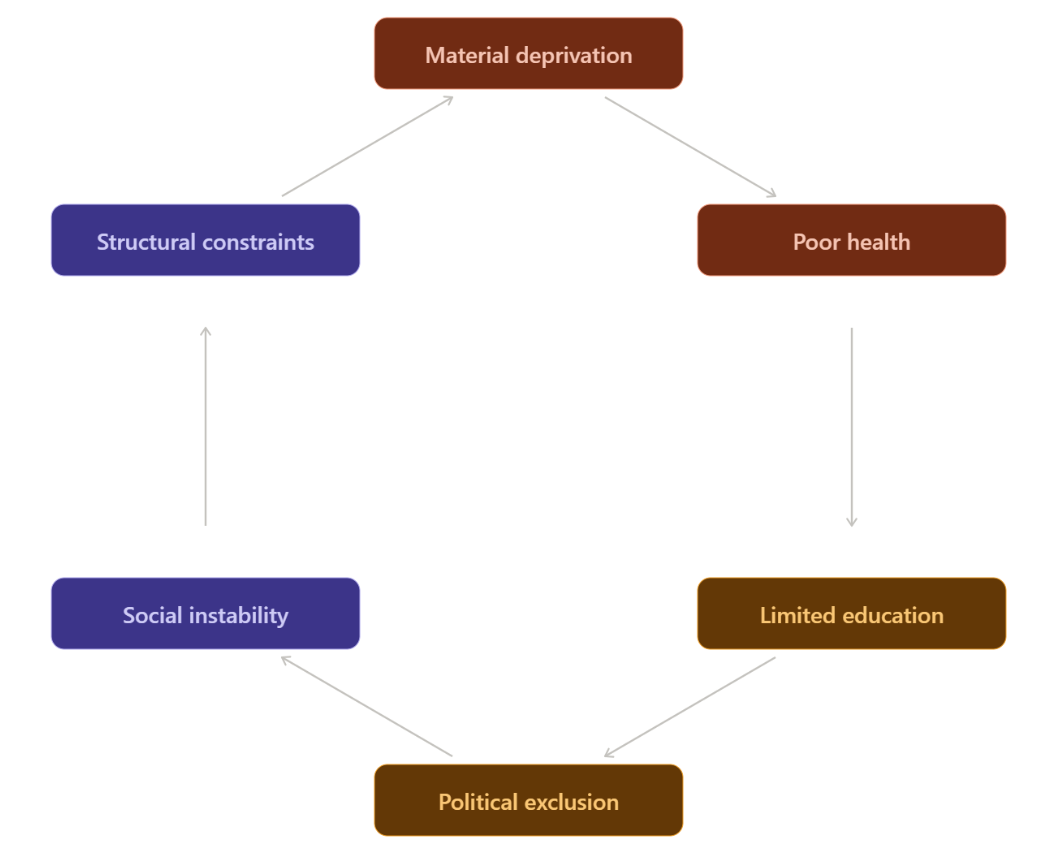
Material deprivation is the starting point
Insufficient income means inadequate food, housing and clothing
The immediate consequences are physical - malnutrition, exposure, preventable illness
But material deprivation also shapes everything that follows
Health deteriorates as a direct consequence of poverty
Poor nutrition weakens immune systems; overcrowded housing accelerates the spread of infectious disease
Without access to healthcare, conditions that are easily treatable become chronic or fatal
Poor health reduces the capacity to work, trapping individuals and families in a poverty–health cycle
Education becomes inaccessible or ineffective
Direct costs (fees, uniforms, materials) may be unaffordable; indirect costs from lost child labour income may be prohibitive
Even where schools are free, hungry or sick children cannot learn effectively
Without education, the next generation inherits the same deprivations — poverty becomes intergenerational
Political exclusion follows
Those in poverty have less time, fewer resources and less social capital to participate in political processes
They are less likely to vote, less likely to be represented and less likely to have their interests reflected in policy
Political exclusion means the policies that perpetuate poverty face no effective challenge from those they harm most
Social instability emerges as the cascade deepens
Sustained deprivation combined with political exclusion generates grievance
Where institutions are weak or corrupt, this grievance can translate into conflict - either within states or across borders
Conflict in turn destroys the livelihoods, infrastructure and institutions needed to escape poverty
The structural dimension closes the loop globally
Trade rules, debt obligations and international financial architecture constrain the policy choices available to poorer states
Wealthy states and international institutions may impose conditions - austerity, privatisation - that reduce public services precisely when they are most needed
This is what makes poverty a global political challenge rather than a local one - the decisions that perpetuate it are frequently made far from those who experience it
Current and recent poverty challenges
Poverty challenges in the contemporary world take many forms and affect states at every level of development
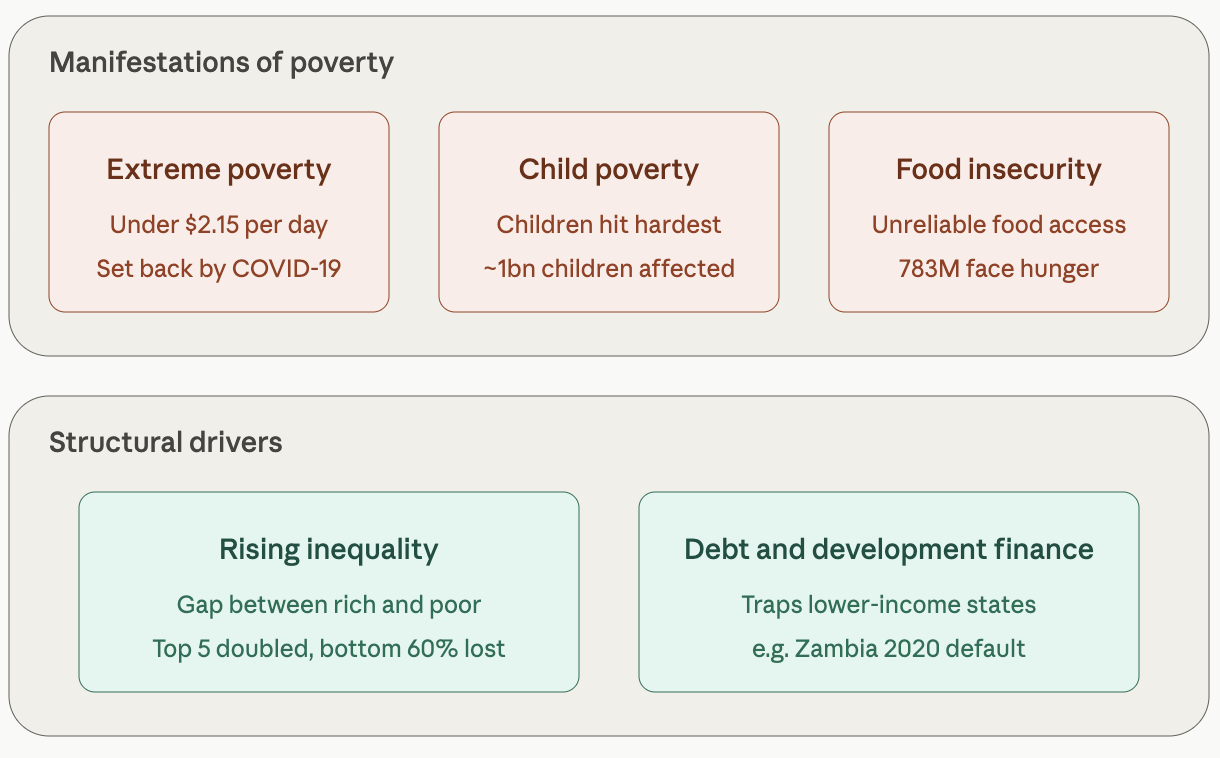
They split usefully into manifestations (how poverty appears in people's lives) and structural drivers (the systemic forces that produce and maintain it)
Manifestations of poverty
Extreme poverty - those living under $2.15 per day; progress against extreme poverty was set back significantly by COVID-19
Child poverty - children are disproportionately affected by poverty, with around 1 billion children affected globally
Food insecurity - unreliable access to adequate food; approximately 783 million people face hunger globally
Structural drivers
Rising inequality - the gap between rich and poor has widened in many states; the wealthiest 5% have doubled their share of global income while the bottom 60% have lost ground
Debt and development finance - debt obligations trap many lower-income states in cycles of austerity (e.g. Zambia became the first African state to default on its debt in 2020)
Actors and stakeholders
When researching a case study on poverty, students should identify a range of actors and stakeholders
Nation-states
Set poverty reduction policies and control access to welfare systems and public services
Negotiate trade agreements and international financial arrangements that shape economic conditions
The World Bank
Provides development finance and technical assistance to lower-income states
Produces influential poverty data; historically required structural adjustment conditions for loans
The International Monetary Fund (IMF)
Provides emergency financial assistance to states in economic crisis
Conditions attached to IMF loans have frequently required cuts to public spending
The UN Development Programme (UNDP)
Coordinates international development efforts
Produces the annual Human Development Report and the Multidimensional Poverty Index
Non-governmental organisations (NGOs)
E.g. Oxfam, Save the Children and ActionAid - advocate for poverty reduction, provide direct assistance and campaign for policy change at national and international levels
Multinational corporations (MNCs)
Create employment and economic activity in developing states
Also extract profits, may avoid taxation and can exploit low-wage labour markets
Social movements
E.g. the Jubilee Debt Campaign, which successfully campaigned for debt relief for the world's poorest states
Use public pressure, advocacy and direct action to challenge the policies that perpetuate poverty
Individuals and communities in poverty
The people most directly affected by poverty
Their voices are frequently absent from the international forums where decisions about poverty are made
Example case studies
The following examples illustrate the kinds of case studies students could develop for this topic area
Case study | Outline | Connections to other HL topics |
|---|---|---|
Child labour in the carpet industry in Pakistan |
|
|
Poverty within indigenous communities in Australia |
|
|
The Jubilee Debt Campaign |
|
|
Links to earlier course content
The poverty topic area connects to all four areas of the IB Global Politics course
Section | Key connections |
|---|---|
Core topics |
|
Rights and justice |
|
Development and sustainability |
|
Peace and conflict |
|
Links to the other HL topic areas
A case study on poverty will frequently connect to other HL topic areas - identifying these links is essential for question 3
HL topic area | Key connections |
|---|---|
Security |
|
Equality |
|
Borders |
|
Health |
|
Technology |
|
Environment |
|
Examiner Tips and Tricks
What distinguishes top-band answers is the deployment of named analytical concepts rather than description alone.
Dependency theory is one strong lens for many poverty cases - when applying it, consider which actors in your case study invoke structural explanations and which emphasise individual or national factors. The tension between these perspectives, and what each reveals about the distribution of power, is the kind of analytical engagement that scores well. The self-reinforcing cycle of poverty is a useful complement: strong answers don't just describe deprivation but trace how it ripples through health, education, political exclusion and social instability.
The syllabus also rewards drawing on the four core concepts (power, sovereignty, legitimacy, interdependence), broader theoretical perspectives (realism, liberalism, Marxism, the capability approach associated with Amartya Sen), levels of analysis (local to global) and multiple stakeholder perspectives. The right concept depends on your specific case - and many cases reward more than one.

Unlock more, it's free!
Join the 100,000+ Students that ❤️ Save My Exams
the (exam) results speak for themselves:

Was this revision note helpful?
