Alternative Views on Development and Sustainability (DP IB Global Politics: HL): Revision Note

De-growth
De-growth is a social movement demanding the planned reduction of economic growth, production and consumption
We live in a world where infinite economic growth is seen as the key to development, but this is simply not possible because the earth’s resources are finite
In order for societies to survive, they should opt out of the never-ending quest for economic growth
De-growth provides a radically different interpretation of development
While most models of development acknowledge the significance of economic growth, de-growth completely disagrees
To promote increased human and environmental welfare, it advocates:
abolishing all economic growth which is destroying our planet and negatively impacting human life
using fewer natural resources and living simpler lives focused on local sustainable resources
Critics of de-growth argue that the theory is unrealistic, as many social improvements are dependent on economic growth
However, the degrowth movement has already inspired people to live more sustainably
Case Study
Amsterdam and Doughnut Economics
In 2020, Amsterdam became the first city to formally adopt Doughnut Economics, a model that rejects infinite economic growth in favour of meeting human needs within environmental limits
The model
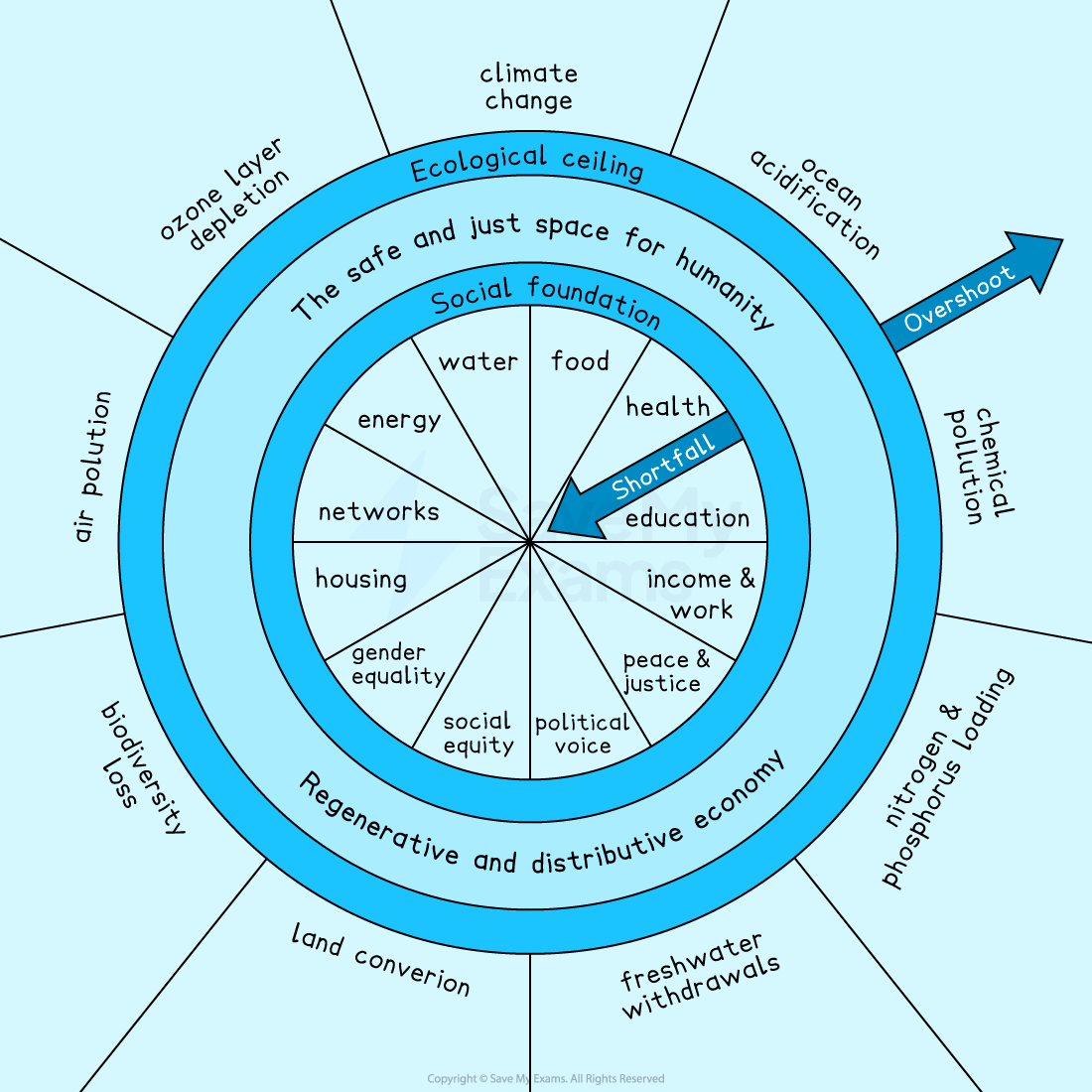
The doughnut sets minimum standards for human well-being and an ecological ceiling (planetary boundaries that must not be exceeded)
Development is only sustainable when it operates within both boundaries - mirroring de-growth principles directly
Policy in practice
Amsterdam set a target to halve its use of new raw materials by 2030
Circular economy initiatives were introduced, including repair cafes, second-hand clothing schemes and local food projects
Meat consumption in public buildings was reduced to lower the city's environmental footprint
Significance
Amsterdam demonstrates that de-growth is not purely theoretical - it can become official government policy
Critics note that Amsterdam remains a wealthy, high-consumption city and these measures fall short of a fundamental rejection of growth
Brussels, Copenhagen and Barcelona have since adopted similar frameworks, suggesting de-growth is gaining wider political traction
Regenerative approaches
Regenerative approaches, advocated by theorists including Medard Gabel, move beyond sustainable development, arguing that sustaining does not go far enough
To regenerate means to use resources in such a way as to build capacity for future growth, not simply sustain it
There are many debates regarding what exactly a regenerative approach
Most support the idea of going beyond sustaining the world as it is
Regenerative ideas are often applied to agriculture and food production
Examples of regenerative approaches
Approach | Explanation | Example |
|---|---|---|
Soil restoration |
|
|
Composting |
|
|
Water management |
|
|
Efficient use of natural resources |
|
|

Unlock more, it's free!
Join the 100,000+ Students that ❤️ Save My Exams
the (exam) results speak for themselves:

Was this revision note helpful?
