Material Causes of Conflict (DP IB Global Politics: HL): Revision Note

Interests
An interest-based conflict is disagreement between parties that arises from competing needs, desires or goals over resources, power or opportunities
They usually occur when the needs of a group of people are not being met
Most interest-based conflicts occur within a state
It is important to remember that there can be multiple causes of any one conflict
Many interest-based conflicts are not violent and can bring about positive change and justice
Workers and their unions may demand better working conditions from the company that prioritises profit
Civil society may organise a protest march to demand their schools receive more funding from local government
Other interest-based conflicts can become violent, particularly if the group demanding change are not satisfied or if their demands are met with violence and conflict
Greed vs grievance
A key debate in the study of intrastate conflict is whether it is driven by greed or grievance
Greed refers to the desire for economic gain, particularly control over valuable resources
Grievance refers to a genuine concern, such as the failure of a government to meet the needs of its people
This debate focuses on intrastate conflict
The greed argument
Some theorists argue that intrastate conflicts may appear to be grievance-based on the surface, but closer analysis reveals economic gain as the main motivator
Key questions
Will the conflict result in economic benefits for those involved?
Will it lead to control over valuable resources such as oil, minerals or land?
Example: The conflict in Yemen has been linked to competition for control of oil and gas resources, suggesting economic interests play a significant role
However, it also involves deep political grievances, including the marginalisation of certain groups and the intervention of foreign powers
The grievance argument
Other theorists argue that when a government fails to meet the needs of its people, through poverty, inequality or repression, conflict becomes inevitable
In this view, greed is not the primary cause; genuine injustice is
Theoretical perspectives
Paul Collier argues that greed is the primary driver of intrastate conflict
Rebel groups are often motivated by the opportunity to seize control of valuable resources rather than by genuine political grievance
Other theorists disagree, arguing that when a government fails to meet the needs of its people conflict becomes inevitable and grievance, not greed, is the root cause
Many researchers argue that the greed vs grievance debate oversimplifies the reality of intrastate conflict; in practice, both causes are deeply interconnected
Intrastate conflict is too complex to be reduced to a single cause
Both greed and grievance typically operate together, shaping the motivations of different groups within the same conflict
Resources
Resources include land, maritime rights, oil, minerals and other assets of strategic or economic value
Conflict can arise when resources are scarce or when the ownership of resources is disputed
Competition for power and resources is the most common form of interest-based conflict driven by material gain rather than ideology or identity
However, most conflicts have multiple causes - resource competition is rarely the only factor
Interest-based conflicts can occur:
between states (interstate conflict)
within a state, when armed groups or political actors challenge the government (intrastate conflict)
Examples of interest-based conflict
Russia-Ukraine war
Widely considered to be primarily an interest-based conflict
Ukraine holds significant strategic importance — including its location, access to ports and its agricultural and industrial resources
Control of Ukrainian territory also has major implications for regional political power
Israel-Palestine conflict
Also considered to be primarily an interest-based conflict
At its core is a long-running dispute over land - who has the right to occupy and control the same territory
Case Study
Resource conflict in the South China Sea
The South China Sea is bordered by China, Vietnam, the Philippines, Malaysia, Brunei and Taiwan
Multiple states claim overlapping rights to the same territories, making it a significant source of interstate conflict
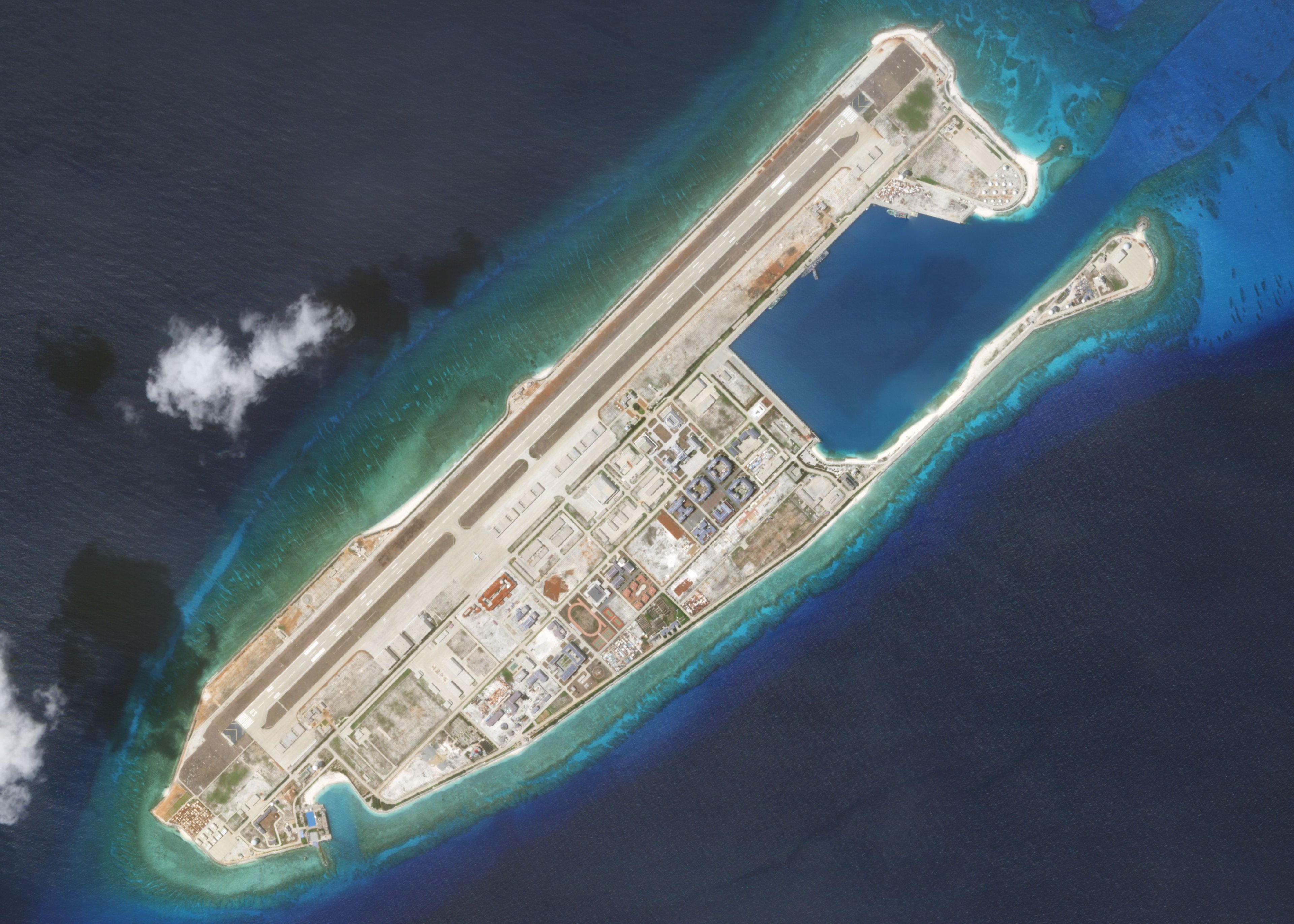
By SkySat - https://www.planet.com/gallery/#!/post/fiery-cross-reef (opens in a new tab), CC BY 2.0
Resources at stake
Significant reserves of oil and natural gas
One of the world's busiest shipping lanes - an estimated $3 trillion worth of global trade passes through annually
Vital fishing grounds for millions of people across the region
The dispute
China claims approximately 90% of the South China Sea through the nine-dash line - a boundary that overlaps with the territorial waters of several neighbouring states
China has constructed artificial islands on disputed reefs and installed military facilities on them
In 2016, the Permanent Court of Arbitration ruled in favour of the Philippines, finding China's claims had no legal basis under international law
China rejected the ruling
Why it is an interest-based conflict
Control of the sea would give China significant economic advantages - access to oil, gas and fishing rights - as well as strategic military dominance over a crucial global shipping route
The conflict also has an identity dimension - China frames its claims in terms of historical ownership
Impact
Tensions remain high, with frequent confrontations between naval and coastguard vessels
Regional body ASEAN (Association of Southeast Asian Nations) has attempted to mediate but has so far failed to reach a binding agreement

Unlock more, it's free!
Join the 100,000+ Students that ❤️ Save My Exams
the (exam) results speak for themselves:

Was this revision note helpful?
