Peace (DP IB Global Politics: HL): Revision Note

What is peace?
Peace is one of the most debated concepts in global politics
It is commonly understood as the absence of war, but in reality it is more complex
Scholars distinguish between negative peace (the end of direct violence) and positive peace (the presence of justice, equality and the structures needed to prevent conflict recurring)
Peace exists on a spectrum
Its absence does not always mean open conflict
Its presence does not always mean genuine stability
Different political traditions, theories and religions interpret peace in contrasting ways, each emphasising different conditions for achieving and sustaining it
Positive peace
Johan Galtung defines positive peace as social justice, meaning:
the absence of racism, poverty and inequality
cooperation, fairness and equality for all people in a society
government and social structures designed to support fairness and equality
government and social structures supporting ways to resolve conflicts and disagreements peacefully
Positive peace requires an understanding of the complexity of the concept of violence
The Positive Peace Report
The Positive Peace Report is produced by the Institute for Economics and Peace (IEP)
It defines Positive Peace as the attitudes, institutions and structures that create and sustain peaceful societies
The 8 pillars of positive peace
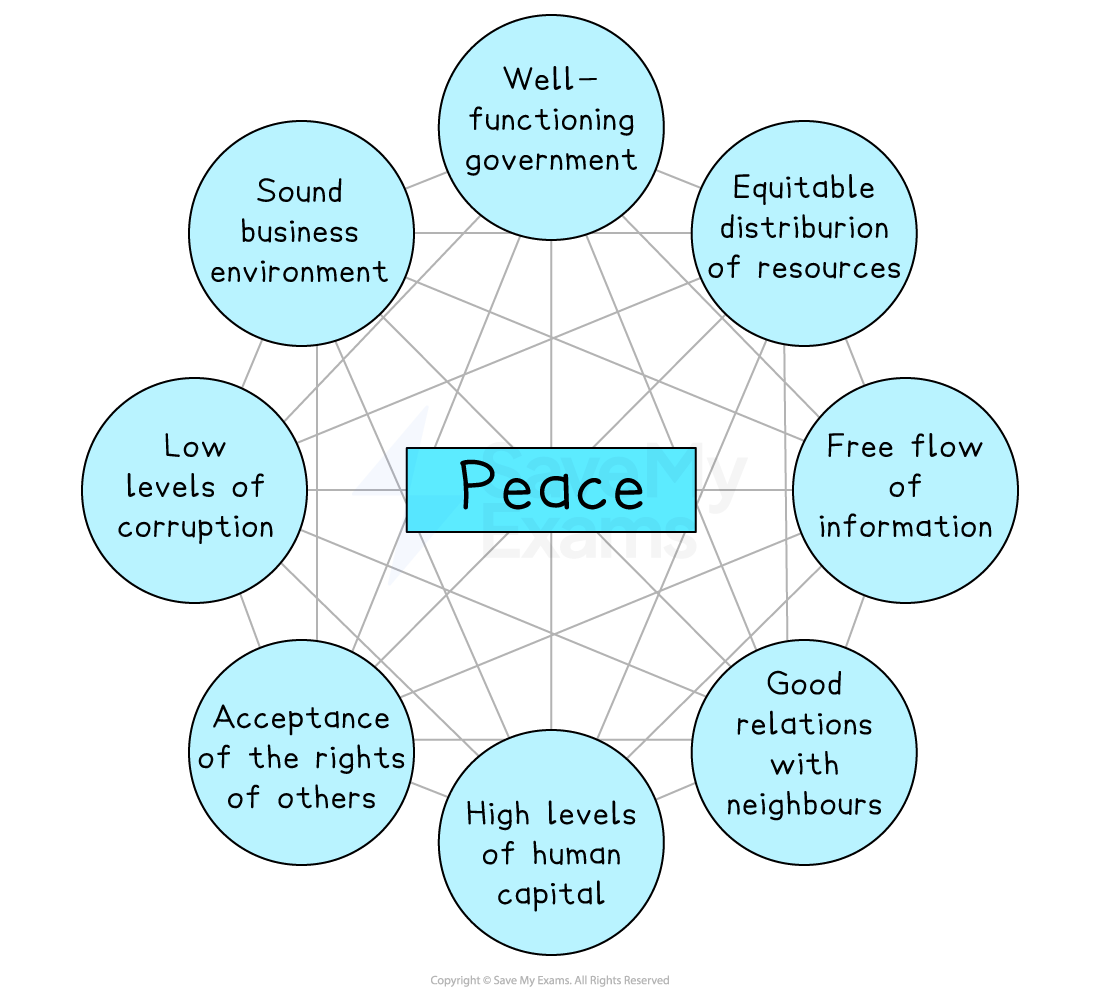
Well-functioning government
Effective delivery of essential services, protection of rights and the ability to govern reliably and accountably
Sound business environment
A formal economy with property rights, a functioning financial sector and opportunities for entrepreneurship and investment
Equitable distribution of resources
Equal access to resources and a fair distribution of wealth across society, reducing grievances that can lead to conflict
Acceptance of the rights of others
Formal laws and social attitudes that ensure equal treatment regardless of gender, ethnicity, religion or political opinion
Good relations with neighbours
Low levels of hostility with neighbouring states and constructive regional cooperation and integration
Free flow of information
A free press, access to reliable information and internet freedom, enabling accountability and informed decision-making
High levels of human capital
Access to quality education, healthcare and training, enabling citizens to contribute productively to society
Low levels of corruption
Transparent institutions, the rule of law and accountable governance that prevent the abuse of power
Negative peace
Negative peace is a term coined by Johan Galtung to describe the absence of direct, physical violence
It does not require harmony or cooperation between parties - only that active violence has stopped
Examples of negative peace
A war or armed conflict has formally ended
Two states with a hostile history are not currently fighting, but tensions remain unresolved
Limitations of negative peace
Negative peace is fragile
Without addressing the underlying causes of conflict, violence can easily resume
It should be understood as a starting point rather than an end goal
Lasting stability requires progress toward positive peace
Building the institutions, attitudes and structures that prevent conflict from returning
Case Study
North and South Korea
North and South Korea have existed in a state of negative peace since 1953, when an armistice ended the Korean War
Technically, the two states remain at war to this day
Background
Korea was divided along the 38th parallel after the Second World War, with the Soviet-backed North and US-backed South forming separate states in 1948
The Korean War (1950–1953) killed an estimated 3 million people before the armistice halted active fighting
No peace treaty has ever been signed, leaving the conflict legally unresolved
Negative peace in practice
Despite no active fighting since 1953, the two states maintain the world's most heavily fortified border - the Demilitarised Zone (DMZ)

North Korea has conducted multiple nuclear weapons tests, maintaining a constant threat of renewed violence
Periodic incidents have continued, including the sinking of a South Korean naval vessel in 2010
Why negative peace has not become positive peace
The root causes of division - ideological conflict between communism and liberal democracy, and the role of external powers - have never been resolved
North Korea remains one of the world's most isolated and authoritarian states, scoring poorly across all 8 pillars of positive peace
Reunification talks have repeatedly stalled, with brief diplomacy giving way to renewed hostility
Summary
North and South Korea illustrate the fragility of negative peace
Over 70 years after the armistice, the absence of war has never translated into genuine stability
This demonstrates why negative peace must always be followed by efforts to address the structural causes of conflict
Peace in different political and theoretical contexts
Peace can be examined using different theoretical lenses
Different interpretations of peace often complement each other and are not usually in opposition
Different political and theoretical views on peace
Feminist peace | Religious and spiritual traditions |
|---|---|
|
|
The balance of power theory | Liberal institutionalism |
|
|

Unlock more, it's free!
Join the 100,000+ Students that ❤️ Save My Exams
the (exam) results speak for themselves:

Was this revision note helpful?