Third-Parties (DP IB Global Politics: HL): Revision Note
Third-party actor involvement in conflict
In conflicts involving multiple parties, third-party actors play a critical role in preventing, managing and resolving violence
They include intergovernmental organisations such as the UN and NATO, intrastate groups operating within conflict zones, and specialist organisations focused on mediation, negotiation and intervention
Third parties may be neutral facilitators seeking a peaceful resolution, or active participants with a stake in the outcome
Their involvement can either help bring conflict to an end or, in some cases, complicate it further
The effectiveness of third-party involvement depends on the trust of the conflicting parties, the legitimacy of the intervening actor and whether the underlying causes of conflict are addressed alongside any immediate ceasefire
Intergovernmental organisations (IGOs)
Intergovernmental organisations, including the United Nations (UN), play a significant role in preventing, managing and resolving conflict
Sometimes IGOs, such as the North Atlantic Treaty Organisation (NATO), actively engage in conflict
The United Nations (UN)
The UN is primarily involved in conflict prevention
It is a platform for states to resolve differences diplomatically rather than through violence
When violent conflict emerges, it takes an active role in attempting to manage and resolve it
The International Court of Justice (ICJ) is a legally-binding court that resolves disputes between states and prevents conflict
Because of state sovereignty only states that agree to the jurisdiction of the ICJ are involved
The Security Council has the power to issue ceasefire directives and attempts to bring about negative peace
It can issue directives to UN member states to enforce economic sanctions
Its five permanent members have different political alliances
This can prevent action being taken, as all have the power to veto
The UN play an active role in peacemaking efforts
UN peacekeeping missions can act as physical barriers in conflict zones to ensure negative peace
The International Criminal Court (ICC) can bring individuals who have committed war crimes and atrocities to trial
The jurisdiction of the ICC is limited to those states that have ratified the Rome Statute
The UN frequently collaborates with other IGOs, NGOs and states around conflict
Responsibility to Protect (R2P) allows the use of force by the UN to intervene if genocide or crimes against humanity are taking place
R2P is controversial as the UN’s mission is to preserve peace
North Atlantic Treaty Organisation (NATO)
NATO is an international alliance made up of 32 member states
It sees itself as an organisation that primarily prevents conflict and responds to crisis
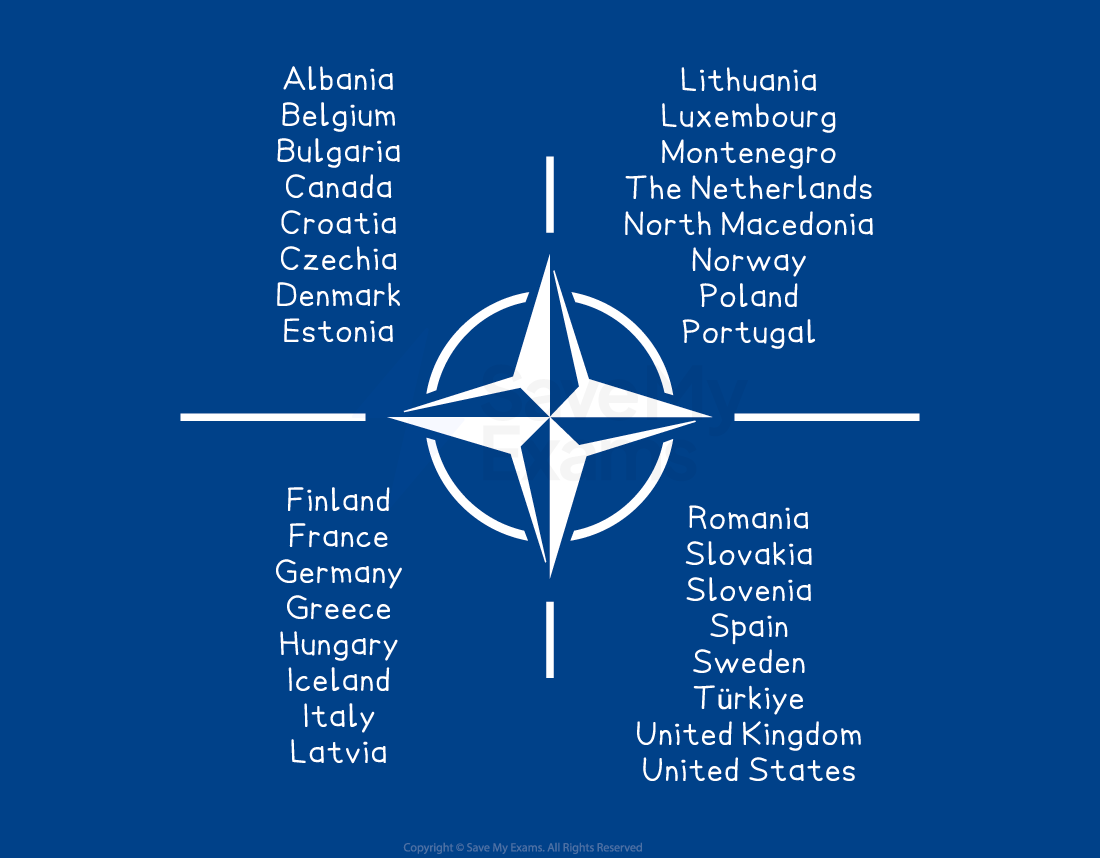
Each member state is expected to spend 2% of its GDP on defence
However, not all do - this has caused friction, particularly with the USA
NATO primarily serves as a system of collective defence
Article 5 of its charter states that an attack against one member is considered an attack against all
It does not have its own military force
Member states contribute their own militaries if needed
Intrastate groups
Intrastate groups are organised groupings that operate within the borders of a single country and seek to influence or challenge the authority of its government
Some intrastate groups can worsen conflict while others attempt to lessen the impact
Intrastate groups that may be involved in conflict
Civil society, NGOs and religious groups
These groups attempt to help civilians who have been impacted by conflict
For example, Al Sham Humanitarian Foundation provides shelter and food to victims of conflict in northern Syria
Rebel and resistance groups
These groups may have long wanted to overthrow the government and take advantage of conflict to launch attacks
For example, rebel groups Jama'at Nusrat al-Islam wal-Muslimin (JNIM) and Islamic State Sahel Province (IS-Sahel) have attacked the Mali government simultaneously
Other groups attempting to further their own interests to take advantage of the chaos of war include criminal gangs and profiteers
For example, in Haiti, the gang coalition Viv Ansanm exploited the collapse of state authority after 2021 to seize capital Port-au-Prince, profiting from kidnappings and extortion while the state was unable to respond
Peacebuilding groups
Some groups attempt to help the community with peacebuilding after the conflict has ended
For example, Respond and Break the Silence is seeking justice for the victims of the Philippines government's 'War on Drugs'
Mediation, negotiation and intervention
Mediation | Negotiation | Intervention |
|---|---|---|
|
|
|
Mediation and negotiation
Mediation and negotiation are usually facilitated by a range of third parties
States
Powerful states who see themselves as global leaders, such as the USA and China
States located in the region where the conflict is taking place
IGOs including the United Nations
The UN provides a neutral, globally recognised platform for peace talks
The UN Security Council can mandate ceasefires, deploy peacekeeping forces and impose sanctions to create conditions for negotiation
The UN Secretary-General can act as a direct mediator or appoint special envoys to facilitate dialogue
Regional IGOs such as the African Union
Regional organisations often have good local knowledge, cultural understanding and political credibility with conflicting parties
The African Union has mediated in conflicts in South Sudan, Somalia and the Central African Republic, brokering ceasefires and monitoring peace agreements
Regional IGOs can act more quickly than the UN and may be better placed to apply peer pressure on conflicting states within their region
NGOs specialising in global mediation
E.g. the Centre for Humanitarian Dialogue works confidentially with governments, armed groups and other parties to facilitate peace talks and negotiate ceasefires
Intervention
Intervention is usually a last resort if multiple attempts at mediation and negotiation have failed and people are suffering grave human rights violations such as genocide
Many question the legitimacy of armed intervention because
Intervention violates state sovereignty
Powerful states have been accused of using intervention as an excuse to invade countries and seize natural resources
Intervention can escalate conflict rather than end it
Intervention may work in the short term to bring negative peace, but it leaves long-lasting problems
Election monitoring
This is a key tool used by third parties to support peace and stability following conflict
International observers, including the UN, the African Union and the Carter Center, oversee elections in post-conflict states, verifying that the process is free, fair and credible
This helps to legitimise newly elected governments, reduce the risk of disputed results reigniting conflict and support the transition from negative peace to longer-term political stability
For example, the UN Mission in South Sudan (UNMISS) has supported electoral preparations as part of the broader peace process

Unlock more, it's free!
Join the 100,000+ Students that ❤️ Save My Exams
the (exam) results speak for themselves:

Was this revision note helpful?
