Justice Institutions (DP IB Global Politics: HL): Revision Note

Justice institutions within the state
Justice institutions within the state include courts, policing agencies, correction services
They can greatly influence the peace and stability of that state
Effective and accountable justice institutions within a state can prevent corruption, violence and instability, all of which breed conflict
When conflict between different actors is handled fairly, there is a greater chance that the conflict will be resolved
If all people are treated equally, including the marginalised or vulnerable, conflict can be prevented
When criminal and violent behaviour is met with consequences, society becomes safer
The least corrupt justice systems are found in states where the government acts transparently and citizens participate in governance
Case Study
Justice institutions in Denmark
Denmark is consistently ranked as one of the least corrupt countries in the world by Transparency International's Corruption Perceptions Index
It is widely regarded as a model of how effective, accountable justice institutions can contribute to peace and stability within a state
Key features of Denmark's justice institutions
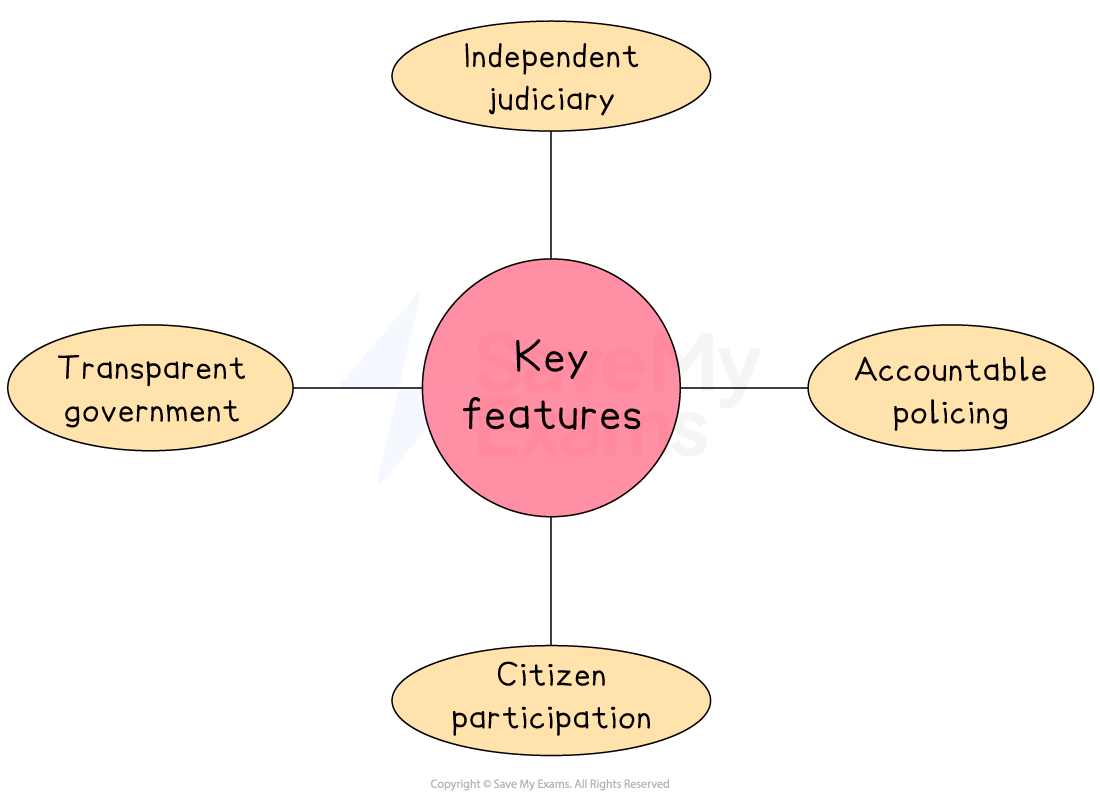
Independent judiciary
Courts operate free from political interference, meaning all citizens, including the powerful, are subject to the same law
Accountable policing
Danish police are subject to independent oversight, with clear mechanisms for reporting misconduct and holding officers to account
Transparent government
Denmark has strong freedom of information laws, meaning citizens can scrutinise government decisions and institutions are less able to act corruptly without consequence
Citizen participation
High levels of civic engagement and a free press mean that justice institutions are regularly held to public account
Why it is stable and peaceful
Because justice is administered fairly and consistently, including for marginalised groups, citizens have high levels of trust in state institutions
Corruption is low, reducing the grievances that often drive conflict
Criminal behaviour is met with proportionate consequences within a system that also prioritises rehabilitation, making reoffending less likely
Denmark consistently ranks among the top countries in global peace indices, including the Global Peace Index
Why it matters
The Danish example shows that peace within a state is not simply the absence of war
It depends on strong, fair and transparent institutions that treat all citizens equally
It also demonstrates that the least corrupt states tend to be those where government acts openly and citizens are actively involved in governance
Regional justice institutions
Regional justice institutions are bodies established by a group of neighbouring countries to address human rights violations, resolve disputes or uphold the rule of law within a specific geographic area
These institutions are ordinarily linked to regional IGOs
They are designed to facilitate justice and thereby promote sustainable peace
They are thought to be more impactful than international justice institutions because they better understand the circumstances of the cases they examine
Examples of regional justice institutions
IGO | Name of court | Political Issues |
|---|---|---|
European Union |
|
|
Organisation of American States |
|
|
African Union |
|
|
With the exception of the European Union, the decisions made by these courts are not legally binding unless member states fully cooperate
International justice institutions
International justice institutions are legal bodies established by the international community to investigate, prosecute or adjudicate serious violations of international law, such as war crimes, genocide, and crimes against humanity
They are a component of global governance
Due to state sovereignty these institutions usually can only work in collaboration with state actors
Examples of international justice institutions
Institution | Purpose and key powers | Limitations | Recent example
|
|---|---|---|---|
International Court of Justice (ICJ) |
|
|
|
International Criminal Court (ICC) |
|
|
|
Interpol |
|
|
|
International justice as a controversial concept
Some believe that international justice institutions act as a deterrent to state actors and individuals planning on committing atrocities or serious crimes
Realists argue that global governance is an illusion
States will only cooperate with international justice institutions if it suits their interests
Critics argue that powerful states (such as those in the Security Council) evade international justice while less powerful states are targeted
In the case of decisions made by the ICJ, enforcement requires the cooperation of the states involved
States must formally recognise the jurisdiction of the ICJ and ICC before cases against them or their citizens can take place
Despite the limitations, many argue that these institutions help to strengthen international norms about justice, which is a key component of lasting peace

Unlock more, it's free!
Join the 100,000+ Students that ❤️ Save My Exams
the (exam) results speak for themselves:

Was this revision note helpful?
