Borders (DP IB Global Politics: HL): Revision Note

Borders in global politics
A set of topic areas is presented for the study of global political challenges to facilitate your explorations. These should not be seen as fully discrete or disconnected topics, but rather as overlapping areas of study that can contribute to understanding and addressing global challenges.
You can conduct an in-depth study of two of the topic areas—for example, security and health—or you may choose to explore the interconnections of multiple topic areas based on a selected case study.
In global politics, borders refer to much more than the physical lines drawn on a map between countries
The concept extends to any division that separates groups of people and creates unequal access to rights, resources or power
Borders can be
Physical – the territorial and maritime boundaries between nation-states
Social – divisions between groups of people based on class, gender, ethnicity or religion
Economic – restrictions on the movement of capital, goods or labour
Why are borders a global political challenge?
Borders are closely connected to sovereignty
When borders are crossed without permission, states may use military or police force to stop this, raising human rights concerns
The movement of large numbers of people across borders puts pressure on states and international organisations to respond
Borders are not always agreed upon between states, which can lead to territorial disputes
Globalisation has reduced some economic and cultural borders, creating tension with states that wish to maintain strict control over their physical borders
Key terms and concepts
Term | Definition |
|---|---|
Sovereignty |
|
Territorial dispute |
|
Migration |
|
Immigration |
|
Refugee |
|
Asylum seeker |
|
Non-refoulement |
|
Human trafficking |
|
Securitisation |
|
Globalisation |
|
Types of borders
Physical borders
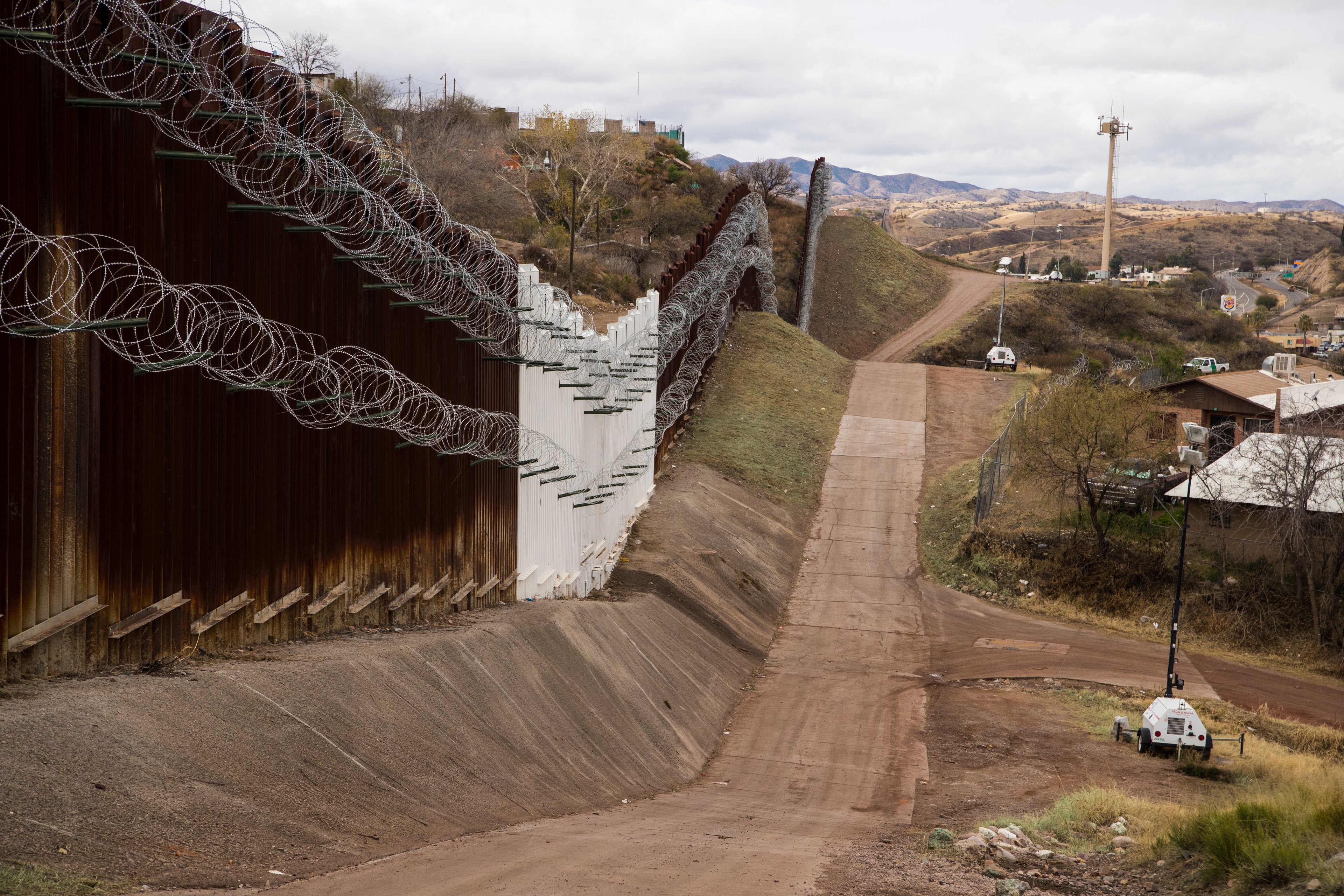
Territorial borders separate nation-states on land
They are often marked by walls, fences, checkpoints or natural features such as rivers and mountains
Maritime borders define a state's control over areas of sea
These are governed by international law, in particular the United Nations Convention on the Law of the Sea (UNCLOS)
Disputed physical borders are a frequent cause of conflict, both between states and within them
Social and symbolic borders
Social borders are less visible than physical ones but are equally significant in global politics
Gender borders
Unequal treatment based on gender, including restrictions on women's freedom of movement or participation in public life
Class borders
Divisions based on economic status, which can determine access to education, healthcare and political participation
Ethnic borders
Divisions based on ethnicity or race, which can result in discrimination, persecution or conflict
A useful analytical lens: sovereignty vs human rights
One of the most productive ways to read a borders case study is through the tension between state sovereignty and individual human rights. It won't be the right lens for every case, but it has analytical traction on most of them
The sovereignty principle gives states the right to decide who enters their territory, on what terms, and with what status
The human rights principle sets limits on that right - most importantly the right to seek asylum (Universal Declaration of Human Rights, Article 14) and the principle of non-refoulement under the 1951 Refugee Convention and Article 3 of the Convention Against Torture
These principles routinely collide in practice:
States invoke sovereignty to justify pushbacks, detention, walls and offshore processing
International law and NGOs invoke human rights to challenge these practices
When this lens applies, strong answers locate the tension precisely in the chosen case study - naming the specific sovereign claim, the specific right at stake, and the actors making each argument
The legal status of border crossers
A person's rights at a border depend almost entirely on the legal category they fall into. This typology is essential vocabulary for any borders case study
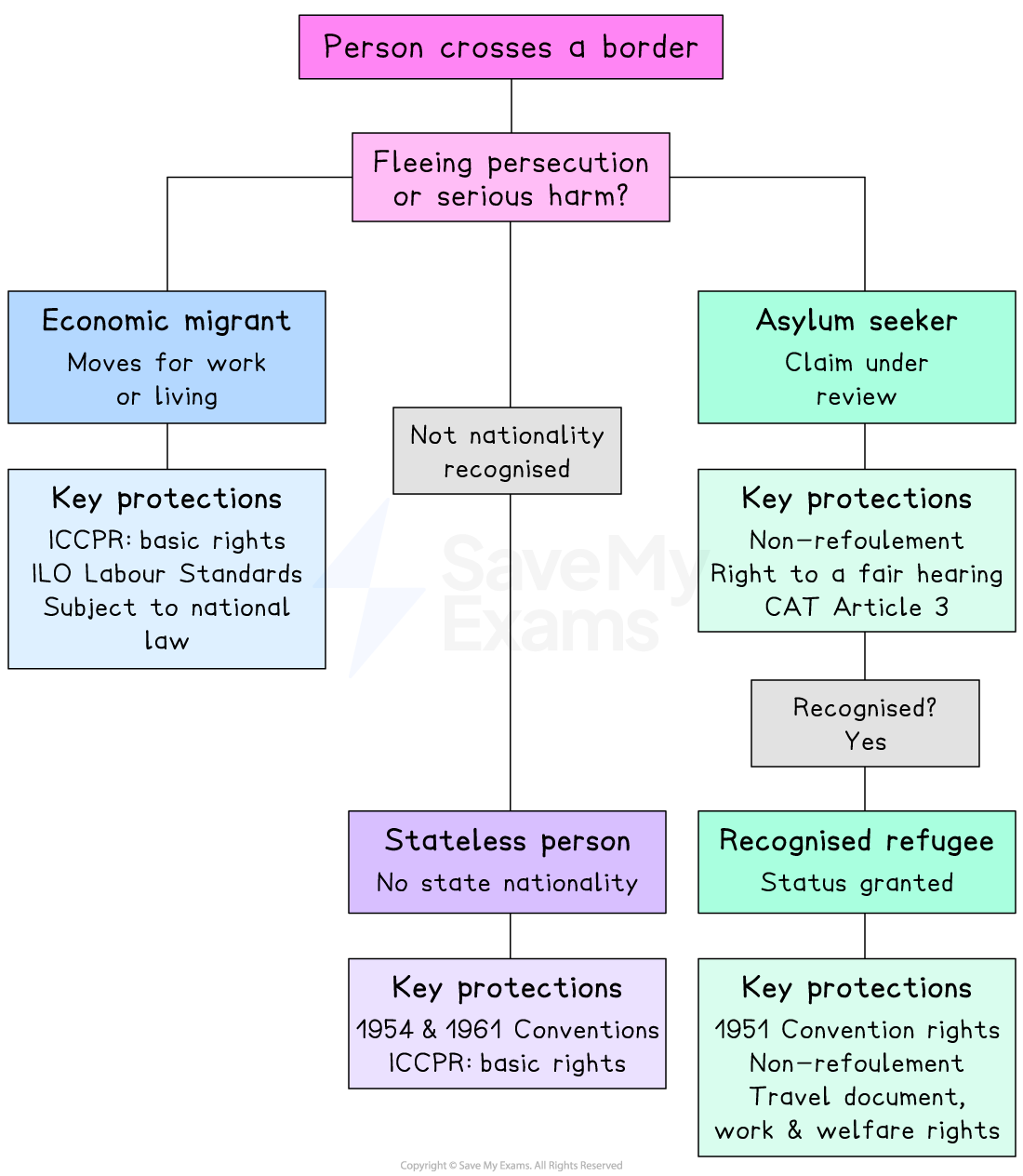
Economic migrants sit largely outside international refugee law
Their protections come from general human rights instruments — the ICCPR (civil and political rights) and ILO conventions on labour standards — but they are ultimately subject to the immigration law of the destination state
Asylum seekers have rights while their claim is being processed
Most critically the principle of non-refoulement (they cannot be returned to a country where they face serious harm), which flows from the 1951 Refugee Convention and Article 3 of the Convention Against Torture
Recognised refugees gain the full package of 1951 Convention rights
Non-refoulement, the right to a travel document, and access to work, welfare and education on terms broadly equivalent to nationals
Stateless persons are those not considered nationals by any state
Covered by two specialist instruments: the 1954 Convention Relating to the Status of Stateless Persons (basic rights of residence and documentation) and the 1961 Convention on the Reduction of Statelessness
The UNHCR has a mandate to protect them, though far fewer states have ratified these conventions than the Refugee Convention
Statelessness and refugee status can overlap — a person can be both stateless and a refugee (e.g. the Rohingya), in which case both frameworks apply
Current and recent border challenges
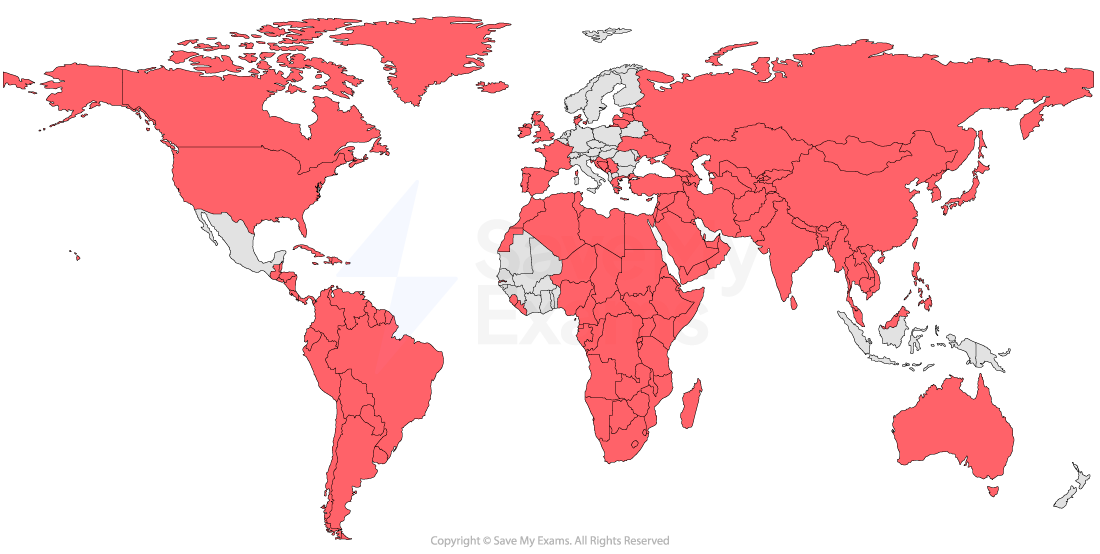
Most countries on the globe are currently involved in territorial disputes and surprisingly few are not
Irregular migration and refugee flows
Border crossings outside official channels are one of the most politically significant sources of tension globally
E.g. the European migration crisis (from 2015), in which over 1 million people crossed into the EU irregularly, primarily from Syria, Afghanistan and sub-Saharan Africa
Territorial disputes
Disagreements over the ownership or control of land and sea remain a persistent source of interstate tension
E.g. China's expanding maritime claims in the South China Sea overlap with those of Vietnam, the Philippines, Malaysia, Brunei, and Taiwan
A 2016 ruling by the Permanent Court of Arbitration rejected China's claims, but China has consistently refused to recognise it
Border securitisation
States have increasingly responded to migration and security concerns by constructing physical barriers and expanding border enforcement
E.g. the USA-Mexico border wall, Hungary's razor-wire fence on the Serbian border and the fortified barriers around the Spanish enclaves of Ceuta and Melilla in Morocco
Stateless and undocumented people at borders
Those without legal status are among the most politically vulnerable, frequently denied protection under international law
E.g. from 2017, over 700,000 stateless Rohingya fled Myanmar into Bangladesh, creating the world's largest refugee settlement at Cox's Bazar
Post-Brexit border disputes
The UK's departure from the EU created significant tensions over the border between Northern Ireland and the Republic of Ireland
E.g. the Northern Ireland Protocol and subsequent Windsor Framework (2023) attempted to resolve the tension between UK sovereignty and the requirements of the Good Friday Agreement
Actors and stakeholders
When researching a case study on borders, students should identify a range of actors and stakeholders
Nation states
Set and enforce immigration and border policies
May use military or police force to secure borders
Intergovernmental organisations (IGOs)
The United Nations High Commissioner for Refugees (UNHCR), which protects refugees
The International Organisation for Migration (IOM)
The European Union (EU), which governs freedom of movement among its member states
Non-governmental organisations (NGOs)
Médecins Sans Frontières, Human Rights Watch and Amnesty International, which monitor conditions at borders and assist migrants
Migrants, refugees and asylum seekers
Individuals most directly affected by border policies
Their experiences vary greatly depending on their legal status
Criminal organisations
Smuggling networks that profit from irregular (unauthorised) migration
Private sector actors
Companies providing border surveillance technology or operating immigration detention centres
Example case studies
The following examples illustrate the kinds of case studies students could develop for this topic area
Case study | Outline | Connections to other HL topics |
|---|---|---|
The USA-Mexico border |
|
|
Singapore and Malaysia: the Pedra Branca dispute |
|
|
The Rohingya crisis: Myanmar and Bangladesh |
|
|
Links to earlier course content
The borders topic area connects to all four areas of the IB Global Politics course
Section | Key connections |
|---|---|
Power and global politics |
|
Rights and justice |
|
Development and sustainability |
|
Peace and conflict |
|
Links to the other HL topic areas
A case study on borders will frequently connect to other HL topic areas - identifying these links is essential for question 3
HL topic area | Key connections |
|---|---|
Security |
|
Equality |
|
Identity |
|
Health |
|
Poverty |
|
Examiner Tips and Tricks
When answering Q3, do not describe the border issue in general terms. You must use the specific details of your case study throughout your answer - named actors, particular events and accurate data where possible.
A strong answer will include precise information such as the number of people affected, the names of organisations involved and the outcomes of specific policies or decisions.
General statements about "border problems" will not score above the middle mark bands.
The most reliable evaluative move is to frame your case study around the sovereignty vs human rights tension and show how it plays out in the specific events you describe.

Unlock more, it's free!
Join the 100,000+ Students that ❤️ Save My Exams
the (exam) results speak for themselves:

Was this revision note helpful?