Answering Question 2 (DP IB Global Politics: HL): Revision Note

Question 2 - actors and recommendations
Question 2 has two parts
Question 2a is worth 4 marks
Question 2b is worth 6 marks
Read both parts before you begin writing either - they are connected and your answers must be consistent
Question 2a - actors and stakeholders
Question 2a asks you to identify and explain the roles of actors and stakeholders in relation to a specific global political challenge
The challenge will be drawn from one of the 8 HL topic areas
Question 2a is worth 4 marks and should take approximately 8–10 minutes
What the examiner is looking for
A range of relevant actors - not just one or two
Explanation of each actor's role, interests and actions - not just a list of names
Coverage of different actor types
Specific, accurate references - named organisations, not vague descriptions
What counts as an actor?
States | Intergovernmental organisations |
|---|---|
E.g. governments, militaries and state institutions |
|
Non-governmental organisations | Non-state actors |
|
|
Step-by-step approach
Step 1: Identify the challenge (1 minute)
Read the question carefully - which specific challenge is it asking about?
Step 2: List your actors (1 minute)
Aim for four to five distinct actors covering different types
For each: who are they and what is their role?
Step 3: Write your response (8 minutes)
For each actor: name them specifically → describe their role → explain their interests or actions → note the political consequence
Common mistakes
Listing actors without explaining their roles
Identifying only state actors - the question expects a range
Vague descriptions ("an international organisation provided assistance") rather than specific ones ("the UNHCR coordinated the registration of refugees in Cox's Bazar")
Confusing actors with issues - the question asks about who is involved, not what the problem is
Q2b — making a recommendation
Question 2b asks you to make a specific recommendation to a named actor about how to address the challenge identified in question 2a
Question 2b is worth 6 marks and should take approximately 12–15 minutes
What the examiner is looking for
A clear, specific recommendation addressed to a named actor
Justification - why would this recommendation be effective?
Awareness of political context - why is this actor positioned to act, and what obstacles might they face?
Consistency with the challenge and actors identified in question 2a
What makes a strong recommendation?
It is addressed to a specific, named actor - not "states should..."
It proposes a specific action - not "do more," but a named policy, mechanism or agreement
It is justified - you explain why it would work
It is realistic - the actor has the capacity and mandate to act
It acknowledges at least one obstacle or limitation
Weak vs strong recommendation
Weak | Strong |
|---|---|
 | 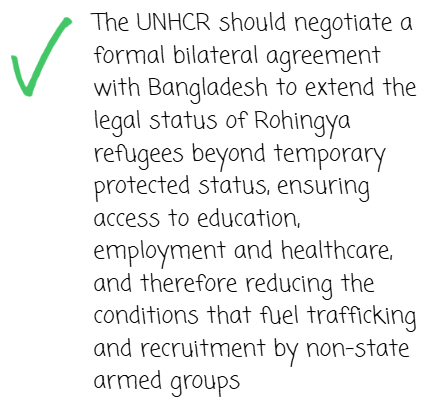 |
Step-by-step approach
Step 1: Choose your actor carefully (1 minute)
Which actor has both the capacity and the mandate to address this challenge?
State actors have direct power but may be part of the problem
IGOs have legitimacy but limited enforcement capacity
NGOs can act quickly but have limited political authority
Step 2: Formulate your recommendation (2 minutes)
Name the specific policy, mechanism or agreement you are recommending
Ask: why would this actor take this action? What is in their interest?
Ask: what obstacle might prevent it, and how could it be addressed?
Step 3: Write your response (10–12 minutes)
State the recommendation clearly in the first sentence
Explain why this actor is well-positioned to act
Justify the recommendation - why would it be effective?
Acknowledge at least one limitation or challenge
Common mistakes
Vague or generic recommendations ("more international cooperation is needed")
Failing to name a specific actor
Ignoring political feasibility - recommendations must be realistic
Omitting justification - a recommendation without reasoning will not score well
Examiner Tips and Tricks
Read question 2a and 2b together before writing either. Your recommendation in 2b must address the same challenge as 2a, and the actors you identify in 2a are the pool from which you select your actor for 2b. Planning both answers together saves time and ensures consistency.

Unlock more, it's free!
Join the 100,000+ Students that ❤️ Save My Exams
the (exam) results speak for themselves:

Was this revision note helpful?
