Environment (DP IB Global Politics: HL): Revision Note

Environment in global politics
A set of topic areas is presented for the study of global political challenges to facilitate your explorations. These should not be seen as fully discrete or disconnected topics, but rather as overlapping areas of study that can contribute to understanding and addressing global challenges.
You can conduct an in-depth study of two of the topic areas-for example, security and health-or you may choose to explore the interconnections of multiple topic areas based on a selected case study.
Environmental challenges are among the most pressing issues in contemporary global politics
They are inherently transboundary - the actions of one state can directly affect others, regardless of borders
They operate at every level - global (the atmosphere, oceans, polar regions), regional (transboundary pollution, shared rivers), national (emissions and land-use policy) and local (the direct impacts on communities)
The relationship between economic development and environmental protection is one of the most contested in global politics - and the political fault lines tend to run between states that industrialised early and those still pursuing development now
Why environment is a global political challenge
Environmental problems transcend national borders
No single state can address climate change, ocean pollution or biodiversity loss alone
The causes of environmental damage are often concentrated in wealthy, industrialised states
However, the effects fall most heavily on poorer, less developed states — creating profound questions of justice
Economic growth and environmental protection are frequently seen as conflicting priorities
Particularly by developing states that argue they should not bear the costs of damage caused historically by developed states
The tragedy of the commons
Resources shared by all (the atmosphere, the oceans) tend to be overused because no single actor bears the full cost of their exploitation
Environmental challenges interact with — and intensify — every other area of global politics, from security to migration to health (see Climate change as a threat multiplier below)
Key terms and concepts
Term | Definition |
|---|---|
Climate change |
|
Greenhouse gas emissions |
|
The Paris Agreement |
|
Sustainable development |
|
Tragedy of the commons |
|
Climate justice |
|
Common but differentiated responsibilities (CBDR) |
|
Environmental NGO |
|
Multilateralism |
|
Green technology |
|
Types of environmental challenge
1. Global commons issues
Problems affecting shared resources that belong to no single state
The atmosphere, the high seas and the polar regions are global commons - no state has sovereignty over them, yet all states contribute to their degradation
Governing the global commons requires multilateral cooperation, which is difficult to sustain
2. Transboundary pollution and resource conflicts
Pollution originating in one state that crosses borders and affects others
Competition over shared natural resources - water, land, fisheries, minerals - is increasingly a source of interstate tension
Water conflicts in particular are projected to intensify significantly as climate change reduces freshwater availability
3. Environmental degradation in developing states
Deforestation, soil erosion, desertification and overextraction of resources are all driven by economic pressures
Developing states often face a tension between the right to pursue economic development (as wealthier states did) and pressure from the international community to adopt greener practices
4. Climate-related displacement
People forced to move because of rising sea levels, drought, flooding or extreme weather
Distinct from refugees in international law - there is currently no legal status for climate refugees
Raises urgent questions about state responsibility, border policy and human rights
A useful analytical lens: common but differentiated responsibilities (CBDR)
One of the most productive ways to read an environment case study is through CBDR - particularly any case involving climate negotiations, treaty obligations, or disputes about who should bear the costs of environmental action. It won't be the right lens for every case, but it has analytical traction on most of them.
CBDR is the central principle of international environmental law. It holds that while all states share responsibility for addressing environmental challenges, developed states bear greater obligations because:
They industrialised first and produced the majority of historical greenhouse gas emissions
They have greater financial and technological resources to address environmental problems
Developing states should not have to sacrifice economic growth to solve a problem they did not primarily cause
Origin and influence
CBDR first appeared in the 1992 Rio Declaration and the United Nations Framework Convention on Climate Change (UNFCCC)
It has shaped every major climate agreement since, including the Kyoto Protocol (1997) and the Paris Agreement (2015)
Source of political tension
Developed states, particularly the USA, have resisted legally binding obligations that do not apply equally to major developing emitters such as China and India
Developing states argue that historical injustice must be recognised before they accept binding commitments
The Paris Agreement attempted to balance these tensions through nationally determined contributions (NDCs) - each state sets its own emissions targets rather than accepting externally imposed ones
Loss and damage
A related debate concerns loss and damage - whether developed states should compensate developing states for environmental harm they can no longer prevent
This was formally agreed at COP27 (2022) but the detail of how payments will work remains contested
A useful process model: climate change as a threat multiplier
Climate change rarely causes political conflict on its own
Instead it often acts as a threat multiplier - intensifying other political challenges, including security, poverty, health and forced displacement
Where this dynamic is at work, tracing the cascade below shows how an environmental shock works its way through the political system
It pairs naturally with CBDR - CBDR addresses who is responsible for environmental damage, the threat multiplier addresses how that damage produces political consequences
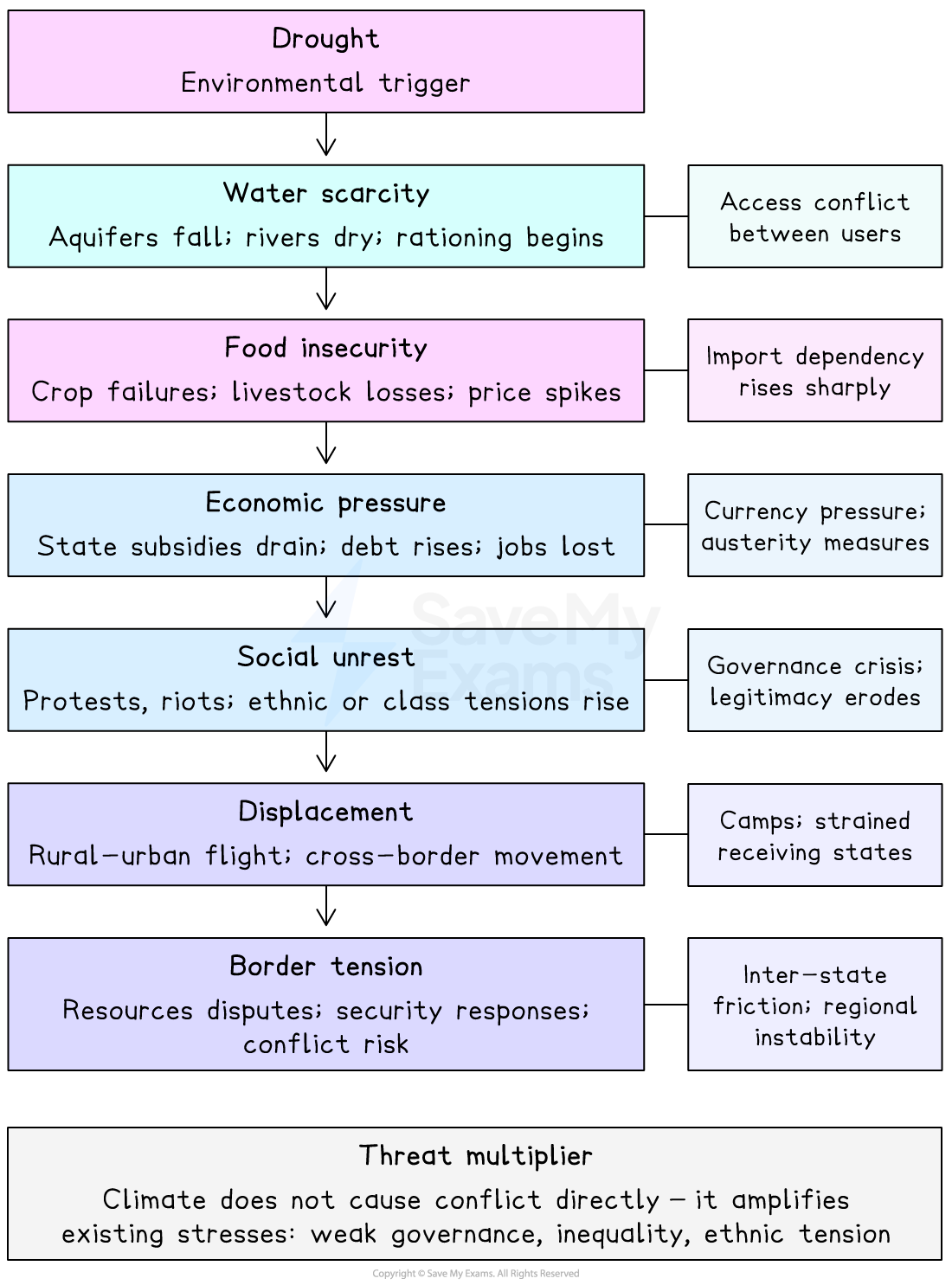
Water scarcity is where political consequences begin
Unlike most resources, water is non-substitutable and geographically fixed, so failing supplies quickly become zero-sum competition between farmers, cities and neighbouring states
Food insecurity follows as harvests fail and prices spike
The poorest are hit hardest
Governments face an unsustainable choice: subsidise food and drain reserves, or let prices rise and face public anger
Economic pressure sets in as tax revenues fall precisely when demands on the state rise
Subsidies, emergency imports, and debt destabilise currencies and crowd out investment, eroding the state's capacity to deliver basic services that sustain its legitimacy
Social unrest emerges as legitimacy breaks down
Latent grievances, such as ethnic tension, regional inequality and elite distrust, organise around hunger and precarity
Crucially, context determines outcome: the same drought hits a resilient democracy very differently than a fragile state with a history of exclusion
Displacement accelerates the cascade
People move first to cities, then across borders, responding not to rainfall figures alone but to the whole chain of failed harvests, lost livelihoods, and state failure
The distinction between climate migrant, economic migrant and refugee becomes almost impossible to determine
Border tension closes the loop geopolitically
Receiving states face service pressures
Shared rivers and aquifers become sites of inter-state competition
Borders harden
In the worst cases, conflict follows between states whose relationship was already strained
Instability undermines the very institutions needed to manage future drought
Irrigation falls into disrepair, agencies lose funding, corruption in water allocation grows
The society becomes more vulnerable to the next shock, not less
This is what distinguishes a threat multiplier from a simple cause-and-effect chain
Current and recent environmental challenges
Environmental challenges in the contemporary world take many forms and affect states at every level of development
The cleanest analytical cut for the IBDP framing is to separate damage to natural systems from the direct impacts those changes have on people
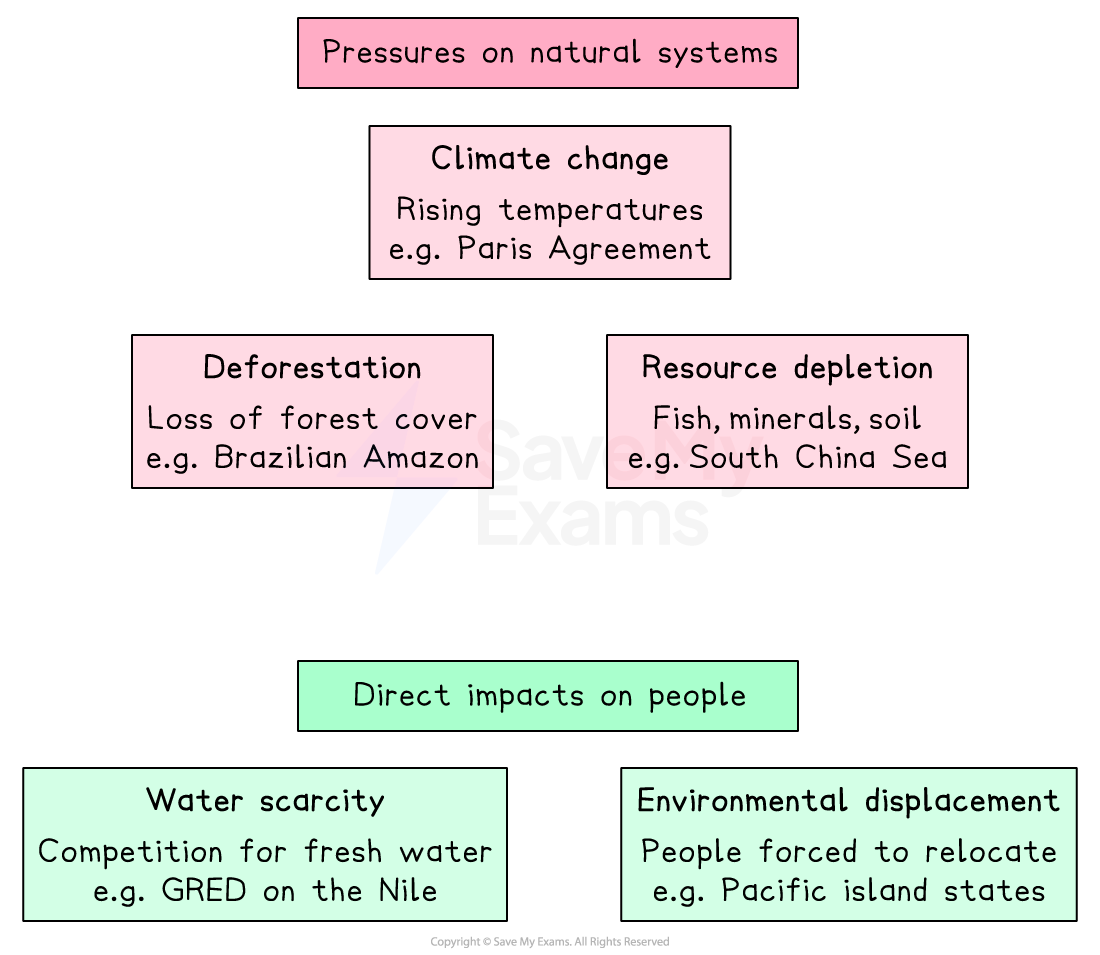
Pressures on natural systems
Climate change - rising global temperatures, extreme weather events and sea level rise caused by greenhouse gas emissions (e.g. ongoing debates about whether states are meeting their Paris Agreement commitments)
Deforestation - the large-scale clearing of forests, particularly in tropical regions, releasing carbon and destroying biodiversity (e.g. rapid deforestation in the Amazon region of Brazil)
Resource depletion - the overexploitation of fisheries, minerals and agricultural land (e.g. overfishing in the South China Sea affecting food security across the region)
Direct impacts on people
Water scarcity - competition over freshwater resources, intensified by population growth and climate change (e.g. the dispute between Ethiopia, Sudan and Egypt over the Grand Ethiopian Renaissance Dam (GERD) on the Nile)
Environmental displacement - people forced to move due to rising sea levels, drought or extreme weather events (e.g. low-lying Pacific island states facing permanent inundation)
Actors and stakeholders
When researching a case study on environment, students should identify a range of actors and stakeholders:
Nation-states
Set national environmental policies
Negotiate international agreements
May resist environmental obligations to protect domestic economic interests
The UNFCCC
The United Nations Framework Convention on Climate Change
The main international framework for climate negotiations, including the annual COP (Conference of the Parties) summits
The IPCC
The Intergovernmental Panel on Climate Change
Provides scientific assessments used to inform international policy
Environmental NGOs
E.g. Greenpeace, WWF and Friends of the Earth
Advocate for stronger environmental policies, conduct research and mobilise public opinion
Multinational corporations (MNCs)
Major contributors to environmental damage through industrial activity
Also increasingly active in green technology investment
Social movements
E.g. Fridays for Future and Extinction Rebellion
Use direct action and public pressure to demand environmental action
Indigenous communities
Often the most directly affected by environmental degradation
Increasingly recognised as key stakeholders in international environmental negotiations
Scientific institutions
Provide the evidence base for environmental policymaking
Findings are sometimes disputed by political actors with economic interests
Example case studies
The following examples illustrate the kinds of case studies students could develop for this topic area
Case study | Outline | Connections to other HL topics |
|---|---|---|
Melting ice caps in the Arctic |
|
|
Deforestation in the Gadchiroli district of India |
|
|
The 2016-2018 drought in Cape Town, South Africa |
|
|
Links to earlier course content
The environment topic area connects to all four areas of the IB Global Politics course
Section | Key connections |
|---|---|
Core topics |
|
Rights and justice |
|
Development and sustainability |
|
Peace and conflict |
|
Links to the other HL topic areas
A case study on environment will frequently connect to other HL topic areas - identifying these links is essential for question 3
HL topic area | Key connections |
|---|---|
Security |
|
Equality |
|
Technology |
|
Health |
|
Poverty |
|
Borders |
|
Examiner Tips and Tricks
What distinguishes top-band answers is the deployment of named analytical concepts rather than description alone.
CBDR is one strong lens for many environment cases - when applying it, look at which actors invoke it, who disputes it, and how it shapes the responses of states and international organisations. The threat multiplier cascade is a useful complement: strong answers don't just note that climate change "causes" their case study but trace how environmental damage ripples through water, food, economic pressure, unrest and displacement.
The syllabus also rewards drawing on the four core concepts (power, sovereignty, legitimacy, interdependence), broader theoretical perspectives (realism, liberalism, constructivism, green political theory), levels of analysis (local to global) and multiple stakeholder perspectives. The right concept depends on your specific case - and many cases reward more than one.

Unlock more, it's free!
Join the 100,000+ Students that ❤️ Save My Exams
the (exam) results speak for themselves:

Was this revision note helpful?
