Example Case Studies (DP IB Global Politics: HL): Revision Note

Lisa Eades

Written by: Lisa Eades

Reviewed by: Steve Vorster

Updated on

Case study 1 - climate change and the survival of Pacific island states

Primary topic area: Environment

Secondary connections: Borders, Security, Poverty, Equality

Overview

  • Pacific island states - including Tuvalu, Kiribati, and the Marshall Islands - face an existential threat from climate-induced sea level rise

  • Despite contributing less than 0.03% of global greenhouse gas emissions, these states risk the permanent loss of land, freshwater and ultimately statehood itself as a direct consequence of the industrial emissions of far wealthier nations

  • The crisis raises profound questions about justice, sovereignty, international law and the obligations of states that bear the greatest historical responsibility for climate change.

Key dates

Date

Event

1992

  • UNFCCC signed at the Rio Earth Summit; common but differentiated responsibilities (CBDR) principle established

1997

  • Kyoto Protocol sets binding emissions targets for developed states

2015

  • Paris Agreement adopted

  • The 1.5°C warming limit included at the insistence of Pacific island states and AOSIS

2019

  • Tuvalu's Foreign Minister delivers a speech to COP25 standing knee-deep in the ocean to illustrate the immediacy of sea level rise

2022

  • COP27, Sharm el-Sheikh - a loss and damage fund agreed in principle for the first time

2023

  • COP28, Dubai - loss and damage fund operationalised

  • UN General Assembly votes to seek an ICJ advisory opinion on states' climate obligations

2023

  • Tuvalu announces a digital nation strategy, preserving its sovereignty, laws and cultural heritage in digital form in the event that physical territory becomes uninhabitable

Key facts and statistics

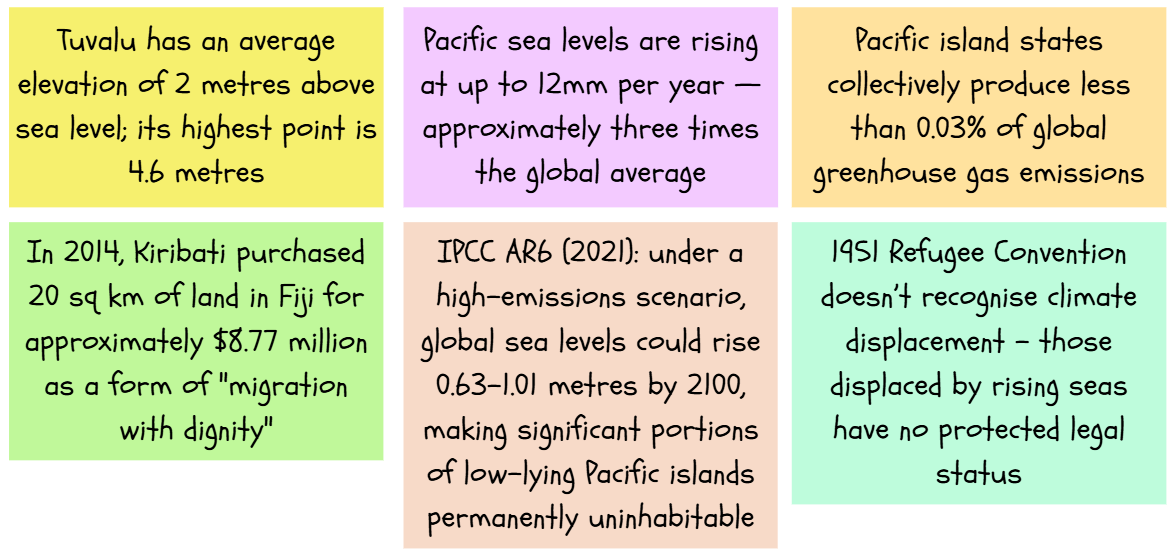
Colourful infographic on Pacific islands showing low elevation, rapid sea-level rise, minimal emissions, migration to Fiji, IPCC sea-rise forecasts and lack of legal protection

Key actors

Actor

Type

Role

Tuvalu

State

  • Directly threatened

  • Pioneered the digital nation strategy

  • Active advocate in UNFCCC negotiations

Kiribati

State

  • Directly threatened

  • Purchased land in Fiji

  • Developed "migration with dignity" strategy

AOSIS (Alliance of Small Island States)

IGO coalition

  • 44-member bloc

  • Championed the 1.5°C target

  • Central advocate for loss and damage at COP negotiations

UNFCCC / COP process

IGO

  • Primary international framework for climate negotiations

  • Hosts annual COP summits

USA, China, India

Major emitting states

  • Collectively responsible for the majority of historical and current emissions

  • Essential to any effective agreement

IPCC

Scientific body

  • Provides the evidence base for international policymaking

  • AR6 confirmed existential risk to low-lying island states

UNHCR

IGO

  • Monitors climate displacement

  • Advocates for legal protection for climate-displaced people

Pacific Climate Warriors / Greenpeace / 350.org

NGOs and social movements

  • Advocacy, direct action, and amplification of Pacific island voices in international forums

Connections to the guiding questions (Environment)

  • To what extent are states fulfilling their obligations to protect the environment?

    • Pacific island states argue that major emitters are systematically failing this obligation through inadequate emissions commitments

  • How does the principle of common but differentiated responsibilities shape international responses?

    • CBDR is the central legal framework

    • Wealthy states industrialised first and bear the greater obligation

  • What is the relationship between environmental challenges and global justice?

    • The loss and damage fund represents a formal, if contested, acknowledgement that wealthy states owe compensation for harms they caused

Cross-topic connections

Topic area

Connection


Borders

  • Sea level rise threatens the physical territory on which statehood is based

  • Climate displacement raises unresolved questions about borders and refuge

Security

  • Climate change is a threat multiplier, driving displacement, resource conflict and regional instability across the Pacific

Poverty

  • Pacific island states contributed least to climate change but face the greatest consequences - a structural injustice with clear development implications

Equality

  • Climate impacts are distributed unequally along lines of wealth and geography

  • The loss and damage fund is a recognition of this injustice

Prepared recommendation for question 2b:(non-state actor)
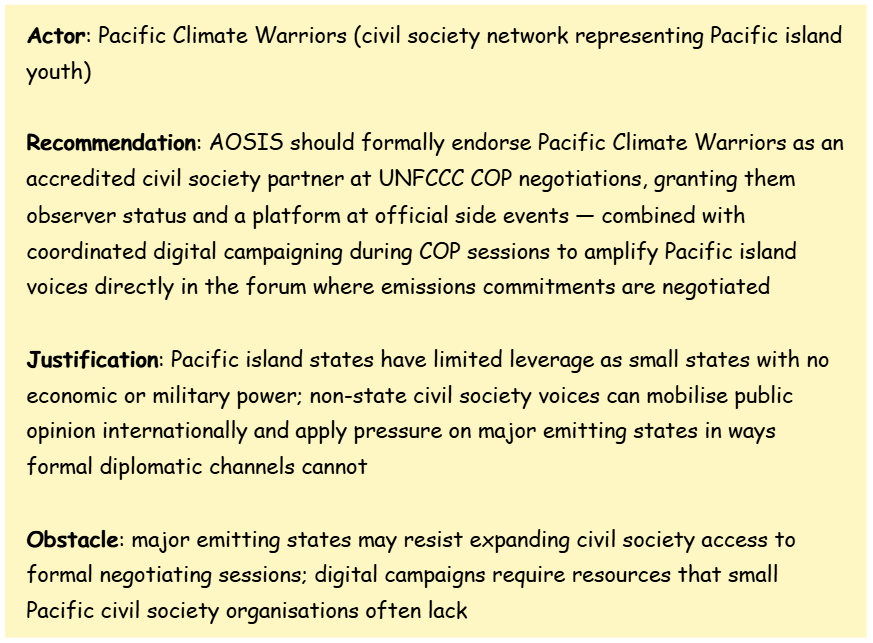
Slide with yellow background outlining: Actor Pacific Climate Warriors, recommendation for AOSIS to endorse them at UNFCCC COP, justification, and challenges.

Case study 2 - the COVID-19 pandemic and global vaccine inequality

Primary topic area: Health

Secondary connections: Equality, Poverty, Borders, Technology

Overview

  • The COVID-19 pandemic (from 2020) exposed deep structural inequalities in global health governance

    • While wealthy nations rapidly secured enough doses to innoculate their populations multiple times over, lower-income countries waited months or years for access

    • By mid-2021, over 75% of all vaccine doses administered globally had gone to just 10 countries

  • The debate over the TRIPS waiver - a proposed suspension of pharmaceutical patents to allow generic vaccine production - crystallised the tension between intellectual property rights, corporate interests and global health equity

  • The pandemic demonstrated how national interest consistently obstructs collective action, and how the costs of that failure fall hardest on the world's poorest states

Key dates

Date

Event 

March 2020

  • WHO declares COVID-19 a pandemic; global emergency response begins

April 2020

  • COVAX initiative launched by WHO, CEPI and Gavi to ensure equitable global vaccine access

October 2020

  • India and South Africa submit TRIPS waiver proposal to WTO on behalf of developing countries

Nov–Dec 2020

  • First mRNA vaccines receive emergency authorisation in wealthy states

  • Vaccine nationalism begins

May 2021

  • Biden administration announces US support for a TRIPS waiver

Mid-2021

  • Over 75% of all doses administered globally concentrated in just 10 countries

June 2022

  • WTO agrees a limited TRIPS waiver - widely criticised as inadequate by NGOs and developing states

Key facts and statistics

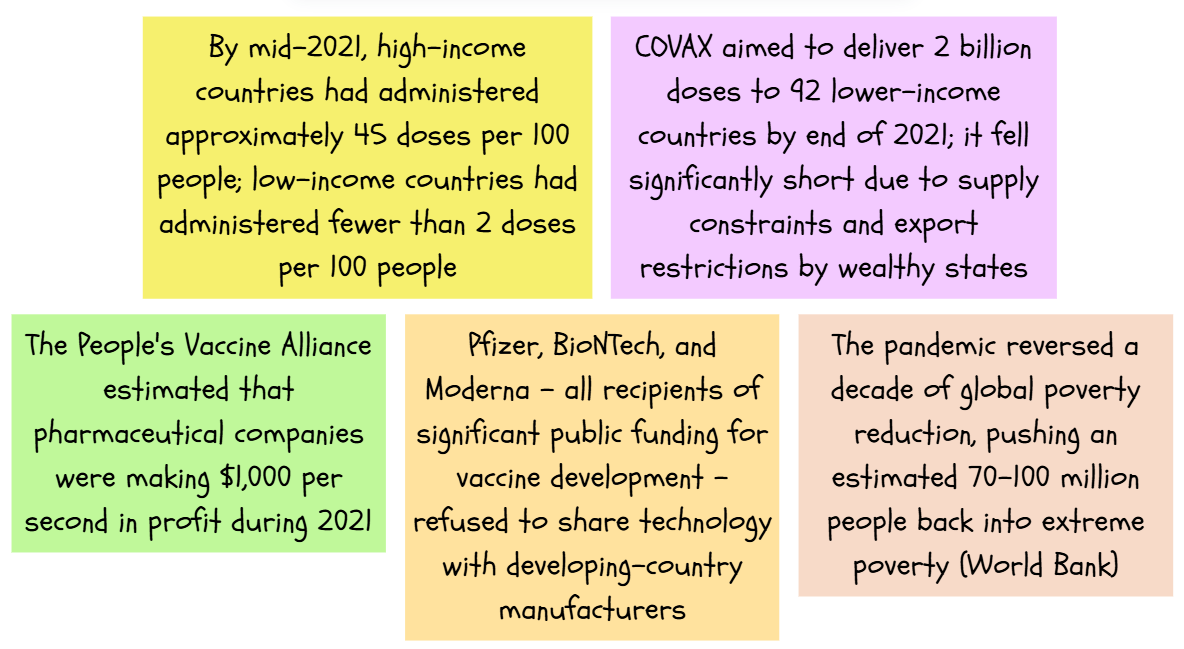
Infographic highlighting COVID-19 vaccine inequality, corporate profits, blocked technology sharing, COVAX shortfalls and a surge in global extreme poverty

Key actors

Actor

Type

Role 

WHO

IGO

  • Declared global emergency

  • Led COVAX

  • Coordinated international response

Pfizer, BioNTech, Moderna

Multinational corporations

  • Developed vaccines

  • Refused to waive IP rights

  • Lobbied actively against TRIPS waiver

COVAX (Gavi, CEPI, WHO)

IGO partnership

  • Mechanism to deliver vaccines to lower-income states

  • Fell significantly short of targets

India and South Africa

States

  • Led the TRIPS waiver proposal at WTO

  • Represented developing world interests

USA and EU

States / regional body

  • Initially blocked TRIPS waiver

  • Engaged in vaccine nationalism

  • US shifted position in May 2021

People's Vaccine Alliance

NGO coalition

  • Campaigned publicly for vaccine sharing and the TRIPS waiver

  • Amplified global health justice narrative

MSF

NGO

  • Advocated for TRIPS waiver

  • Provided healthcare in low-income settings

  • Documented vaccine access failures

WTO

IGO

  • Forum for TRIPS waiver negotiations

  • Agreed limited waiver in June 2022

Connections to the guiding questions (Health)

  • "How does global health governance address inequalities in access to healthcare?"

    • COVAX and the TRIPS waiver debate illustrate both the ambition and failure of global equity mechanisms

  • "What is the relationship between poverty and health outcomes?"

    • Lower-income states faced both greater vulnerability and lower access to the tools needed to respond

  • "In what ways do political decisions shape health outcomes?"

    • Vaccine nationalism was a deliberate political choice that caused preventable deaths in lower-income states

Cross-topic connections

Topic area

Connection 

Equality

  • Access to life-saving vaccines was distributed along lines of wealth

  • IP rules systematically privileged wealthy states and corporations over lower-income populations

Poverty

  • The pandemic reversed decades of poverty reduction

  • Lower-income states could not afford vaccines at the prices set by pharmaceutical companies

Borders

  • Border closures disrupted supply chains

  • Travel bans were applied unequally - the rapid "Omicron ban" on southern African states penalised the region that first detected and reported the variant

Technology

  • mRNA technology developed with significant public funding was privatised

  • Vaccine passports and digital surveillance raised additional equality concerns

Prepared recommendation for Q2b (non-state actor)
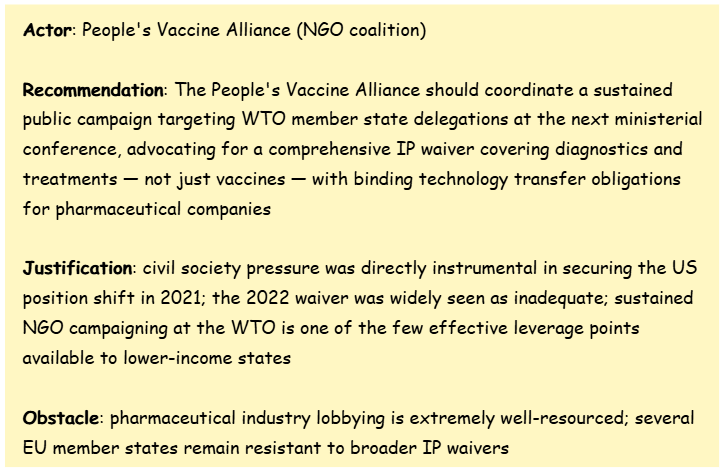
Yellow note outlining People’s Vaccine Alliance role, recommending WTO campaign for broad IP waiver on Covid diagnostics and treatments, with justification and obstacles

Unlock more, it's free!

Join the 100,000+ Students that ❤️ Save My Exams

the (exam) results speak for themselves:

Lisa Eades

Author: Lisa Eades

Expertise: Business Content Creator

Lisa has taught A Level, GCSE, BTEC and IBDP Business for over 20 years and is a senior Examiner for Edexcel. Lisa has been a successful Head of Department in Kent and has offered private Business tuition to students across the UK. Lisa loves to create imaginative and accessible resources which engage learners and build their passion for the subject.

Steve Vorster

Reviewer: Steve Vorster

Expertise: Economics & Business Subject Lead

Steve has taught A Level, GCSE, IGCSE Business and Economics - as well as IBDP Economics and Business Management. He is an IBDP Examiner and IGCSE textbook author. His students regularly achieve 90-100% in their final exams. Steve has been the Assistant Head of Sixth Form for a school in Devon, and Head of Economics at the world's largest International school in Singapore. He loves to create resources which speed up student learning and are easily accessible by all.