Mitosis & the Cell Cycle (AQA GCSE Combined Science: Trilogy: Biology): Revision Note
Exam code: 8464

The cell cycle
Mitosis is a stage in the cell cycle when the nucleus divides
The cell cycle is a series of stages in the life cycle of a cell
During the growth phase of the cell cycle, the DNA replicates to form two copies of each chromosome
Two copies of each chromosome are produced; these initially remain attached to each other with each strand called a chromatid
The chromatids will eventually be divided between the two genetically identical daughter cells that form from the dividing cell
During the growth phase, the number of sub-cellular structures (such as ribosomes and mitochondria) also increases
The process of mitosis
For a multicellular organism to grow, cells must divide by mitosis to produce two identical daughter cells
Before mitosis (in the growth stage), the DNA replicates so that each chromosome becomes X-shaped, made of two identical chromatids
During mitosis the following events occur:
The chromosomes line up along the equator of the cell
One set of chromosomes is pulled to each end of the cell (the two chromatids of each chromosome are separated)
A new nucleus forms around each new group of chromosomes
After this, the cytoplasm and cell membrane divides in a process known as cytokinesis; this results in the formation of two genetically identical daughter cells
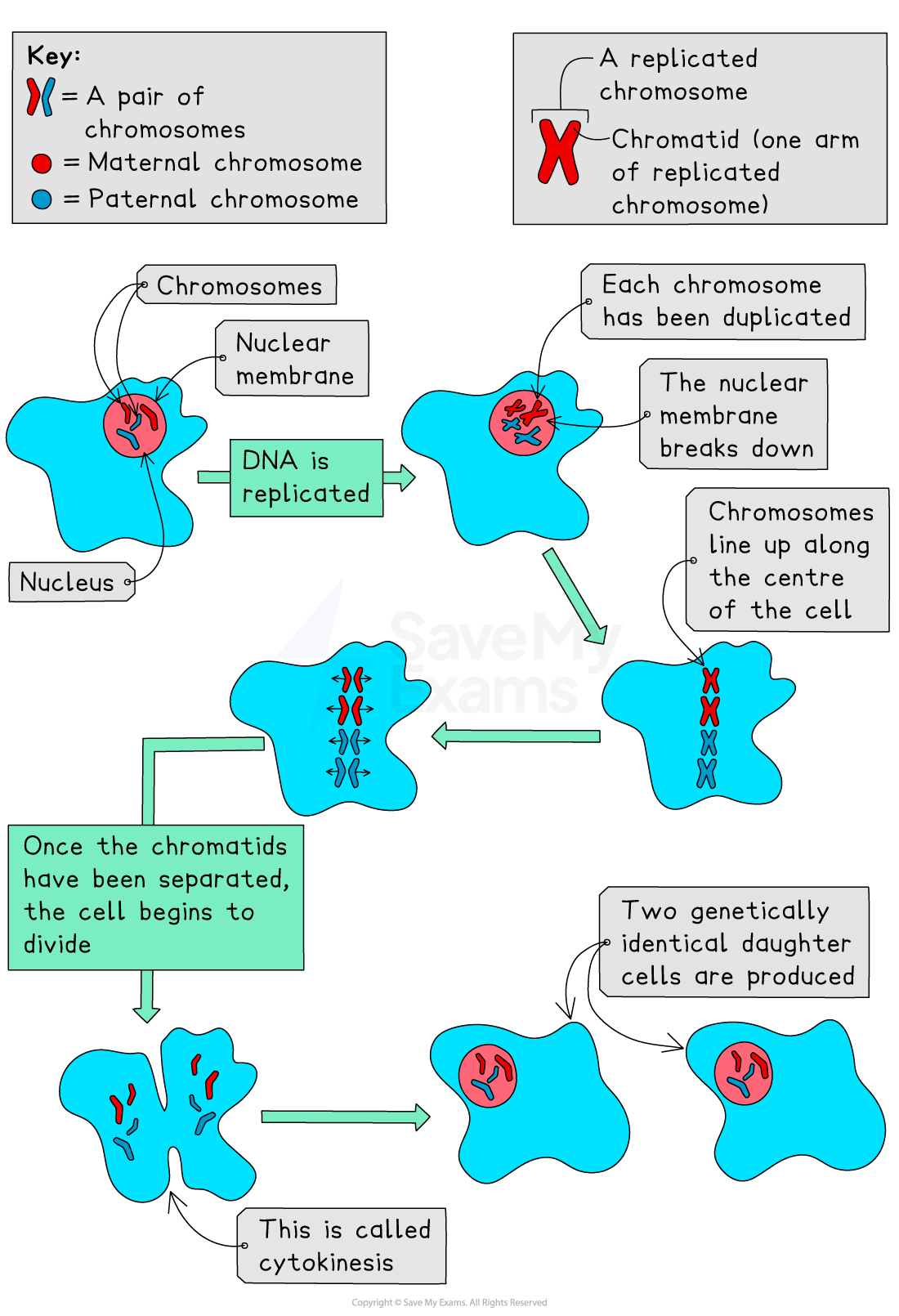
So, if a human cell with 46 chromosomes in 23 pairs needs to divide by mitosis:
Its 46 chromosomes are doubled, so that there are two copies of each of the 46 chromosomes (or 92 chromatids) in total in the cell
The number of ribosomes and mitochondria subcellular structures also increases
During mitosis, the chromatids are pulled apart, with a complete set of 46 chromosomes in 23 pairs moving to each end of the cell
The cytoplasm and cell membrane divide, forming two new daughter cells
Examiner Tips and Tricks
You do not need to know the names or phases of mitosis (such as prophase) – so don’t write about them in your AQA GCSE exam. Doing so will not earn you credit and will only waste valuable time. But you do need to appreciate the three overall stages of the cell cycle:
Growth phase (DNA replication and subcellular structures increase)
Mitosis
Cytokinesis (division of cytoplasm and the cell membrane)
The role of mitosis
Cell division by mitosis is important in the growth and development of multicellular organisms
When a sperm cell fertilises an egg cell in human reproduction, the resulting zygote cell that forms divides by mitosis, with each subsequent cell produced dividing in the same way to form an embryo
As the embryo continues to grow in size, with the cells dividing by mitosis (and differentiating), a fetus forms
Therefore, for a multicellular organism to grow, cells have to divide by mitosis to produce an increase in cell number
Examiner Tips and Tricks
In your exams, expect to see micrographs of either animal or plant cells in different stages of mitosis. You need to be able to recognise and describe what might be occurring in the images.
Cells that are not actively dividing should be easy to identify as their chromosomes will be unravelled and look non-distinct (they’ll appear like strands of thread).
Calculating cell cycle length
The number of cells in each stage of the cell cycle can be used to estimate how long each stage of the cell cycle lasts
Worked Example
The cells in the root tip of a celery plant were observed under the microscope. The number of cells at different stages of the cell cycle were counted.
The student was told that a complete cell cycle takes 15 hours in the celery root tip cells.
Stages in the Cell Cycle | Number of Cells |
|---|---|
Non-dividing cells | 27 |
Stage 1 | 14 |
Stage 2 | 11 |
Stage 3 | 2 |
Total | 54 |
Calculate the length of time that Stage 1 lasts in a celery root tip cell.
Length of time in stage = (observed number of cells in stage / total number of cells observed) × total length of cell cycle
= (14 cells observed in Stage 1 / 54 cells in total) x 15 hours
= 14/54 × 15
= 3.89 hours / 233 minutes
(To convert hours into minutes, multiply by 60)

Unlock more, it's free!
Join the 100,000+ Students that ❤️ Save My Exams
the (exam) results speak for themselves:

Was this revision note helpful?
Build on this topic