Diffusion in Multicellular Organisms (AQA GCSE Combined Science: Trilogy: Biology): Revision Note
Exam code: 8464

Diffusion in multicellular organisms
Multicellular organisms like humans need exchange surfaces and transport systems, as diffusion alone is too slow to meet their needs; this is because
they have a relatively small surface area (SA) in relation to their volume (V)
the distance between the surface of a multicellular organism to its centre is relatively large
Adaptations for exchange in animals
Because diffusion alone is too slow to supply the needs of multicellular organisms, specialised structures and systems are needed for them to function
The small intestine
Role in the body:
Absorption of digested food molecules into the bloodstream occurs across the wall of the small intestine
How it’s adapted to its role:
The lining of the small intestine has finger-like projections called villi (singular villus); this increases surface area
Only one layer of epithelial cells covers the surface of each villus - this decreases diffusion distance
Each villus has a good blood supply - this maintains a concentration gradient
The cells of the villi contain many mitochondria, which release energy by aerobic respiration for the active transport of glucose
The small intestine is very long, which gives more time for absorption

Mammalian lungs
Role in the body:
Gas exchange between air in the alveoli and the blood supplies cells with oxygen for aerobic respiration and removes waste carbon dioxide
How it’s adapted to its role:
Millions of alveoli (singular: alveolus) collectively provide a large surface area
The walls of the alveoli and the capillaries are each one cell thick - this gives a short diffusion distance
Each alveolus is surrounded by a capillary network (good blood supply) - this maintains a steep concentration gradient
The lungs are ventilated (breathing moves air in and out) - this also maintains the concentration gradient

Fish gills
Role in the body:
Gas exchange between water flowing through the gills and the blood
How it’s adapted to its role:
Gills are made of many thin gill filaments, which give a large surface area
The walls of the gill filaments and capillaries are one cell thick, so the water is very close to the blood - this gives a short diffusion distance
A dense capillary network ensures a good blood supply; this maintains a concentration gradient
Water flows constantly over the gills, which maintains the concentration gradient

Adaptations for exchange in plants
Roots
Role in the plant:
To absorb water and mineral ions (such as magnesium and nitrate ions) from the soil
How it’s adapted to its role:
The root network is highly branched, increasing surface area
The surface of the roots are covered in root hair cells, which have a specialised structure with root hair projections; this also increases surface area

Leaves
Role in the plant:
The leaves contain most of a plant's photosynthetic cells
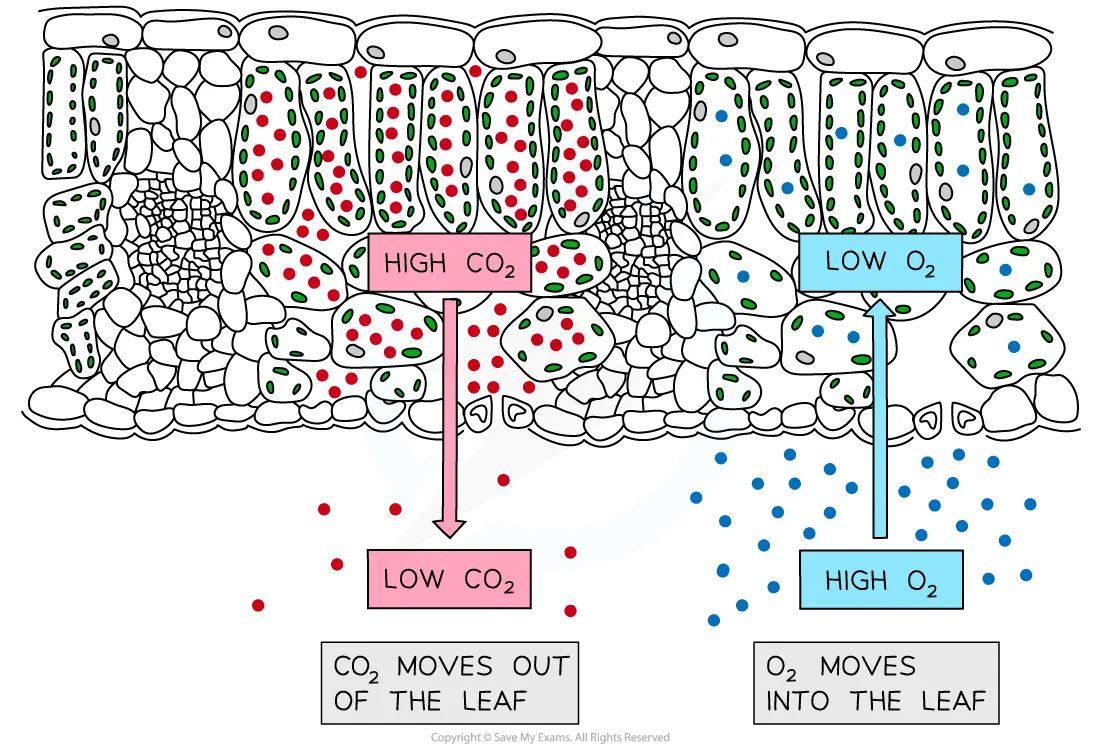
Photosynthesis requires efficient gas exchange between air surrounding the leaf and the photosynthetic cells, whilst minimising water loss
How it’s adapted to its role:
Leaves are thin, decreasing the diffusion distance for gas exchange
Spongy mesophyll cells are loosely packed with air spaces between them, giving a large internal surface area for gas exchange
Guard cells control the opening and closing of stomata, allowing gas exchange while reducing water loss in dry conditions
Exchange surfaces
In summary, multicellular organisms have surfaces and organ systems that maximise the exchange of materials by increasing the efficiency of exchange in a number of ways:
Having a large surface area to increase the rate of transport
A barrier that is as thin as possible to separate two regions, to provide as short a diffusion path as possible for substances to move across
In addition, animals have:
a large network of blood vessels throughout the body:
to reduce distance of exchange of materials between cells and the bloodstream
to move substances towards or away from exchange surfaces to maintain concentration gradients
gas exchange surfaces that are well ventilated to maintain concentration gradients
Examiner Tips and Tricks
Remember that the ‘walls of the alveoli’ or the ‘walls of the intestines’ are not cell walls; both of the walls above are made from animal cells and animal cells do not have cell walls.

Unlock more, it's free!
Join the 100,000+ Students that ❤️ Save My Exams
the (exam) results speak for themselves:

Was this revision note helpful?
Build on this topic