Plant Tissues (AQA GCSE Combined Science: Trilogy: Biology): Revision Note
Exam code: 8464

Plant tissue: Structures & functions
The structures of plant tissues are related to their functions
Some important plant tissues include:
epidermal tissues
palisade mesophyll
spongy mesophyll
xylem and phloem
meristem tissue found at the growing tips of shoots and roots – made of unspecialised cells that divide to produce new cells, which can differentiate into any type of plant cell
Structure and function in leaves
Structure | Description |
|---|---|
Waxy cuticle | Protective layer on top of the leaf, prevents water from evaporating |
Upper epidermis | Thin and transparent to allow light to enter palisade mesophyll layer underneath it |
Palisade mesophyll | Column shaped cells tightly packed with chloroplasts to absorb more light, maximising photosynthesis |
Spongy mesophyll | Contains internal air spaces that increase the surface area to volume ratio for the diffusion of gases (mainly carbon dioxide) |
Lower epidermis | Contains guard cells and stomata |
Guard cells | Absorb and lose water to open and close the stomata to allow carbon dioxide to diffuse in, oxygen to diffuse out |
Stomata | Where gas exchange takes place Opens during the day, closes during the night, evaporation of water also takes place from here In most plants, found in much greater concentration on the underside of the leaf to reduce water loss |
Vascular bundle | Contains xylem and phloem to transport substances to and from the leaf |
Xylem | Transports water into the leaf for mesophyll cells to use in photosynthesis and for transpiration from stomata. Made of dead, hollow cells with no end walls; the walls are strengthened by lignin. Transports water and mineral ions upwards only, from the roots |
Phloem | Transports sucrose and amino acids around the plant. Made of living cells with pores in the end walls; transports dissolved sugars (sucrose) both up and down the plant |
The leaf
The leaf is a plant organ adapted specifically for photosynthesis
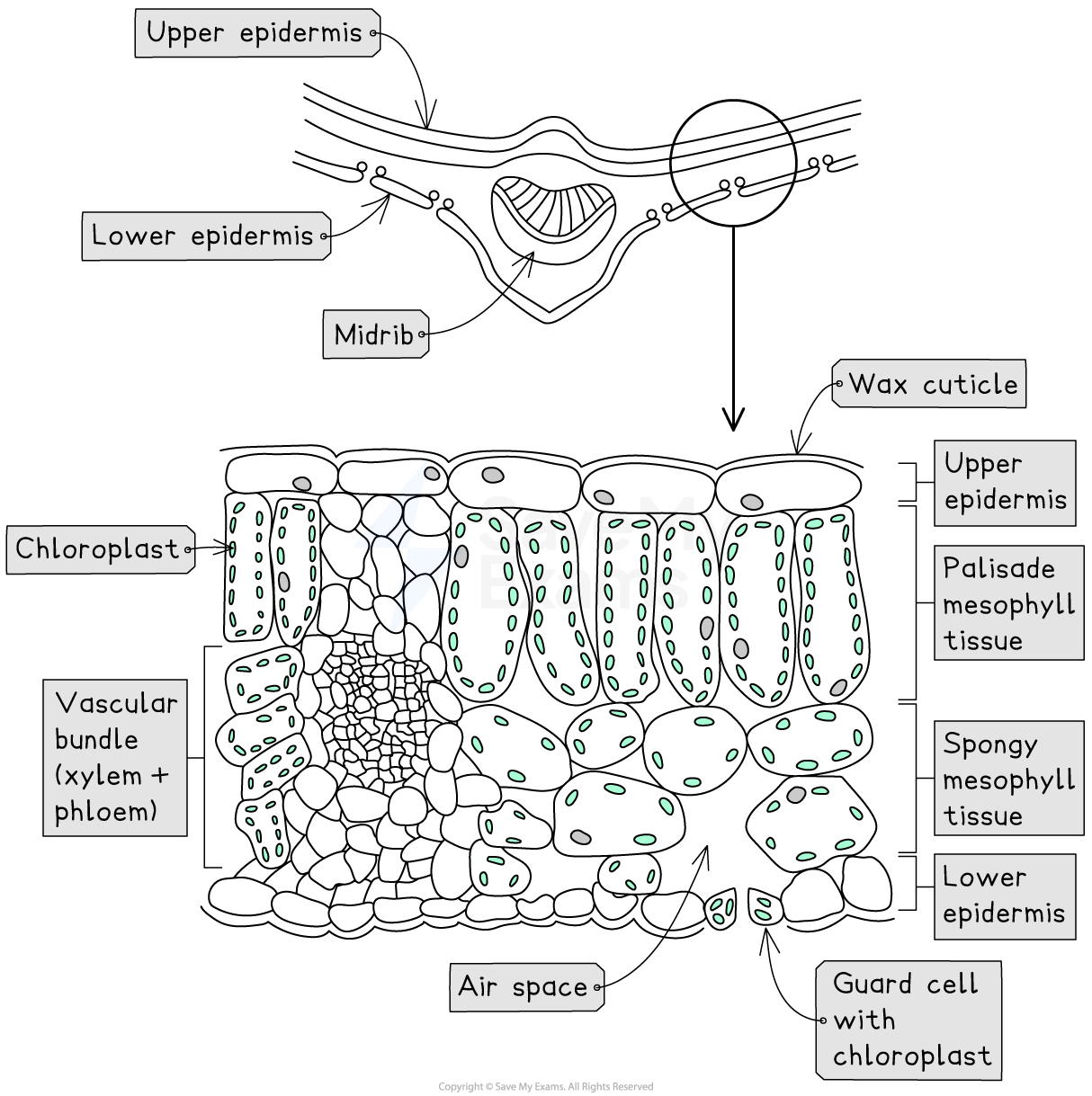
Leaf adaptations
Large, flat surface: increases area for absorption of light for photosynthesis
Thin: allows carbon dioxide to diffuse to palisade mesophyll cells quickly
Chlorophyll: absorbs light energy so that photosynthesis can take place
Xylem and phloem: vascular cells support the leaf and allows the transport of water and carbohydrates
Stomata: allow gases to diffuse in and out of the leaf
Epidermis is thin and transparent: allows more light to reach the palisade cells
Thin waxy cuticle: protects the leaf without blocking sunlight
Palisade layer at the upper side of the leaf: maximises the absorption of light
Air spaces in the spongy layer: allow gases to diffuse through the leaf
Examiner Tips and Tricks
You should be able to observe and draw a transverse section of a leaf

Unlock more, it's free!
Join the 100,000+ Students that ❤️ Save My Exams
the (exam) results speak for themselves:

Was this revision note helpful?
Build on this topic