Annihilation of Matter & Antimatter (Edexcel International A Level (IAL) Physics): Revision Note
Exam code: YPH11

Annihilation of Matter & Antimatter
Annihilation
When a particle meets its antiparticle partner, the two will annihilate
Annihilation is:
When a particle meets its equivalent antiparticle, they both are destroyed, and their mass is converted into energy in the form of two gamma ray photons
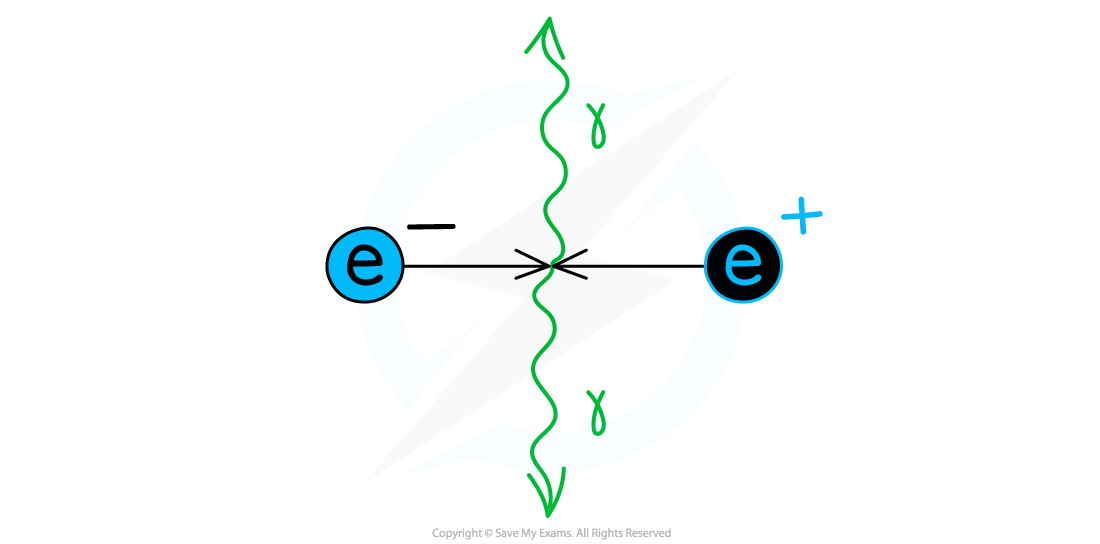
When an electron and positron collide, their mass is converted into energy in the form of two photons emitted in opposite directions
Pair Production
Pair production is the opposite of annihilation
Pair production is:
When a photon interacts with a nucleus or atom and the energy of the photon is used to create a particle–antiparticle pair
The presence of a nearby nucleus is essential in pair production so that the process conserves both energy and momentum
A single photon alone cannot produce a particle–antiparticle pair, or the conservation laws would be broken
Pair creation is a case of energy being converted into matter
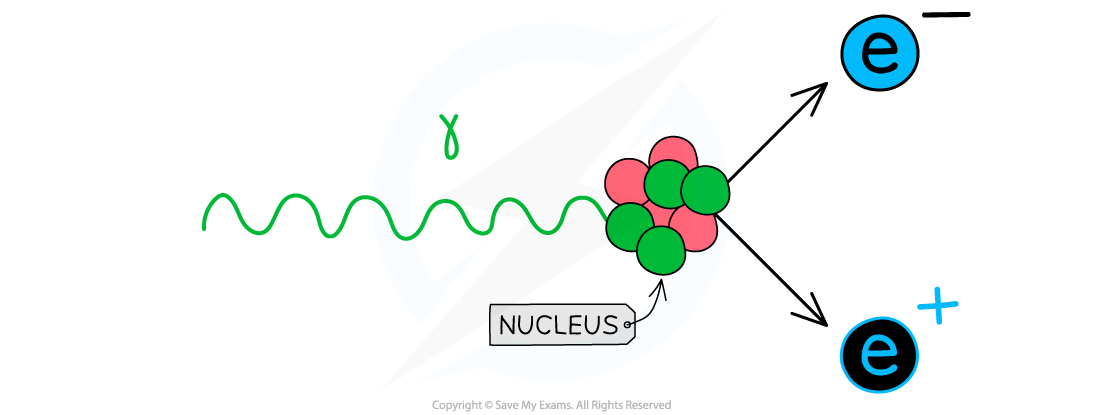
When a photon with enough energy interacts with a nucleus it can produce an electron-positron pair
This means the energy of the photon must be above a certain value to provide the total rest mass energy of the particle–antiparticle pair
Einstein's famous mass-energy relation showed that energy can be converted into mass, and vice versa
It is given by:
ΔE = c2 Δm
Where:
Δm = rest mass of the particle (kg)
c = speed of light (m s–1)
ΔE = rest mass energy of the particle (J)
Therefore, in order to create a particle & anti-particle pair, the energy carried by a single photon must be at least twice the rest-mass energy required, i.e.
2ΔE = 2(c2 Δm)
This also means if a particle meets its anti-particle and annihilates, the energy carried away by each of the two photons Ephoton is given by:
Ephoton = hf = = c2 Δm
Worked Example
Calculate the maximum wavelength of one of the photons produced when a proton and antiproton annihilate.
Rest mass of a proton =
Answer:
Step 1: Write down the known quantities
Rest mass-energy of a proton (and antiproton) =
Step 2: Determine the total rest mass energy of the proton-antiproton pair
Step 3: Determine the minimum energy of one of the photons in J
Note: since the question asks for the energy of one of the photons, you could skip step 2 and simply use
Step 4: Write down the equation for minimum photon energy
Step 5: Rearrange for the maximum photon wavelength
Step 6: Calculate the maximum photon wavelength
Examiner Tips and Tricks
Since the Planck constant is in Joules (J s) remember to always convert the rest mass-energy from MeV to J.
Remember that the equation E = hf is only relevant for photons, not for all particles!

Unlock more, it's free!
Join the 100,000+ Students that ❤️ Save My Exams
the (exam) results speak for themselves:

Was this revision note helpful?
Build on this topic