Testing for Organic Functional Groups (AQA A Level Chemistry): Revision Note
Exam code: 7405

Testing for Organic Functional Groups
REQUIRED PRACTICAL 6
For this practical, you need to be able to give the tests and positive results for the following functional groups:
Alkenes
Alcohols
Aldehydes
Carboxylic Acids
Examiner Tips and Tricks
It is important to distinguish between observations and deductions.
Examiners penalise students who write chemical deductions like "carbon dioxide is given off" instead of observations like "effervescence" or "fizzing." Similarly, for a negative test, "nothing happens" or "no observation" scores zero; students must write "no visible change" or "stays [colour]."
Testing for an Alkene
Halogens can be used to test if a molecule is unsaturated (i.e. contains a double bond)
Br2(aq) is an orange-yellow solution, called bromine water
The unknown compound is shaken with the bromine water
If the compound is unsaturated, an addition reaction will take place and the coloured solution will decolourise

Examiner Tips and Tricks
Students often say the solution turns "clear" — examiners require "colourless" (clear just means transparent, not lacking colour). Also worth noting that the colour change goes from orange to colourless, not the other way round — examiner reports flag students getting the direction wrong.
Testing for an Alcohol
Alcohols can be classified as either primary, secondary or tertiary, depending on the placement of the -OH group
Primary and secondary alcohols can both be oxidised, but tertiary alcohols cannot
To test for the alcohol functional group, add a small amount (1 cm3) of the substance to a test tube using a pipette
Then, add a small amount (1 cm3) of a suitable oxidising agent to the sample using a different pipette
The most commonly used oxidising agent for this test is acidified potassium dichromate solution (K2Cr2O7, acidified with H2SO4)
Add a stopper to the test tube and shake well
Place in a hot water bath (heated to around 60 oC) for a few minutes
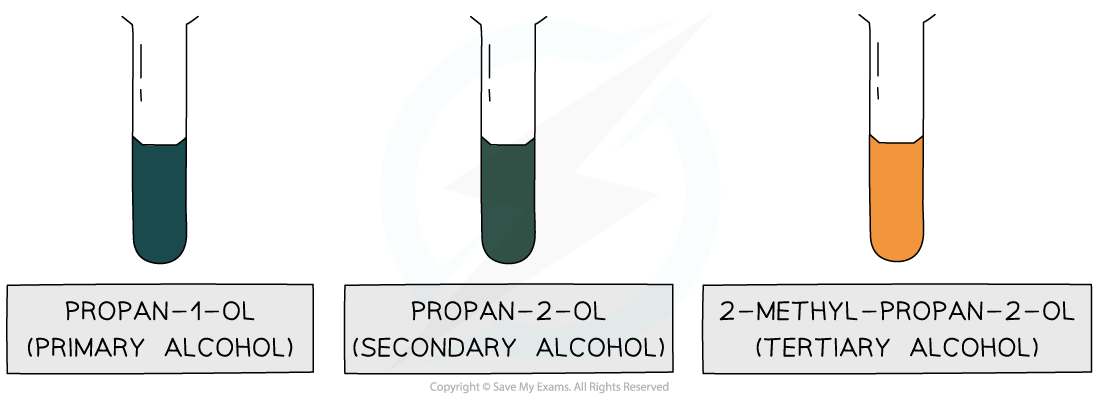
If a primary or secondary alcohol is present, then the colour will change from orange to green
If a tertiary alcohol is present, then nothing will happen - the solution will remain orange
Examiner Tips and Tricks
Acidified potassium dichromate cannot distinguish between an aldehyde and a primary/secondary alcohol because both turn it from orange to green. Examiner reports flag this as a frequent logical error. To distinguish aldehydes from alcohols, use Tollens' reagent or Fehling's solution instead.
Testing for an Aldehyde
Fehling’s solution
Fehling’s solution is an alkaline solution containing copper(II) ions which act as the oxidising agent
When warmed with an aldehyde, the aldehyde is oxidised to a carboxylic acid and the Cu2+ ions are reduced to Cu+ ions
In the alkaline conditions, the carboxylic acid formed will be neutralised to a carboxylate ion (the -COOH will lose a proton to become -COO– )
The carboxylate ion (-COO–) will form a salt with a positively charged metal ion such as sodium (-COO–Na+)
The clear blue solution turns opaque due to the formation of a red precipitate, copper(I) oxide
Ketones cannot be oxidised and therefore give a negative test when warmed with Fehling’s solution

Examiner Tips and Tricks
A very common mistake is describing only a colour change ("it turns red") without mentioning a precipitate. Examiners require "red precipitate" or "brick-red solid" to gain the mark.
Tollens’ reagent
Tollens' reagent is an aqueous alkaline solution of silver nitrate in excess ammonia solution
Tollens' reagent is also called ammoniacal silver nitrate solution
When warmed with an aldehyde, the aldehyde is oxidised to a carboxylic acid and the Ag+ ions are reduced to Ag atoms
In the alkaline conditions, the carboxylic acid will become a carboxylate ion and form a salt
The Ag atoms form a silver ‘mirror’ on the inside of the tube
Ketones cannot be oxidised and therefore give a negative test when warmed with Tollens’ reagent

Testing for a Carboxylic Acid
Carboxylic acids in solution have a pH of around 3, so measuring the pH is a way of testing for the presence of the carboxylic acid functional group in an organic sample
The end of a glass rod could be dipped into the solution and then carefully dripped onto indicator paper
Or, a pH probe could be used, which would give you an exact pH
Since carboxylic acids are acids, they will react with a carbonate solution to produce carbon dioxide gas
1-2 cm3 of sodium carbonate (Na2CO3) or sodium hydrogen carbonate solution (NaHCO3) could be added using a pipette
If effervescence/bubbles of gas are seen, this is a good indicator that the solution is a carboxylic acid
If an exam question asks you to simply distinguish between different types of organic compound, and the carboxylic acid is the only organic compound present which would react in this way with a carbonate solution, then this is enough
The gas produced could then be bubbled into limewater
If the limewater turns milky or cloudy, then this proves that the gas produced was carbon dioxide

Related topics
Examiner Tips and Tricks
Students should name reagents correctly. AQA's rule is that a reagent must be something you can "take out of a bottle" — naming just the active ion (e.g. "dichromate" without "acidified", or the [Ag(NH3)2]⁺ ion instead of "Tollens' reagent" or "ammoniacal silver nitrate") scores zero for the reagent mark.

Unlock more, it's free!
Join the 100,000+ Students that ❤️ Save My Exams
the (exam) results speak for themselves:

Was this revision note helpful?
Build on this topic