Oxides Reacting with Water (AQA A Level Chemistry): Revision Note
Exam code: 7405

Oxides Reacting with Water
Going across Period 3, electronegativity increases from 0.9 (Na) to 2.5 (S), causing the shift from ionic to covalent bonding in the oxides
Structure and bonding of the Period 3 oxides table
Period 3 element | Period 3 oxide | Chemical bonding of the oxide | Structure of the oxide |
|---|---|---|---|
Na | Na2O | Ionic | Giant ionic |
Mg | MgO | Ionic | Giant ionic |
Al | Al2O3 | Ionic (with a degree of covalent) | Giant ionic |
Si | SiO2 | Covalent | Giant covalent |
P | P4O10 | Covalent | Simple molecular |
S | SO2 | Covalent | Simple molecular |
Behaviour of the Period 3 Oxides with Water
Metal oxides (to the left of the periodic table):
Sodium oxide, Na2O, and magnesium oxide, MgO, are made up of ions
They contain an oxide ion, O2-, which is a strong base and will readily produce hydroxide ions through reaction with water
O2- (aq) + H2O (l) → 2OH- (aq)
This is why the solutions formed are strongly alkaline
Sodium oxide forms a more alkaline solution than magnesium oxide because it is far more soluble in water
Oxides in the middle of the periodic table
Although ionic, aluminium oxide does not react with water because the oxide ions are held too strongly in the ionic lattice
This means the ions cannot be separated
Silicon dioxide is a giant covalent molecule - it is the main component of sand
It has millions of strong covalent bonds, so it does not react with water
Non-metal oxides (to the right of the periodic table):
Oxides of phosphorus and sulfur are simple covalent molecules that react with water to produce acidic solutions
They form an acid which donates H+ ions to water
Reaction of Period 3 oxides with water table
Oxide | Chemical equation | pH | Comments |
|---|---|---|---|
Na2O | Na2O (s) + H2O (l) → 2NaOH (aq) | 14 | - |
MgO | MgO (s) + H2O (l) → Mg(OH)2 (aq) | 10 | - |
Al2O3 | No reaction | - | Al2O3 is insoluble in water |
SiO2 | No reaction | - | SiO2 is insoluble in water |
P4O10 | P4O10 (s) + 6H2O (l) → 4H3PO4 (aq) | 2 | Vigorous / violent reaction |
SO2 | SO2 (g) + H2O (l) → H2SO3 (aq) | 2-3 | - |
SO3 | SO3 (g) + H2O (l) → H2SO4 (aq) | 0 - 1 |
Examiner Tips and Tricks
Key thing to remember: The metal oxides form alkaline solutions in water, the oxides in the middle do not react and the non-metal oxides form acidic solutions.
Structures of Acids and Anions Formed
When P4O10, SO2 and SO3 react with water, they form acids
These acids can then dissociate to form anions.
Phosphoric acid, H3PO4
Phosphoric acid is formed by:
P4O10 (s) + 6H2O (l) → 4H3PO4 (aq)
H₃PO₄ has a central P atom double-bonded to one O and single-bonded to three OH groups
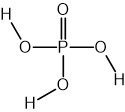
Successive dissociation produces three anions:
H2PO4-
HPO42-
PO43-
Sulfurous acid, H2SO3
Sulfurous acid is formed by:
SO2 (g) + H2O (l) → H2SO3 (aq)
H2SO3 has a central S atom bonded to two OH groups and one =O
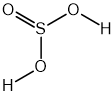
Dissociation produces two anions:
HSO3-
SO32-
Sulfuric acid, H2SO4
Sulfuric acid is formed by:
SO3 (g) + H2O (l) → H2SO4 (aq)
H2SO4 has a central S atom double-bonded to two O atoms and single-bonded to two OH groups
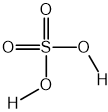
H2SO4 is a strong acid
The first dissociation uses a one-way arrow:
H2SO4 (aq) → H+ (aq) + HSO4- (aq)
The HSO₄⁻ formed is a weak acid
So, the second dissociation uses an equilibrium arrow:
HSO4- (aq) ⇌ H+ (aq) + SO42- (aq)
The SO42- anion has S double-bonded to two O and single-bonded to two O-

Examiner Tips and Tricks
For H2SO4 dissociation, the arrow type matters:
The first step is a one-way arrow (H2SO4 is strong),
The second is an equilibrium arrow (HSO4- is weak).
Using the wrong arrows loses marks
Acid-Base Reactions of the Oxides
Acid/base Nature of the Period 3 Oxides
Aluminium oxide is amphoteric which means that it can act both as a base (and react with an acid such as HCl) and an acid (and react with a base such as NaOH)
Period 3 oxide | Na2O | MgO | Al2O3 | SiO2 | P4O10 | SO2 |
|---|---|---|---|---|---|---|
Acid / base nature | Basic | Basic | Amphoteric | Acidic | Acidic | Acidic |
Reactions of the Period 3 oxides with acid/base table
Period 3 oxide | Chemical equation | Comments |
|---|---|---|
Na2O | Na2O (s) + 2HCl (aq) → 2NaCl (aq) + H2O (l) | - |
MgO | MgO (s) + 2HCl (aq) → MgCl2 (aq) + H2O (l) | Used in indigestion remedies by neutralising the excess acid in the stomach |
Al2O3 | Al2O3 (s) + 3H2SO4 (aq) → Al2(SO4)3 (aq) + 3H2O (l) | Reacts with acid to form a salt and water |
Al2O3 (s) + 2NaOH (aq) + 3H2O (l) → 2NaAl(OH)4 (aq) | Reacts with hot, concentrated alkali to form a salt | |
SiO2 | SiO2 (s) + 2NaOH (aq) → Na2SiO3 (aq) + H2O (l) | Reacts with hot, concentrated alkali to form a salt and water |
P4O10 | P4O10 (s) + 12NaOH → 4Na3PO4 + 6H2O (l) | - |
SO2 SO3 | SO2 (g) + 2NaOH (aq) → Na2SO3 (aq) + H2O (l) SO3 (g) + 2NaOH (aq) → Na2SO4 (aq) + H2O (l) | - |
Examiner Tips and Tricks
It is crucial that you learn these reactions - make sure that you know the state symbols, the products formed and the full balanced equations!

Unlock more, it's free!
Join the 100,000+ Students that ❤️ Save My Exams
the (exam) results speak for themselves:

Was this revision note helpful?
Build on this topic
